0
0

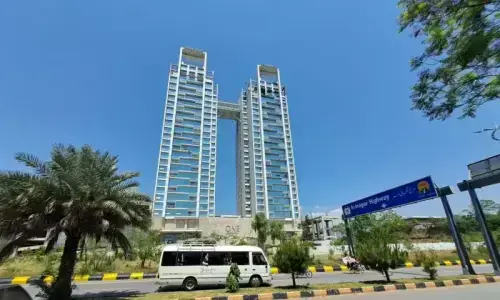
ISLAMABAD, Oct 18: Cities all over the world are known for their landmarks. But Islamabad is perhaps one capital city without any such recognised feature.
London has tube system, Venice is known for its canals and Gondolas, Melbourne boasts of its tram system, New York's landmark is Statue of Liberty and Kuala Lumpur has world's highest Petronas Towers.
Whereas in Pakistan the federal capital has no railway station. The streets here are haphazardly numbered, most roads have no footpaths, its streams stink, drinking tap water is a great health risk and encroachments abound.
All the metropolitan cities in Europe, the US and Australia have a 'street directory' for quick reference to a particular place. In fact the whole of the taxi industry depends on it.
Despite the fact that it is a planned city, Islamabad does not have a street directory. Finding a house in a sector itself is a time consuming exercise and the only option for a traveller is 'trial and error' method.
Simply following the street numbers will lead nowhere as the numbers in many of the streets are not in a sequence.
Pakistan Tourism Development Corporation few years back brought out a leaflet outlining all the sectors and streets but since then it has never been updated.
The CDA officials admit the need for such a brochure, if not a street directory, for the public and tourists in particular, but cite resource constraints.
City planning requires that the rights of the pedestrians must also be guarded and every road should have a footpath.
The road in front of the KRL Hospital in Sector G-9/1 is one such example where pedestrians have to dodge the fast moving vehicles and walk either on the road or on the unpaved track.
A couple of heavy downpours are enough to expose the poor road work which sometimes looks like a shabby downtown Rawalpindi street.
The road leading to Peshawar More from Pindora cries for the authorities' attention where poor drainage and heavy traffic has made the condition worse for the road users.
Islamabad is known for its pristine natural beauty and once clear water streams, which are now heavily polluted with waste water.
A visit to Rose and Jasmine Gardens can become not-so- pleasing an experience once the stinking odour from the dirty stream, flowing through the gardens, gets into one's nostrils.
When the first inhabitant settled in the capital nearly 40 years ago, pipelines for clean drinking water were laid. Since then hardly any of these have been replaced and have outlived their life.
It's a common complaint that sewage and drain water gets mixed into the main pipeline especially in the poor sectors of G- 6 and G-7, making people prone to water-borne diseases.
With a population of slightly over 800,000 (CDA's Statistics), the city is fast emerging as a metropolitan. At the present growth rate of 5.19 per cent, the Capital Development Authority expects the population to reach nearly 1.5 million by 2020. This calls for development of new sectors. But the way the authorities handled the protesting crowd in 2002, in a bid to start civil works in Sector D-12, it is clear that it can take indefinite time to start development of new sectors.
Though the CDA claims that they have compensated people disturbed in the sector, the development work there is yet to be started.
Traffic congestion on the main arteries of the city during the morning and the evening rush hours is almost a daily phenomenon. The traffic snarls can stretch to considerable lengths.
With a growing number of vehicles, thanks to banks' financing, there has been a sudden increase in number of cars on the capital roads. The smoke emitting public transport and old cars add to the air pollution.
The situation demands urgent planning for construction of flyovers to ease traffic congestion. But the bureaucracy involved in the city's future planning has already successfully shelved, a number of times, the plan to construct flyover at Zero Point, the major reason being lack of resources.
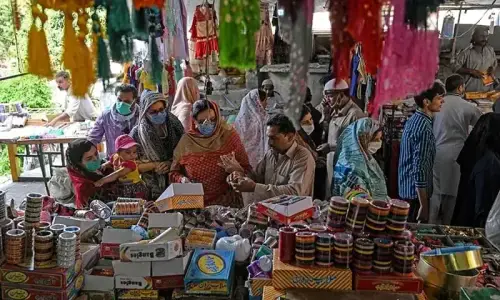
The other major problem of the city is encroachments in the markets and plazas and in residential sectors. Though the CDA tries its best to purge the city of this perpetual menace, the encroachers are so much accustomed to this exercise that as soon as the district administration finishes its work, they are back within days.
The encroachments abound in Aabpara where the shopkeepers and vendors have permanently occupied the footpaths and verandahs, leaving no space for the pedestrians.
Even the officials in the administration admit that they are faced with a daunting task to rid the shopping centres and markets of the encroachments.
Islamabad is still considered by many to be one of Pakistan's most 'livable' cities but the authorities will have to take drastic measures to solve its problems.-APP