0
0

The uniform controversy
An agreement between the government and the main opposition party in parliament was reached under the 17th Amendment Bill last year which apparently resolved the acrimonious dispute over the Legal Framework Order, and the nation welcomed it.
Contrary to expectations, another controversy has emerged over the constitutionality of the president continuing as army chief after December 31. Several statements have come from ministers that there is nothing in the Constitution that may bar him from holding both posts simultaneously. President Musharraf has given indications that he may continue to hold both offices. It is an ominous development that may tarnish his image as national leader.
Unsubstantiated claims have come from several leaders that the relevant part of the aforementioned amendment does not put a bar on the president to continue as army chief. None of the leaders has come out with convincing arguments in support of these claims.
Opposition leaders have based their attack on a clause of the amendment, which says that Article 63(1)(d) will come into full operation, which says that "a person shall be disqualified from being elected or chosen as member of Parliament if he holds any office of profit in the service of Pakistan". Article 62 provides that no person is eligible to be elected president unless he is qualified to be elected member of parliament. In view of these provisions, it is difficult to find any justification for the president to continue as army chief.
In the ongoing debate, neither the leaders of the party in power nor those belonging to the opposition have referred to Article 43(1) which provides that "President shall not hold any office of profit in the service of Pakistan or occupy any other portion carrying the right to remuneration for the rendering of service". Thus, to continue as army chief would mean a violation of the article. Even if the proviso contained in the constitutional amendment is interpreted in a different way, it does not render Article 43(1) ineffective and inoperative.
The Supreme Court may rule that the president must vacate the office of army chief. Let the government party come out with justifications for pressing the president not to vacate the office of army chief.
So far as the popularity of President Musharraf and people's appreciation for his leadership is concerned, there is a very small section of people who would contest it. He is a strong man and derives his strength from his influence over the people, and if he vacates the army office, his influence will increase.
We hope that our president will ignore the advice and suggestions of his supporters, whose motives are questionable or at least devoid of wisdom and foresight.
PROF MUKHTAR ALI NAQVI
Orlando, Fl., USA
Of diplomacy and poetry
Amidst a welter of conflicting reports about an officially unpublicized meeting between India's National Security Adviser J. N. Dixit and the secretary-general to Pakistan's National Security Council, Tariq Aziz, in an undisclosed third country, your New Delhi correspondent has reported in the issue of September 15 the version of a "usually authoritative source". The source maintains that "both officials were sanguine that talks on bilateral issues, specifically the Kashmir dispute, were not going to yield any results in a hurry. Apparently there were exchanges of Urdu couplets accepting that everything would work out in good time".
If the authoritative source had also identified the couplets recited by the two sides, it would have delighted connoisseurs of Urdu poetry and at the same time provided useful clues to observers of diplomatic developments.
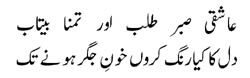
At a time, however, when in spite of exchange visits by nearly 150 groups, numerous CBMs and the first full round of the composite dialogue, India has not conceded a substantive inch on the Kashmir dispute but has claimed to have offered 72 proposals in diverse fields, as 72 excuses presumably for not tackling the Kashmir issue, the Urdu couplets which most readily come to mind are by Ghalib:
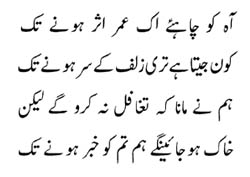
With the increasing toll of death and destruction on a daily basis in the continuing Kashmir struggle, the Kashmir freedom-fighter may well add:
MAHDI MASUD
Karachi
Car bombings in Iraq
It is a matter of concern that while bombings of any kind are viewed as terrorist attacks in Pakistan, Saudi Arabia, Indonesia, Afghanistan and Turkey, they are viewed by many Pakistanis as part of the 'freedom' struggle in Iraq. Iraq's Interim Government (IIG) led by Prime Minister Allawi is viewed as a puppet government of the US, even though it is endorsed by the UN Security Council that unanimously passed Resolution 1546 on June 8, allowing transfer of sovereignty to Iraq's new government. UN envoy Lakhdar Brahimi had played a key role in putting the IIG together.
The UN resolution further authorizes the US-led multinational force to remain in Iraq until the Iraqi government asks the US force to leave at any time. But its withdrawal will keep getting delayed if the security situation in Iraq remains as bleak as it currently is.
Insurgents fail to realize that the more they militate violently, the more will they be creating a need for US troops to stay on Iraqi soil, which has also been allowed now by the UN for security reasons.
And if resistance against US forces in Afghanistan is not presented as a freedom struggle, why is the one in Iraq viewed as such, where a deadly struggle is going on to grab power by militant groups of all shades? If good wishes are being expressed for the forthcoming elections in Afghanistan still under US troops, why must we already be displaying a lack of confidence in the elections in Iraq expected early next year? If the expected elections in Iraq are already projected as unrepresentative, how can the militant actions be viewed as representative of the will of the multitude in Iraq who are in dire need of security, jobs and utilities, and who will most certainly not want the US occupation to be replaced by occupation of their country by foreign and domestic militants?
As for the US occupation, it is the American electorate who will want their troops to return home sooner than later.
DR MAHNAZ FATIMA
Karachi
'Partitioning music?'
This refers to the letter by Mr Irfan Ahmed Urfi (Sept 12) in response to mine regarding PTV's odd decision of telecasting a programme Dunya Meri Jawan Hai: A tribute to the legendary female Muslim singers of the subcontinent, in which he has merely defended PTV.
Mr Urfi says that the programme also telecast duets which these Muslim singers had recorded with non-Muslim singers and that credit was given to all music directors, Muslim or non-Muslim, when the songs were shown. This doesn't answer my criticism, which is very simple: why should PTV show a programme of Muslim singers and not non-Muslim singers, whose contribution to subcontinental film music is just as important?
Mr Amin-e-Ajam, who too wrote on the subject (Sept 16), agreed that music cannot be divided on the basis of gender or religion, but he adds: "If PTV is highlighting our own national heroes, they are indeed doing their job." The fact is that PTV is not highlighting our heroes (shouldn't we call them heroines?) because Suraiya and Shamshad Begum, unlike Noor Jehan and Khurshid, decided to stay back in India. They were well within their right to do so, but just as we can't call Kananbala and Lata Mangeshkar (both excellent singers) our national heroines, we can't include Suraiya and Shamshad Begum in that list either. They were as proud to be Indians as Noor Jehan and Khurshid were proud to be Pakistanis.
It's about time we realized that literature, art, music and dance cannot be partitioned on the basis of religious beliefs of the practitioners of these artforms.
ASIF NOORANI
Karachi
EOBI beneficiaries
I would like to bring to your notice the plight of superannuated retired pensioners in private and public sectors who after having been covered and registered under the EOBI scheme get a very meagre amount as relief - a widow gets Rs730 a month while a retiree gets about Rs1,700 a month.
The pension rules applicable to federal and provincial government employees and bank employees are quite different and adequate. The amount sanctioned and paid in these cases even to a low-paid employee/menial staff is by and large enough to enable pensioners to make ends meet.
The Employees Old-age Benefits Institution has sufficient funds and a lot of assets, besides substantial amounts that it receives from various organizations/factories on account of monthly contributions from registered members. Hence, an increase in the amount of the relief after a lapse of certain years will not encumber the EOBI's functioning.
I appeal to the relevant quarters to increase minimum amount of the relief to Rs3,000 a month for each retired employee and Rs1,500 for each widow under the EOBI scheme.
M. ASLAM
Karachi
Improving public schools
This is apropos of the Sindh government decision to regulate private schools. Admittedly, this policy decision has been taken to prevent exploitation of teachers and students, or rather, parents by 'cottage industries' in the education sector. Imagination runs wild as far as school names are concerned. They are as interesting, if not more, as the 'poetry' on the back of rickshaws, tankers and trucks.
It will be, however, more than embarrassing for a government team of inspectors to warn or cancel registration on grounds of poor quality of education, considering that the vast majority of government schools, though free, are not popular with even poorly-paid government servants or the poorest of the poor. Reasons for this are so obvious that they need not be spelt out here. Government schools should be model schools.
The argument that a shortage of funds is the prime reason for the falling standard of education at public schools is just not correct. One despairs when one sees acres of land attached to government schools bare, crying out loud for a thought, let alone use. There is a constant demand for playgrounds but no organized sports programmes are regularly held. School gates are wide open round the clock, and most buildings look deserted, except where the grounds have been encroached upon. All this is because of a "no ownership" phenomenon which is the crux of this sad situation.
Government schools suffer for the same reason for which all government property does; there is no ownership. The first victims after an accident on the road are public buses, facilities such as telephone booths, traffic lights, ambulances and offices. They are damaged or burnt in immediate reaction. Most people have distanced themselves from what is their by right of being tax prayers, voters or merely citizens.
I often cite the example of the nine government schools lumped together in what was once a well-known private school in 1972 - five schools in the morning shift and four in the afternoon shift. What they came to share were broken windows, termite-eaten doors, one poor neem tree, a room full of broken desks and chairs. Experts have been urging the education authorities to merge schools running separately in the morning and evening shifts, pool their resources and rationalize the teacher-student ratio. At present, one school has 92 students and 25 teachers, and another one has 80 students and six teachers. There are some schools which have no teachers at all. Who will bell the cat?
The 'security' of being in a government job has made employees complacent. They are defiant and use any card to escape action. Monitoring personnel are handicapped because of lack of transport, and when inspections do take place, it is either an opportunity to "feast" or policing. Inspections should be advisory-cum-counselling sessions and there should be subsequent reports about difficulties and needs.
One can list a hundred things that do not require financing, except a minimal amount for regular maintenance. The bare start essentials for quality education are committed teachers, at least a six-hour (9am to 3pm) school day and a variety of good textbooks. One should take for granted that committed teachers will cover a converging of aspects when dealing with an assigned topic and project work under guidance. The full-day school will ensure that there are organized games and a library period.
Children should reach home happy in the thought that they can mess around, have time with their families and look forward to the next day. Meticulous planning is required and these proposals should be piloted, bearing in mind the requirements and possibilities of need-based education in the ruraland urban areas.
PROF ANITA GHULAM ALI
Karachi
Russia's ambitions
Your editorial "Russian unilateralism?" (Sept 10) speaks the truth about Moscow's announcement of pre-emptive action, pointing out that Russia also appears to be flexing its muscles to come in league with the US and UK in pursuit of bounty in the form of the oil wealth of Muslim countries.
The article "Beslan: 'Silence at the top'" by Ms Anna Politkovskaya (Dawn, Sept 10) also supports the apprehension expressed in the editorial.
GHEEWALA A.G.M.
Karachi
First cabinet meeting
It is heartening to read the account of the first cabinet meeting presided over by Prime Minister Shaukat Aziz. He was reported to be quite business-like, assertive and mission-oriented. He did not allow the ministers to deviate or interrupt one another or to have a free-for-all amongst themselves. He is reported to have asked the ministers, ministers of state and their secretaries to come prepared for the next meeting and brief him about the objectives set by them for the coming quarter.
This is a good start, but it will be better if he prescribes three-year objectives for his government and asks the ministries to set their yearly, biannually and quarterly objectives. We would also like to know the targets set for the government.
The efficiency of his government will be judged from the trickle down effect of his policies at the grass-roots level.
S.M.H.BOKHARI
Rawalpindi
Shepherd and Bari
Might sometimes can be wrong as has been proved by the reaction of the ICC over Wasim Bari's remarks about umpire David Shepherd. As a cricket lover for the last 70 years, not to speak of reacting as a Pakistani, I fully support Bari who, in my opinion, has been rather polite in his remarks about the umpire.
Bari has been kind in accusing Shepherd of senility when the umpire was obviously biased when he twice gave wrong judgments to dismiss two Pakistani batsmen, the captain and the vice-captain, at vital stages of the game.
Although umpires may be above criticism by players in the field, they should not be immune from criticism by others.
Why shouldn't the use of technology be extended by allowing the players to appeal to the third umpire when they are not satisfied with a leg before decision by one of the field umpires?
A.M. SAYIED
Karachi
Operation in Wana
Wana is bleeding. I have still to hear from our politicians or for that matter the leaders of religious parties to stand up and raise their concern about the blood that's being split daily in Wana. Our political-religious parties expressed their concern on each and every issue in the past, but where are they now? Maulana Fazlur Rahman or Qazi Hussain Ahmad have still to plan a visit to Waziristan.
We involve ourselves in petty issues like the president's uniform but do not think for a second to condemn what's happening in Wana and Waziristan. Yesterday's mujahideen have become today's terrorists.
AFZAL RAHIM
Peshawar
Diplomatic enclave in Karachi
Because of the fear of terrorist attack the law-enforcement agencies in Karachi are going all the way to protect some foreign consulates. The measures taken by them include the blockade of some of the main thoroughfares, disallowing parking at some hotels, etc. The concern of the law enforcers and the protection given to the consulates and embassies is understandable. However, there should be a limit to such measures. How long are Karachiites going to be harassed by the stoppage of traffic and blocking of parking lots?
I do not know whether the measures taken present a solution to the menace of terrorism but I know for sure that the harassment meted out to road users does not earn any goodwill for the overly protected consulates and missions.
A permanent solution must be found. The solution lies in asking them to shift from their present locations. All consulates and foreign missions may be offered suitable plots on one or two particular streets of the DHA to construct their consulates and residences there. Providing security to this enclave will be easier and effective. The streets can be blocked whenever considered necessary for security reasons without causing disruption in the lives of the people of Karachi.
MOHAMMAD YAMIN
Karachi
'Crorepati' lucky draw
The first 'Crorepati' draw was held on August 23 and the results were announced on August 25.
I won a prize of Rs1,000 and called at a branch of the Bank of Punjab to claim the prize. I submitted the original ticket and my NIC, as required. I was told that photo-copies of both the documents also have to be supplied. This requirement I duly fulfilled upon which I was asked to call after some days for payment.
I visited the bank on August 30, but I did not receive my payment. The bank is unwilling to give a date and I do not know how many times I will have to go there for it.
The winners will appreciate it if collection of prize money is made easier.
AHMED
Lahore
Belated wisdom
UN Secretary-General Kofi Annan has taken more than a year to realize that the American invasion of Iraq was illegal. But he can get some solace from the proverb "dair aayed, droost aayed". Thank you, Mr Annan, for showing your belated wisdom.
DR SHAUKAT MAHMOOD
Lahore