0
0

IDBP employees' plea
This has reference to Mr Akbar Khan Jakhrani's letter "IDBP staff plea" (August 11). While reiterating the views of the writer I regret to add that the employees of this institution have been expressing apprehensions about their jobs but nobody has ever listened to them.
The IDBP is the oldest development bank established as PIFCO (Pakistan Industrial Finance Company) in 1949 and is the first one to cater to the financial needs of private manufacturing sector.
Cognizant of the potential of small and medium-sized industry in bringing about social justice and the need to develop an institutional focus for allocating foreign exchange resources to the private sector, the government converted PIFCO into the Industrial Development Bank of Pakistan in 1961.
It may be pointed out that while the charter mainly assigned to the IDBP the role of financing the small and medium-scale industry, it also provided certain exception by virtue of which the IDBP was to engage in financing large-scale units. Its staff base has all along been unique in terms of size and discipline and has the expertise to provide financial and advisory services of a high standard.
The tempo of development was upset in the early 1970s when the economy experienced unprecedented strains because of political crisis, massive devaluation, then nationalization in 1976 and also in the early '80s on delinking of rupee from US dollar. The combination of these adverse factors led to suspension of its access to multi-lateral credits.
Even then the staff mobility did not go low and their performance to meet the given targets in every field of emphasis always remained good. Their work on recoveries, settlement, rehabilitation for reducing portfolio infection and thus improving quality of the bank's operations cannot be ignored.
The bank concentrated on consolidating commercial and merchant banking activities begun in 1990. Deposits recorded a significant increase though the branch network was limited.
Had the focus been on the full range of banking services, with an expanded branch network, it would not have declined. But for the last five years a gradual squeezing of operations at the hands of the authorities is going on.
Moreover, statements of government functionaries on its future have hurt the institution. Its employees are extremely worried because they do not know either the fate of their jobs or security of financial benefits.
In the recent past wherever an institution is liquidated, closed or downsized for privatization, the views and suggestions of the employees were taken into account and even implemented. But in the case of the IDBP, its employees have been simply ignored.
We appeal to the prime minister to ensure that professional and qualified officers of the IDBP are not sacrificed in the process of privatization. Our foremost preference even today is that the government should negotiate with the Asian Development Bank for continuing with IDBP after its restructuring and conversion of operations with an expanded branch network.
In case such effort do not bear fruit, the services of employees be either absorbed in some healthy institution or they be given financial benefits commensurate with their experience and professionalism.
TARIQ IQBAL
General-Secretary, IDBP Officers Association, Lahore
Compulsory maths for science students
Through these columns I would like to draw the attention of the Higher Education Commission to the following matter: Universities in Pakistan are adopting the new syllabi, prepared and introduced by the HEC, from BSc Part-I.
The new syllabi are at par with the syllabi in advanced countries. Apart from major subjects, a number of minor subjects are also introduced, thereby giving a wide range of choice to students.
Most students who are poor in mathematics do not opt for it at the intermediate level and take the biology group. Such students, after passing their intermediate examinations, either go for medical education or enrol themselves for BSc/MSc courses in universities where they do not learn mathematics as a minor or major subject. Rather, they are not allowed to take mathematics because of their poor knowledge of the subject.
But with the introduction of the new syllabi, the Sindh University authorities have taken the unusual decision of making mathematics a compulsory minor subject for students of the biology group, and they are taught algebra, trigonometry and linear algebra.
My own children and their classmates have been made to study mathematics. Consequently, a majority of the students could not qualify in the subject and thus will linger for years to pass or abandon university education.
I do not understand the logic and wisdom in teaching algebra, trigonometry and linear subjects to students of zoology, botany, fresh water biology, microbiology, biochemistry and psychology.
After going through a copy of the syllabi introduced by the HEC I do not see mathematics as a compulsory minor subject mentioned anywhere for the students of biological sciences.
It will not be irrelevant to mention here that the vice-chancellor of the University of Health Sciences wrote a letter to the HEC chairman, stating that most of the medical graduates did not perform well in the general entrance test mainly due to their inadequate knowledge of subjects like mathematics, biostatistics, physics and chemistry, which they did not study during their MBBS courses and post-MBBS clinical experience. To this, Prof Dr Attaur Rahman said that the commission could modify the test for students in biology/medicine in future (Dawn, May 27).
I request the HEC authorities to investigate how and why mathematics has unnecessarily been made a compulsory subject for students of biological sciences, and direct the authorities of the University of Sindh to allow students to select minor subjects of their own choice.
PROF. MUHAMMAD ALI RAJPUT
Hyderabad
Building large dams
This refers to your editorial "Bhasha: decision made?" (August 19). You have rightly said: "The world over expert opinion has gone increasingly against big dams. They are found to have progressively lost their utility, interfered with ecology, and uprooted populations from traditional settlements. Experts feel small dams could do a better job. It is time Pakistan thought on these lines."
But, surprisingly, you have suggested: "As for the federal government, it must secure consensus of the provinces before launching the construction of such a large project as the Kalabagh or Bhasha dam."
The two thoughts are irreconcilable. No doubt, the construction of large dams is harmful for many valid and obvious reasons. First, a large number of people would be displaced.
We have the example of the Tarbela dam where all the displaced people could not be settled even after 37 years. The Kalabagh dam will render, according to Wapda, more than 12,000 people homeless.
The second reason is that because of seepage about 40 per cent of water would become useless. In case of collapse, it will bring unprecedented ruination. There are examples of such devastation before us. Therefore, construction of small dams should be encouraged.
Unfortunately, construction of large dams in Pakistan is demanded on political grounds. Three elected provincial assemblies out of four have passed nine resolutions against the construction of the controversial Kalabagh dam.
I suggest the federal government should not lay emphasis on building large dams in view of the ground realities and its possible ruination.
IMRAN KHAN SIAL
Karachi
Plight of special children
Being a blind person I can understand the frustration of Firdous Naqvi ("Plight of special children", August 27). I regularly read Dawn with the help of JAWS.
His frustration which is shared by many cannot be addressed without personal ownership of this issue by our education minister as well as by our minister of science and technology. In this connection I would like to submit that:
1. The board of education is too full of red tape and has no time to give attention to the genuine problems of special children. Several letters have been written to the board during the past several years but to no effect.
My letters have also appeared in Dawn regarding eliminating subjects and questions which require drawing, such as geometry and geography. I myself was deprived of 20 marks in geometry and lost an A grade only because I could not "see". The apathy continues.
2. I am trained in the use of JAWS and am imparting JAWS training at the Ida Rieu School. I hereby offer to have all the English medium textbooks starting from Class IX converted for JAWS reading, that is if the minister takes this matter seriously and provides official patronage for this humble offer. This will greatly benefit English medium students.
3. JAWS must be a compulsory subject for visually-challenged persons. All examination centres for the blind must have PCs available equipped with JAWS where the students can give their examinations.
SHAZIA HASAN
Karachi
Mango tree disease
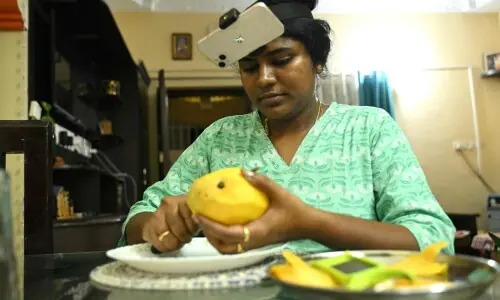
For a long time we have been hearing about a mysterious mango tree disease. Some have tried to analyze it and suggested a number of remedies. I do not have any mango orchard, but only three mango trees, out of which two were attacked with the same symptoms (sap oozing from the loose bark and powdery substance dropping from various parts of the trunk).
After a thorough search, it was found out that the enemy was neither a micro-disease nor any deficiency in the soil but the larvae of some kind of moth that punctures the trunk and branches (due to which the sap oozes out) and lays its eggs inside it.
The eggs soon hatch and the larvae starts tunnelling inside the tree, first near the bark, which loosens it, and as the insect grows, burrowing deeper. If its journey is upwards, only the relevant part or branches die, but if it journeys towards the roots by boring through the centre of the trunk, the entire tree soon dies as the supply of the sap to its branches is stopped. It also attacks sheesham trees.
The colour of this creature is white, with a very hard, orange head. It is extremely hardy when it is fully grown (five inches approximately). The only effective remedy that one has come across is the application of insect powder on the trunks, which prevents the moth from coming in contact with the tree to lay its eggs.
We have managed to save both of our trees by chiselling deep into the tunnels up to the place of the insect's presence and removing it. This operation, however, left deep marks on the trunk.
Z.K. HUSSAIN
Karachi
Chaudhri Rehmat Ali's remains
This refers to the letter (August 24) by Mr Kunwar Idris in which he has rightly questioned former prime minister Chaudhry Shujaat Hussain's announcement to bring the remains (50-year-old) of Chaudhri Rehmat Ali to Pakistan for burial. I support him.
Chaudhri Rehmat Ali was opposed to the Quaid-i-Azam and his concept of Pakistan. He was equally opposed to the All-India Muslim League and took no part in its campaign for the struggle for Pakistan.
It is also true that he came to Pakistan after the death of the founder and soon left, saying that he would not like to live or even die in the kind of Pakistan we had.
I will, therefore, request Chaudhry Shujaat Hussain and Senator Tariq Azeem Khan not to hurry in this case and consult with people like Prof Shariful Mujahid and any political historians to ascertain the truth and then decide the issue.
ISHTIAQ ALI KHAN
Islamabad
(2)
In continuation with Mr Kunwar Idris's concerns regarding the controversy of bringing back Chaudhri Rehmat Ali's remains to Pakistan, what baffles us is that if we are to believe him, Chaudhri Rehmat Ali not only refused to be buried in Pakistan but he also used derogatory language against the Quaid-i-Azam. Not only that but he actually referred to our land as 'a parody of Pakistan'.
I am sure that Mr Kunwar Idris must have all the historical facts before him and, if true, why all this effort to transform Rehmat Ali into a hero after about half a century? What the PML is up to? Or is the move meant to create a ghost equivalent to that of Mr Jinnah from Punjab viz-a-viz the Pakistan Movement?
Has any debate been held in the National Assembly? Has any of the graduate members of the National Assembly bothered to raise this issue? Not one of them realizes that today they are here because of Pakistan and Pakistan is here because of Mr Jinnah.
SAJID ISHAQ KHAN
Karachi
(3)
This is with reference to Mr Khalid Hasan's letter "Resurrecting Chaudhri Rehmat Ali (August 28). It is a historical fact that the 1946 elections held in India turned the tide in favour of Pakistan.
This was a challenge thrown by Lord Wavell, the then viceroy of India, to Quaid-i-Azam Mohammad Ali Jinnah who accepted this challenge and the result was Pakistan - the Muslims of India voted en bloc for the All India Muslim League and that clinched the issue.
It is a fact admitted by the Indian National Congress and also by historians that had there been no Jinnah, there would have been no Pakistan. So far as Chaudhri Rehmat Ali's role in the nomenclature of Pakistan is concerned, it is a dead issue now. There is no point in flogging a dead horse after 57 years or in bringing his remains from England to Pakistan.
ALI ASHRAF KHAN
Karachi
Cricket: why we lost the final
Pakistan performed exceptionally well in the recently concluded Videocon Cup in the Netherlands and were unfortunate not to have lifted the cup. Two major factors led to Pakistan's defeat: the silliness of Youhana as a runner and the ineptness of umpire David Shepherd.
Yousuf Youhana is no doubt a brilliant batsman, but undoubtedly he is the worst runner in the Pakistani team, even worse than Inzamamul Haq because he is the worst judge of a run you could ever see. A comparison could be drawn with legendary English batsman Dennis Compton who was equally notorious for getting his partners run out.
As regards umpire David Shepherd, the less said the better. It appeared from the way he did umpiring that he was the 12th Australian on the field. He is aging and has consistently been making horrendous decisions for quite some time now. There seems to be a problem either with his eyesight or with his hearing, but whatever it is it cost Pakistan dearly in the final.
I think Wasim Bari is quite justified in asking him to say goodbye to the game. As far as Australia is concerned, no doubt they are the world champions but this time around they were very lucky to have won the trophy.
KHALID MANZOOR KHASKHELI
Hyderabad
Accepting responsibility
This refers to Mr Khalid Ahmad's letter "Setting an example" (Aug 26) about the voluntary resignation by the chief justice of Quebec's superior court following a traffic offence.
Double parking of cars belonging to the army and senior officers is done with impunity around the busiest shopping centres in Pakistan. Officials involved in custodial deaths and extra judicial killings are occasionally transferred or briefly suspended - judicial inquiries into these killings, if ordered, result in frivolous trials and no convictions.
Political actors in Pakistan are devoid of positive morality and do not feel obliged to resign even if they fail to discharge their ministerial responsibility. Most of us can read the writing on the wall; we just assume it's addressed to someone else.
LT-COL (retd) SYED AHMED
Mississauga, Ontario, Canada
Sympathy
"Italy quietly secures cities, airports to meet terror threat" (Dawn, August 15). Quietly? Maybe Italian leaders do not require to play the flute to obtain American sympathy.
Z. A. KAZMI
Karachi
Arms for all
I have lived abroad for some years but have not experienced such lawlessness anywhere as in Karachi. Robberies in broad daylight, car jacking and robbing people of mobile phones at gunpoint have become a matter of daily occurrence, and our 'vigilant' police are no help. Being unarmed, the victims have to yield to the demands of the miscreants.
Arming of the public for self-defence has now become essential to defeat criminals, many of whom possess only dummy weapons to terrorize their victims. For some time it may create some problems, but then it is going to produce results. The relevant authorities may weigh the pros and cons of the suggestion in the interest of public safety and to check the crime rate.
MOHAMMAD HABIB SIDDIQUI
Karachi
Admission to medical colleges
An entry test for admission to first year MBBS and BDS for the session 2004-5 will be held on September 19. Keeping in view the experience of the six previous tests, it can be said that the tests have caused grievous loss to good students. They only provide another chance to try their luck to those who could not get good marks in their FSc examinations and are a great boon for so-called academies.
After the FSc examinations, instead of relaxing for some time, students rush to these academies, growing like mushrooms in every city, where they spend as much money as the total spent on their whole education.
Even then the sword of uncertainty continues to haunt them. There are many examples that some very brilliant students, even position holders, failed in the entry test because of some confusion.
In view of these demerits of entry tests, the Punjab government has decided to end them, but gradually. The question is: when the experience has proved that these tests are unnecessary, why are they not being immediately stopped?
A NUMBER OF SIGNATORIES
Bahawalpur
'At our own risk and peril'
This is with reference to Sindh Finance Minister Syed Sardar Ahmad's letter published on August 25. In my letter of May 2001 addressed to governor Mohammedmian Soomro I wrote: "An MQM delegation comprising suspended Senator Aftab Shaikh, Khalid Bin Walid, Sardar Ahmad, and another came to the offices of Shehri-CBE where they were met by Amber Alibhai, Dr Raza Gardezi and one other."
What provoked the minister into believing that he was the Sardar Ahmad of the delegation to which I referred?
ARDESHIR COWASJEE
Karachi