0
0

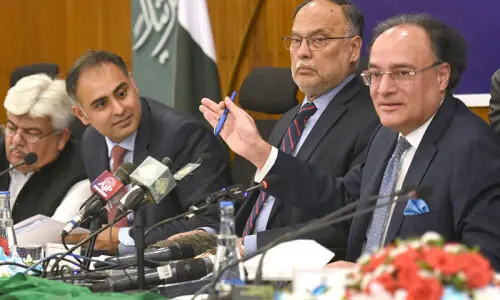
KARACHI, April 29: Amidst confusion and extreme uncertainty, the food ministers of the federal government and the four provinces are meeting in Islamabad on Friday to work out a plan to ensure availability of wheat to flour mills from open market or from government stocks and a year-long smooth supply of flour to consumers at reasonable prices.
What has to be the reasonable price of flour has to be decided by the 'elected and responsible' government and not the millers and traders who in time of distress push up the prices as high as Rs20 a kilogram. If a farmer gets Rs8.75 for a kilogram of his produce than a consumer should not pay more than Rs12 for a kilogram of flour.
Right now on agenda is the concern of Sindh and Punjab who find it difficult to get wheat from farmers at the officially fixed prices of Rs350 per 40kg. Reports suggest that wheat price has shot up to Rs400 and even Rs450, notwithstanding a ban on inter-district and inter-province movement of wheat imposed by both Punjab and Sindh.
Punjab's decision to ban wheat movement has already provoked the NWFP leaders who have threatened to disconnect Punjab's electricity supply. An angry voice has also been heard from Karachi where a MQM legislator wants wheat to be imported from India if Punjab maintains its restriction.
The provincial governments of both Punjab and Sindh hold traders and millers responsible for pushing up wheat price in the open market. Traders have now easy access to bank loans at dirt cheap rates.
Market reports suggest that in Sindh over Rs2 billion bank loans have been used for purchase of wheat which is now being stacked in mills, ginneries and other odd places.
Therefore, the most pressing issue before the food ministers of the centre and the four provinces is whether they have the capacity to 'rein in' the unscrupulous traders and millers who are thriving on easy bank loans.
But if a trader now gets bank loan at 5-6 per cent interest rate, the provincial governments are getting it at about 1.3pc. It gives the governments sufficient space in their budgets. Why don't they use this advantage in the interest of farmers and consumers? And why should a food bureaucrat grudge if a farmer gets Rs400 for a maund of his produce?
"A small farmer in Sindh does not get even Rs300 for a maund," a knowledgeable source said. He said a farmer depended a lot on the 'bania' for farm inputs.
This credit is given at a very high rate and on very hard terms. The harvested wheat is immediately lifted by the 'bania' who after adjusting the loan plus exorbitant interest and other charges does not pay even Rs300 for a maund to a small farmer.
The food ministers will explore at the Friday meeting many options for keeping the wheat trade clean and flour availability within manageable limits.