0
0

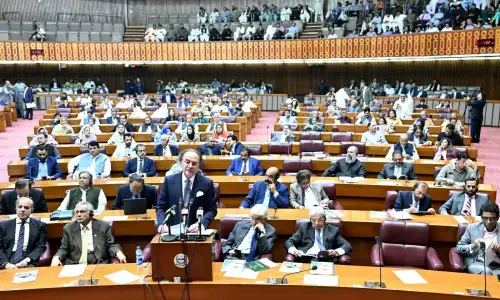
ISLAMABAD, April 9: Finance Minister Shaukat Aziz on Friday told the Senate that the per capita income in Pakistan would reach $600 this year, though the exact figures would be announced at the time of the coming budget.
Replying to supplementary questions during the question-hour session in Senate, the finance minister said that due to prudent monetary disciplines and economic growth the per capita income in the country would reach $600.
According to the Economic Survey 2002-03, the per capita income in Pakistan was $492. If the per capita income increases to $600, then Pakistan would be the third highest ranking country among the Saarc countries where the per capita income is very high.
According to profiles of the Saarc countries, the highest per capita income is of Sri Lanka which is around $879, Bhutan $645, India $433, Bangladesh $380 and Nepal $240. Mr Aziz also told the house that till the time the budget would be announced, Pakistan's GDP must have reached 6 per cent against the full year target of 5.5 per cent.
He was also hopeful that the level of poverty would further reduce in the coming years as the government was expecting an additional cash flow of Rs65 billion to Rs70 billion in rural areas in the coming budget. This much amount would obviously help in reducing the level of poverty in the country.
To another question, the finance minister said that during the first half of the current fiscal year, 34 to 36 per cent of allocations under the head of Public Sector Development Programme (PSDP), had already been spent which was 20 per cent higher than expenditures in the last year.
Referring to the Social Action Programme (SAP), the minister explained that the government wound up SAP-I and SAP-II in June 2002 because it was incorrectly designed, heavily consultant driven and too much management-loaded project, that was costing much more than the actual results it was yielding.
"That is why the project was closed down after negotiations with the World Bank," he said adding that its closure was in the best interest of the country. The minister however explained that SAP-I was designed to focus on primary education, basic health care, basic health units, AIDS, malaria control, extended programme of immunization (EPI), water supply and sanitation in rural areas and population welfare programmes both in rural and urban areas.
Under the SAP-II it was expanded to cover middle schools and non-formal education in the education sector, tehsil level referral hospitals, tuberculosis and nutrition in health sector and water supply sanitation in urban slums.
He said the World Bank withdrew its assistance for SAP from June 2001 due to introduction of the devolution plan under which the ownership was transferred from provinces to district authorities.