Iraq: a year after
A million strong crowd of protesters in Rome, hundreds of thousands in the grief-stricken cities of Spain, 75,000 or more in London, 120,000 in Japan and some 3,000 in Sydney marked the anniversary of the American action in Iraq. In the United States, there were some 250 protest marches with the one in New York attracting some 60,000 people.
These figures are impressive but can also be seen in another light. The demonstrations were much smaller than those that were held last year when the war was being planned. Last year, there were a million demonstrators in Madrid and the gathering in London was termed the largest that had ever been witnessed in that city. In New York, the figure topped 100,000.
If there has been some decline in the intensity of opposition to the American action, it can hardly be attributed to the kind of success that the Americans have had, or, for that matter, to any evidence supporting the American claims that Saddam's weapons of mass destruction were posing an imminent threat to America or at least to Iraq's neighbours.
Except for the most diehard, clearly the opponents of America's actions have concluded that protest is futile and that they are unable to influence the policies of their own governments, let alone those of the Bush administration. Otherwise, there would be much more to protest now than there was a year ago.
The Americans have had to more or less acknowledge that there were no weapons of mass destruction in Iraq, and have had to fall back on other rationales to justify their actions such as Saddam's cruelty toward his own people and, more tenuously, his connection with terrorism.
They have also had to acknowledge that their fond hope of being welcomed as liberators has been belied by the reality on the ground, and that while they can claim a measure of progress in bringing peace to Iraq, the task has certainly been far more uphill than originally anticipated.
A recent poll by the TV network ABC showed that 42 per cent of the Iraqis and 33 per cent of the Arab Iraqis, felt the war had liberated Iraq, but that 41 and 48 per cent respectively were of the view that it had humiliated the country. The presence of the US-led forces in Iraq was opposed by 51 per cent of Iraqis.
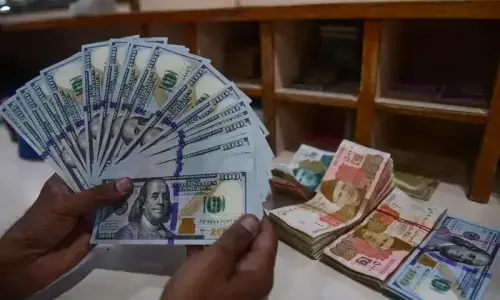
The Americans claimed in April 2003 that the total amount they would need for reconstructing Iraq would be $1.7 billion and that the rest of the reconstruction cost would be met through oil revenues.
Six months later, the administration asked Congress to approve $20 billion or a sum twelve times larger than the earlier estimate, and officials now concede that reconstruction costs may exceed $75 billion.
Some of this money has generated economic activity and provided an income to the Iraqis. The Americans claim that electricity generation is now at the same level as it was before the war and that oil production too has reached pre-war levels.
According to the poll mentioned earlier, more than 56 per cent of the Iraqis said things were better now than they were before the war, and 71 per cent expected that their lives would improve further in the coming year.
There are, however, question marks about how much of the money has been absorbed by American firms that were offered contracts at prices which are now being investigated.
Last May, Bush proclaimed the end of major combat operations. Since then, there have been daily deaths with the latest count being approximating 600 Americans, 100 allies, 6,400 Iraqi security personnel and a huge number of Iraqi civilian casualties.
Recent explosions in various parts of the country have added to this toll. A report by the Council of Foreign Relations task force led by distinguished American statesmen and entitled " Iraq: one year after" states: "The coalition has been unable to ensure a safe and secure environment within critical areas of Iraq."
All this perhaps pales in comparison to the boost that American actions in Iraq have given to terrorism both in Iraq and elsewhere. The decision by Bremer, the Rumsfeld-nominated administrator and pro-consul in Iraq, to disband the 400,000- strong Iraqi army has left thousands of soldiers unemployed and disaffected on the streets of Baghdad and other Iraqi cities.
Many, if not most, of the officers in this army are Sunnis, deeply conscious of the fact that in the new dispensation in Iraq members of their sect would no longer play their traditionally dominant role.
Their resentment at this change in fortunes has been compounded by unemployment and has made them easy recruits for a resistance movement that Saddam's diehard Baathist supporters are seeking to promote. Perhaps, their resentment has even made them active supporters of the infiltration into Iraq by extremists from other parts of the Arab world.
The Americans maintain that Zarqawi, a Jordanian-born Islamic activist, was responsible for the carnage in Baghdad and Karbala on the 10th of Muharram. Zarqawi, according to American intelligence, was the head of the Ansar-ul-Islam an extremist Sunni group which before the war had its headquarters in what was nominally Kurdish-controlled territory in northern Iraq.
Zarqawi, the Americans had claimed before the war, was allied to Saddam and had been provided facilities by Saddam's intelligence network.
Now they claim that his group has moved to southern Iraq and is responsible for some of the terrorist attacks including the one on the UN headquarters. Much has been made of a letter purportedly written by Zarqawi, who opposes the Shia sect, in which he called for the promotion of sectarian strife to rattle the American occupation forces.
American field commanders speaking to reporters now maintain that foreign and indigenous Islamic extremists rather than the remnants of the Baath party have emerged as the "principal threat" to security.
The picture they paint is that of a limited number of foreign extremists who, armed with money and expertise, make common cause with local extremists of the Wahabi persuasion, and together recruit ex-Iraqi soldiers and Baathists to carry out terrorist attacks.
They also concede that apprehending Baathist financiers has been comparatively easier than this new brand of trouble makers, whose numbers are still comparatively small but whose capacity to create problems is large.
If this is correct, Iraq, rather than becoming the beacon of democracy in the Middle East that the Americans hoped to create, will become the focal point of terrorist and sectarian activity in the region and beyond.
While it may not be possible to establish a direct connection between the sectarian attacks in Iraq and those in Pakistan, there is no doubt that our local militants derive inspiration from events in Iraq. It is noteworthy that the suicide attacks in Iraq were followed shortly by suicide attacks in Afghanistan and Quetta.
Today, the Americans talk of the adoption of the constitution by the Iraqi Governing Council as one of their most significant achievements and as the foundation for a democratic and secular Iraq.
The federal principle that theoretically underlies this constitution gives far too little to the Sunnis of central Iraq making it a source of concern not only for Iraqi Sunnis but also for Iraq's Arab neighbours.
Iraqi Shias will probably not make common cause with the Iranians but the fear that they may do so persists. There are also links between Iraq's Sunni tribes and those in Jordan and Saudi Arabia. They too will resent the loss of power suffered by their tribesmen.
Many problems lie ahead on this score. The Americans are intent on handing over power to selected rather than elected Iraqis by July. The United Nations has persuaded Ayatollah Sistani, whose word is law for most Iraqi Shias, to acquiesce in the promise that the UN will organize elections as soon as it is feasible.
The election date, however, is yet to be decided upon and the UN seems to be dragging its feet over sending its people to Iraq, presumably because of the security situation and because the relationship with the occupation authorities has not been worked out.
American occupation forces will probably end up handing over power to a governing council that has little representative capacity and enjoys little popular support. Many fear that, using his well-known influence in the Pentagon, the unscrupulous and little trusted Chalabi will emerge as the dominant force. Once this happens it is unlikely that he will ever allow a truly representative government to come to power.
In the meanwhile, the Americans have to cope with what is a qualitatively new situation in Europe. In Spain, the manner in which the terrible tragedy of the train bombings was handled i.e. attributing the outrage to the Basque ETA party, reversed the political fortunes of Prime Minister Aznar's party.
The new socialist Prime Minister had said as part of his election campaign that he would recall Spanish troops from Iraq. However, Americans hope to see some flexibility in his stance that much depended on deeper UN involvement in Iraq. They also believe that since Spain places a high value on the "American connection", no government would take any precipitate action.
Throughout Europe there are many who feel that the carnage in Spain can be attributed to the Iraqi mess and that Europe was having to pay the price for Americans' actions.
In America itself, there is enough ambivalence on the subject to suggest that even if Bush succeeds in making national security rather than the economy the focus of the presidential election campaign, he may not emerge the winner. These points will be examined in a subsequent article.
A curriculum of hatred
The religious parties in Pakistan are at loggerheads with the government on yet another issue: the so-called "exclusion" of some Quranic verses from the biology textbook for Intermediate classes. What has annoyed the MMA?
It all began three weeks ago when in reply to a question in the National Assembly, the federal education minister explained that the inclusion of Quranic verses is not a requirement of the curriculum.
While replying to a supplementary, the parliamentary secretary further provoked the self-appointed guardians of our morals, when he attempted to reinforce the minister's argument by questioning the relevance of the excluded verses to biology.
This created quite a rumpus in the House and the opposition staged a walk-out. It was later persuaded to return to the chamber to hear the information minister dutifully tender an apology and the education minister assure the House that no change was made in the curricula on any external pressure.
But, intriguingly, the controversy has refused to die down. A fortnight later the Punjab teachers union announced its decision to launch a protest movement from Gujranwala from April 15 if the verses, which pertain to jihad, were not reinstated.
It has been reported that at the heart of this controversy is a report released by the SDPI, an independent think tank. Titled The Subtle Subversion: The State of Curricula and Textbooks in Pakistan, this report, which draws extensively from the research on the subject by Dr Rubina Saigol, an educational sociologist, without adequately and specifically acknowledging it, points out that the curricula and textbooks in Pakistan were insensitive to the existing religious diversity of the nation, incited militancy and violence, and encouraged prejudice, bigotry and discrimination towards fellow-citizens, especially women and religious minorities.
The religious parties are not too pleased that the curricula prescribed by the curriculum wing of the Ministry of Education and the books produced by the textbook boards have come under the spotlight.
Since the days when General Ziaul Haq used his authority backed by military power to induct religion into every sphere of national life and then use it to perpetuate a narrow right-wing ideology, the public sector education system in the country has been harnessed to promote a mindset which upholds retrogressive values.
But why was no notice taken of this state of affairs before? The fact is that for at least two decades the media has been trying to draw the attention of the authorities to the dismal state of the textbooks and the distortions in their contents. But all the editorials and articles have proved to be a cry in the wilderness.
Much before the SDPI commissioned this report, Dr Rubina Saigol wrote a profoundly insightful paper, "The boundaries of consciousness: interface between the curriculum, gender and nationalism" in a book called Locating the Self (published by ASR, Lahore, in 1994).
In this paper she showed with several examples how our textbooks construct India and Hindus as enemies and how they incite permanent enmity, hatred and alienation with India. The author's contention was that these books promote militarism and violence and indirectly justify a heavy defence expenditure.
Since then, she has been expanding relentlessly and painstakingly on this subject in several publications to show how an ultra-nationalist, hypermasculine, militarized state is constructed in our textbooks and what effects this has on our identity and society. Some other scholars, such as Dr Mubarak Ali and Prof K.K. Aziz have also published their reports on this issue.
In 1999, the National Committee on Education, which was constituted under the chairmanship of the federal education secretary on the prompting of some eminent educationists, prepared a report National Curriculum 2000: A Conceptual Framework calling for a paradigm shift in the curriculum in order to produce "involved, caring and responsible citizens". This report was stored away somewhere in the ministry's records on some dust-laden shelf.
Several women's groups have carried out extensive studies from time to time to identify the gender bias in our textbooks. The exercises they have carried out have demonstrated again and again how these books denigrate women and relegate them to a secondary status.
Therefore it is difficult to understand why at this stage the SDPI's report, which is not presenting something new, being in Dr Saigol's terms "a complete plagiarism of my work" and "intellectual dishonesty", should draw the ire of the religious parties. The SDPI has come under attack for implementing the "American agenda".
The furore this time can simply be explained in terms of the growing power of the religious parties which hold office in two provinces. They want to preempt the Musharraf government from heeding the voices of sanity being raised on this matter.
The fact is that after the nationalization of schools and colleges had all but destroyed the education infrastructure in Pakistan, the system has suffered from a serious dichotomy.
Two parallel streams have run side by side in the country. Those in power remained quite indifferent to the mindset of the masses fed on the ideological and hate contents of the government prescribed curricula.
As the impact of these textbooks filled with hate and the teachings of the madressahs is being felt generally, the syllabus has set the alarm bells ringing. The subtle poisoning of the mind of the students has been clearly established by another report produced by the Karachi-based Social Policy and Development Centre (SPDC).
In its Annual Review 2002-2003 (The State of Education), the authors of the report observe about the Pakistan Studies textbooks, "Entire periods of history are missing and other events have been casually mentioned. No attempt has been made to identify circumstances leading to particular events or to establish the relationships between different events."
It continues that as a consequence of these books, "Instead of being able to acknowledge diversity in points of view, they (students) are likely to look at the world in over-simplified, uncritical, 'black and white' and 'us versus them' terms and to develop single dimensional, exclusivist mindsets."
What the school textbooks are doing to the thinking of our students is indicated by a survey of school children. The opinions of children in Urdu medium schools (who are not exposed to progressive literature in the English language) are quite instructive.
A little less than half of them do not support equal rights to minorities. A third of them support the jihadi groups. Two-thirds of them want the shariah to be implemented. Nearly a third want Kashmir to be liberated by force and nearly 80 per cent of them support Pakistan's nuclear status.
In other words, it is not the madressahs alone which are creating hatred and militancy among the younger generation. The indoctrination is affecting everyone and probably this is now causing concern in the government circles which are now trying to battle religious bigotry.
In this context, the most meaningful recommendation in the SDPI report comes from Zarina Salamat in the chapter titled "Peace Studies; a proposed programme of studies in schools". Ms Salamat suggests that peace building and conflict resolution be taught to children from an early age. They should be told about the inhumanity of violence and the brutality of war and the forces which lead to them.
At the same time children should be made aware of the value of peace and the dignity of human life while they are taught the ways of developing their capacity to maintain peace in society and at the national and international level.
The positive aspect of the SDPI report - though one wishes the sources of the analysis had been adequately given credit where it was due - is that for the first time in years the issue of textbooks contents is receiving some attention from the authorities, although the press - at least this paper - and the educationists who care had been crying themselves hoarse for decades about the poor quality of the textbooks that are being taught in our schools.
New aid for education
In the old days we used to hear of good-hearted gentlemen who had subsidized the education of a poor boy keen on studying because of his God-given aptitude but whose parents could not afford to send him even to a municipal school, or thought it was a waste of time to do so.
Now it is the turn of rich nations to assist in the spread of education or the provision of quality education in developing countries. Like many other people in Pakistan I too am against foreign aid.
Whether it is apparent or not, economic and military aid does have strings attached to it which is sometimes not visible, but I think one should not bridle at assistance from a friendly nation intended to further the cause of education. There is no reason to be dogmatic about it, because even the major powers of the world can be altruistic in some matters.
No country in the world can assume the responsibility of financing its entire educational programme, even the richest ones can't do it. And Pakistan, least of all, whose overall plans for development in various fields require astronomical investment which it is certainly incapable of making available.
The education field is just one of them. Not to talk of quality and higher education, in the domain of literacy alone the situation is mind-boggling.
For example, out of 105 administrative districts in the country, 40 are in the very low literacy regions, 43 in the low literacy regions, 15 in the high literacy regions, and only seven are in the very high literacy regions.
To go along with the modern world and to make a mark internationally you have to have the maximum number of your districts in the very high literacy regions. Everyone says that the private sector must come into the picture in Pakistan to supplement government effort.
Over the last few decades, it has come in, but unfortunately most of its endeavours are commercially motivated and not aimed at general, inexpensive, low-level education for the masses.
A number of developed countries are helping Pakistan through aid programmes to revamp its education system and make it more productive and meaningful. Let me tell you about one of them which, I think, has taken on a rather difficult responsibility.
Funded by US-Aid, 60 million dollars are to be spent on the ambitious Education Sector Reform Assistance designed to support Pakistan's efforts to achieve strategic, significant and sustainable improvement in education.
It is being implemented by a consortium of international and national partners under the aegis of the Research Triangle Institute (RTI) of North Carolina, USA, which undertakes research, analysis and development activity in education (among other fields) all over the world.
There are two special features of the programme. One, it is confined to four districts each of Balochistan and Sindh to start with, and will encourage and support linkages through public-private partnership between the public education sector and several key industries (e.g. oil and gas, textiles and garments) located in these districts.
Two, it will concentrate particularly on improving the education management system capacity in these districts. This capacity is rather poor at the moment. Already the eight districts have been linked via the internet with each other as well as with the provincial secretariats and ESRA offices.
Among the other aims of ESRA are, strengthening the capacity of the five provincial and national Education Foundations so that they can properly meet existing and expanded mandates as leading entities in educational reform; development of a national strategy for the use of Information and Communication technologies; provision of technical assistance to facilitate work in educational policy, development and planning; and enhancing the on-going professional abilities of teachers and administrators, particularly women.
It is also to promote public-private partnerships in support of quality in education.
"This is the first of several new large grants US-Aid will award in the education sector," says Myles Elledge, one of the project's home office managers. "It is the first major grant to link back to special appropriations given by the government to countries that provided assistance during the fight against terrorism in Afghanistan."
I have been deeply impressed by RTI and the scope of the responsibilities that it has taken upon itself. There are a number of welfare organizations in Pakistan which provide educational facilities for the love of humanity but none with its wide and varied scope.
It is an independent, non-profit corporation with a distinguished history in scientific research and technology development. All activities of ESRA are guided by RTI's mission, i.e. to improve the human condition through objective, innovative, multi-disciplinary research, development and technical services, setting the standards for scientific and professional excellence.
The ESRA work in Balochistan and Sindh is a four-year project, and since stress is on locally building up the education management system capacity (which, as I have just observed, is rather poor in our country) one can take it that it will have lasting effects when it is completed, and leave the school system in the areas covered by it in a much better shape.
I have noticed that even in the best of our educational institutions, where there is everything desirable - money, well-trained staff, adequate buildings and equipment, good working conditions for all concerned - the weak point always is management.
I suppose it is nobody's fault. Our administrative system all over the country, and even in some parts of the government itself, suffers from this perennial deficiency in management which we have somehow not been able to overcome in more than half a century of existence as an independent nation. I wish there were an RTI to deal with that too!
RTI's projects span the globe, involving researchers from numerous disciplines including education, statistics, survey research, computer science and psychology. With its ability to assemble multi-disciplinary research teams to address the needs of nations at the macro level and of local agencies at the minor level, it is well-equipped to help in any part of the world to meet the education and training challenges of the 21st century.
I think educational institutions in the eight districts of Balochistan and Sindh ae fortunate to get selected for RTI's attention, and everyone in Pakistan connected with education is any way will watch the project's progress with keen interest. I shouldn't be surprised if other areas in the country also demand similar specialist treatment.