0
0

PESHAWAR, March 5: Federal Minister for Water and Power Aftab Ahmed Khan Sherpao has stressed the need for legislation aimed at discouraging rash driving, making fastening of seat belts mandatory and educating the drivers to abide by traffic rules.
Speaking as chief guest at a seminar on head injuries organized by the Head Injury Society (HIS) at Rehman Medical Institute here on Friday, the minister also extended support to the society's demand to establish a rehabilitation centre in Hayatabad.
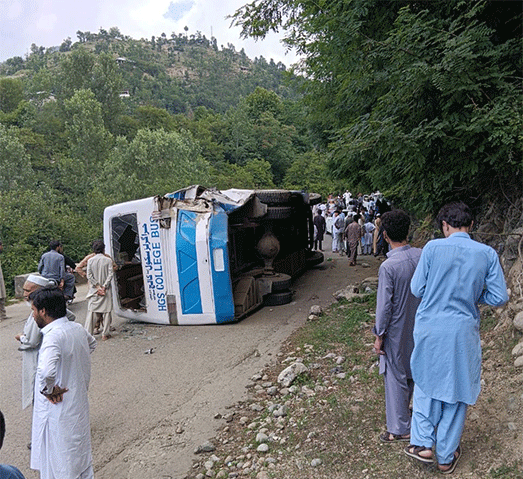
Other speakers in their lectures cited bad roads, reckless driving, overloading in vehicles and firearm injuries as the main causes of head injuries and asked the government to establish neurosurgery units at district level to provide prompt treatment to victims.
"We have only 1,500 beds, 45 neuro-surgical centres and 140 surgeons for a population of 150 million, which means only one surgeon is available for one million people in the country," said Dr Iftikhar Ali Raja in his speech.
In view of inadequate treatment facilities for patients, there was a need to prevent the causes of head injuries by educating the drivers on first-aid methods, by enforcing a strict control on overspeeding and overloading, and making fastening of safety-belts and use of helmets mandatory, he added.
Dr Raja said lack of transportation facilities to take patients to hospitals was also a problem. He stressed the need for safe designing of houses with protected boundary walls, safe windows and balconies to preempt the chances of head injuries.
He also called for regular checking of vehicles, front and rear lights, and brakes, saying that problems with vehicles lights often lead to mishaps. Prof Franco Servadei of Italy said 66 per cent of head injuries were caused by road traffic accidents (RTAs). The situation in Pakistan, he said, was no different from Europe where people sustained head injuries due to car crash, over speeding and rash driving by bus and truck drivers.
According to him, a significant decline in RTAs had been witnessed after imposition of strict penalties on overspeeding. Still, he said, victims often landed in hospitals which did not cater to such patients.
Brain injuries required multi-disciplinary treatment, which was long and expensive, he said, adding that patients also needed speech-therapy, physiotherapy and rehabilitation exercises to enable them to return to normal life.
Dr Tariq Khan, technical director of the society, said the NWFP had only five centres for head injury patients, which were not enough to meet the number of patients.
According to him, over 2,500 people admitted every month to hospitals in the Frontier province due to head injuries or spinal cord problem. Of these, he said, 70 were hospitalized due to RTAs, 80 due to roof-fall, 8-10 due to bullet injuries and 10-12 persons happened to be hit by blunt devices.
More than 50 per cent of the patients with head and spinal cord injuries died instantly, he added. Dr Khan urged the government to set up a rehabilitation centre at the paraplegic centre in Hayatabad to provide treatment to accident victims.