0
0

ISLAMABAD, March 3: Pakistan on Wednesday once again rejected outright foreign media reports insinuating that Islamabad had agreed to permit the American forces to operate on its soil for a joint get-Osama operation as a quid pro quo for the concession shown by the US over the pardoning of Dr A.Q. Khan by Pakistan president.
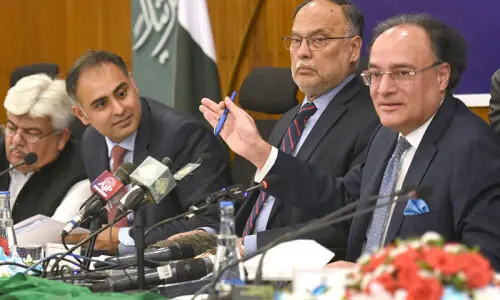
A Foreign Office spokesman asserted here at a press briefing that Dr Khan was granted only a "conditional pardon" by President Pervez Musharraf in his position as head of a sovereign state.
Moreover, the FO spokesman pointed out that the United States' "rational understanding" of the president's action was adequately reflected in a recent statement of US Secretary of State Colin Powell.
Responding to some criticism in the US Senate against the pardoning of Dr Khan, Mr Powell recalled that the president of Pakistan had explained the position of his government on the issue which had to be balanced between the two interests - the supreme national interest and Dr Khan's acclaimed stature as a "national hero" for providing the country with a nuclear weapon for its defence.
The FO spokesman also strongly denied foreign media reports that Islamabad had accepted to conduct a joint military operation in Afghanistan and Pakistan as a partner in the war on terror. Nothing of this sort would happen, he said emphatically.
He said Pakistan exclusively operated within its frontiers while the US forces as part of ISAF operated within Afghanistan. However, he added, the Pakistani and ISAF forces cooperated on "all aspects of the war against terrorism" under an established tripartite mechanism.
About the military operation in Wana, the FO spokesman said that it was an ongoing war against terrorism. He explained that special operation in Wana would be conducted when the need arose from time to time but the operation would be confined within the Pakistani territory.
He opposed a move by some European and other countries to install India as a permanent member of the Security Council, saying Pakistan did not want any new "centres of privilege" in the United Nations.
He said Pakistan's opposition to the Indian ambition was based on the principle that instead of creating new centres of privilege in the Security Council, it should be made "more representative and democratic" by creating a balance between the SC and the General Assembly since the membership of the United Nations had increased considerably in the past decades.
Answering another question, the FO spokesman admitted that several countries concerned with nuclear proliferation had been holding dialogue with both India and Pakistan, particularly since 1998 when the two South Asian neighbours became overt nuclear states.
However, that caused no concern to Pakistan, he emphasized, adding that "indeed Pakistan had also been conducting dialogue with several countries interested in the subject."
France's proposal for a security council summit which it had made recently, was under consideration and Islamabad's response was expected in due course, the spokesman said.
Replying to questions concerning Tuesday's armed attacks on Ashura procession in Quetta, which resulted in the killing of innocent people, he said the possibility of a foreign hand being behind the incident would be finally determined by the judicial commission set up to launch probe into the tragedy.
Whether there was any involvement of Al Qaeda or the Indian consulate in Afghanistan would also be looked into by the commission, he added. On a statement by the president that Pakistan would soon test-fire a missile of over two thousand kilometres range, the spokesman observed that when the president spoke himself, that should be accepted as the government's decision. But he would not say more on the subject, the spokesman said.