



 0
0

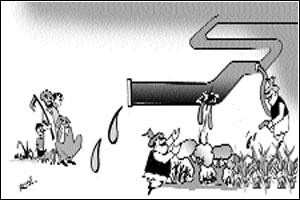 More than 80 per cent of our country is arid or semi-arid. Its entire irrigation system comprises three reservoirs: 19 barrages ,12 link and 43 main canals and 134,913 water courses.
The original storage capacity of 18.37 maf of Mangla Tarbela and Chashma reservoirs has already declined by 5.58 maf due to their silting up, thus necessitating the construction of new dams for the survival of the agro-based economy. Meanwhile, the construction of the Kalabagh Dam has been made a controversial issue — purely on political grounds rather than on technical grounds.
The same politicians who never stop protesting against the proposed Kalabagh Dam, they keep mum over the mass-scale theft and inequity of canal water distribution. The discord between the provinces over the water shortage has sidetracked the role of the irrigation departments of these provinces which are doing nothing to prevent theft of water and have been silent spectators over the inequity of water distribution at the head and tail ends. Maintenance funds are misappropriated and in many cases, lower field staff exists on paper only.
For example, in Sindh, the canal paths maintained for routine inspection have become unaccessable for inspection. This has rendered the concerned officials totally dependable on false reports of the local staff. Watercourses are tempered with broken and even open cuts made with official connivance. The ‘kutcha’ Chaab (fall-profile) crop up during night, while ‘vaderas’ and the influentials easily get authorization for concrete fall-profiles adjacent to their lands. Some even get the approval of fall-profiles near the regular heads.
One such fall-profile is located on RD5 of the Naseer wah, Ex-PFL, upper Pinyari, Kotri barrage. The fall thus constructed was a mixture of both vertical—parallel profiles clogging and silting of entire canal system.
According to the press reports, a former irrigation minister recently manoeuvred to construct a fall-profile on mile 33 of Phuleli— a small river-like canal of the Kotri Barrage. Its consequences will be very serious as the entire distribution system attached to this canal will eventually be adversely affected.
However, the victims of these illegal connections and thefts are ‘haris’ and small farmers, especially who are at the tail-ends. During my visit to Sindh as a member of the World Bank team for reviewing agricultural aspects of Second Scarp Transition Project, North Rohri Phase-1, we came across certain distributaries and minors which were in full flow at the head ends, but there was little or no water at tail-ends. Moreover, due to mismanagement, breeches of canals have become a routine matter.
Similar thefts and inequity of water distribution prevails in Punjab where influentials and feudal lords steal water and farmers at middle and tail ends suffer silently. For example, the Legharis, Khosas and Gurchanis have installed around 1200 engines along the Dajal canal by making illegal outlets depriving water to small farmers in Pachad Dhundi situated at the tail-end.
The situation has reached a point where irrigated land and green pastures of Pachad Dhundi are becoming barren and farmers have started shifting to other areas.
The irrigation department records show that there are 276 illegal outlets and on each outlet four peter engines are installed to illegally irrigate around 40,000 acres of land to render as much area barren in Pachad Dhundi and adjoining areas. A writ petition was also filed in the year 2000 in the Lahore High Court, Multan Bench, against the unlawful installation of these engines in the past. The court directed the concerned officials to remove all these unlawfully installed engines within a fortnight, but according to press reports, ‘no action was taken still September 2003’.
These poor small farmers even vote for influentials and vaderas hoping that when elected, these vaderas and influentials will solve the problems of farmers; but after being elected these vaderas get busy in solving their own problems.
The tragedy is that functionaries continue to allow these influentials in the upper reaches of canals and distributaries to temper modules for having far more water than their legal share at the cost of the water rights of the small and tail-end farmers.
The present irrigation system is a legacy of British colonial empire. It is highly centralised leaving very little scope for participation of common farmers and end-users in managing the water distribution system. On the other hand, the participatory irrigation management (PIM) is considered to be farmer-friendly system and has been successfully followed in many other countries. The basic principle of this system is to ensure the participation of water users in all aspects of water management through their organized associations.
Under the scheme, irrigation departments are replaced with more decentralized and participatory institutions such as provincial irrigation and drainage authority (PIDA) at the provincial level, area water boards (AWBs) at the canal levels and farmers organizations (FOs) at the distributary level, under the World Bank-funded the National Drainage Programme.
The main objective of this reform is to organize, encourage, and mobilize irrigation system at distributary level through the FOs. In addition to that farmers are provided representation at the AWB, PIDA and the Sindh Irrigation Authority (SIA).
The NDP was formulated as a national level programme and was expected to be implemented in all the four provinces. After its initial implementation, the province of Balochistan withdrew from it, and in spite of the World Bank warning, the province of Punjab too stopped taking any interest in the programme.
However in Sindh, in spite of the earlier commitment of replacing Sindh irrigation department with the SIDA, the Sindh irrigation department is still working as a parallel body in the irrigation sector . Consequently SIDA has failed in many cases to assert itself in spite of the SIDA Act.
Thus, the overall performance of NDP over the past several years is far below its projected development programme and thefts and inequity of water distribution continue at a significant scale.
One of the reasons being that the powerful bureaucracy does not want any change in the set-up of the irrigation department.
Then the question arises: what is the point in over-burdening the nation with a loan of $785 million for the NDP?




























