0
0

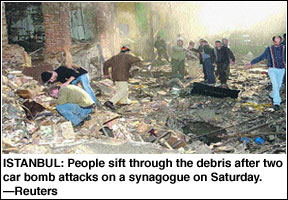 ISTANBUL, Nov 15: Powerful blasts rocked two Jewish quarters of old Istanbul on Saturday, killing at least 23 people and partly destroying the city’s biggest synagogue as worshippers were at their Sabbath prayers.
Hospitals struggled to cope with the flood of the injured. The city’s health department estimated that about 300 people had been wounded.
Both blasts went off outside two synagogues. Officials said they were probably caused by explosive-laden vehicles activated by remote control or timer.
Security officials told Anatolia news agency a security camera at one of the synagogues showed a person parking a car outside the building and leaving and then the vehicle blowing up.
Although an unidentified caller to the Anatolia news agency claimed the bombings were the work of a home-grown group called the “Islamic Front of Raiders of the Great Orient”, Turkish officials were more inclined to think the attacks were carried out by a foreign organization, perhaps the Al Qaeda network.
“It is obvious that this is a terrorist incident with international connections,” said Foreign Minister Abdullah Gul. “We are faced with a different type of a terrorist attack.”
Turkish Interior Minister Abdulkadir Aksu said the blasts may have been suicide attacks.
From Pope John Paul to Turkey’s own Kurdish rebels condemnations of “terrorism” poured in after the blasts, which shattered the tolerant cohabitation that exists between the Jewish community and Turkey’s Muslim population.
Most of Turkey’s Jews are descendants of Jews who found shelter in Ottoman-ruled Turkey 500 years ago after being expelled from Spain by the Inquisition. Many of Istanbul’s estimated 27,000 Jews still speak Spanish as it was spoken by Cervantes, the 16th century writer of Don Quixote fame.
In five centuries of history, Jews have found a relatively tolerant home in polyglot Istanbul and Mustafa Kemal Ataturk, the founder of the modern Turkish nation, also welcomed many Jewish refugees from Germany.
The Turkish government has good relations with Israel. Most of the casualties occurred at the Neve Shalom synagogue in the city’s Belogyu area, close to the Golden Horn and the cultural heart of Istanbul’s European quarter.
“The blast went off in the middle of the prayer,” said Yitzhak Haleva, the chief rabbi. “It came from downstairs. All the windows were shattered and I suddenly found myself surrounded by thick smoke. We left the synagogue and started rescuing the injured. My son Yossi was wounded.”
The blast ripped the front off the building, opened up a large crater and turned the narrow street leading to the building into what looked like a war zone.
Two bodies lay for a long time in front of the synagogue, covered by sheets of newspaper and people with mutilated legs and arms were carried away on stretchers.
Debris and the twisted wreckage of a vehicle littered the streets. Window frames hung lop-sidedly from buildings for a considerable area around and the signs from shop fronts were ripped away. “It was like an earthquake,” said one shopkeeper, covered in dust. “This is inhuman.”
The chief rabbi at the Neve Shalom synagogue told Israeli public radio that before the blast the Turkish authorities had asked him to stay at home for his safety and Istanbul’s Jewish community had been living in constant fear of being targeted.
The synagogue, opened in 1951, is the Istanbul Jewish community’s largest and most prominent building and hosts most of the big weddings and bar mitzvahs (a coming of age ceremony). This is the second time it has been bombed. The first bombing took place in 1986, killing 21 people.
At the Beth Israel synagogue, a spokesman for the rabbinate said: “The damage is extensive... The roof of one of the buildings collapsed.”
Spokesman Silvio Ovadyo said about 300 people were in the synagogue when the blast occurred. At least four were killed and about 60 injured.
ISRAEL’S CONDEMNATION: Israeli Foreign Minister Silvan Shalom reacted by urging the international community to fight against “the forces of evil”.
“No country in the world is immune to terrorism. This is why all states should fight against the forces of evil,” Israeli army radio quoted him as saying.
“We hope the international community will not be content with condemning what happened in Istanbul, but will take vigorous action against terrorism, which is a global phenomenon.” —AFP/Reuters