



 0
0

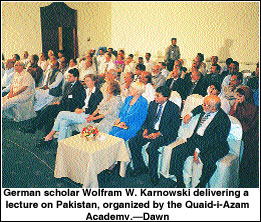 KARACHI, Oct 21: The visiting German scholar, Mr Wolfram W. Karnowski, did not agree with the perception that ‘Pakistan is a failed state’ and said that such a view would not do justice to what, in fact, this country had achieved during the past 56 years.
Mr Karnowski, who served in Pakistan as a technical adviser to a private sector insurance company many years ago, was giving his impressions as a guest of the Quaid-i-Azam Academy on Tuesday. His talk focused mainly on the perceptions about Pakistan and his own experiences.
“Isn’t it a fact that Pakistan since decades is a highly respected member of the United Nations and dozens of other very important international organizations? Then why do responsible politicians, journalists and businessmen talk about distorted pictures of today’s Pakistan, and about the necessity to give this country a second chance?
“Are they, perhaps, afraid that Pakistan, in some way, has not yet fully arrived in the minds and hearts of those public opinion framers in ministries and publishing houses in many important capitals of the world?”
The German scholar expressed great respect for the founder of Pakistan besides Sir Syed Ahmad Khan, Allama Iqbal, Nawab of Bhopal, Raja Saheb Mahmoodabad, Abbas Khaleli, and Roshan Ali Bhimjee, and referred to a recent Pakistan-German Forum meeting.
It was dominated by the theme that Pakistan is not receiving and has not been given a fair treatment by foreign news media when it comes to an evaluation of her achievements in various fields, particularly, of course, in the field of politics and economic development. Pakistan, therefore, would need to be given, as it was called, a second chance.
He was all out for giving people, and for that matter also institutions, commercial organizations or even states, a second chance if they have messed up the first one.
But he asked the question: Have Pakistan and/or her people, done something which in the understanding of world opinion is considered to be very wrong, or even criminal!? He did not think that even Pakistan’s most fierce critics have ever suggested that.
But he did agree with those who say, that many of the comments and articles appearing in non-Pakistani news media do contain a certain amount of pre-occupied anti feelings, as subtle as they may be formulated.
Perhaps, according to him, it is not too difficult to identify a few of those reasons which at surface are responsible for it: ignorance and misinterpretation of facts could be some of them.
“Look at the Kashmir dispute for instance. How many people in the world living outside the subcontinent are really aware of what happened in Kashmir after British India was divided and Pakistan created? Or, what does the world really know about Pakistan’s constructive and very positive role following the events of the defeat of the former Soviet Union in Afghanistan, and, even more decisively, the downfall of the Taliban regime and the measures it took following the September events in 2001.”
Mr Karnowski emphasized that even if one would have an answer to each of these questions and issues, would this warrant to publicly demand a second chance while the first one was still waiting to be fully availed!
What has gone wrong that after 56 years of nation-building, a nation seems to be under the impression that it still is under probation, with a worldwide crowd of examiners sitting over its head which, hopefully one fine day, may certify that now, finally, Pakistan has cleared her last papers and successfully stood the test?
Looking back now at Pakistan’s more than five decades of sovereign history, the biggest surprise, perhaps, is that her greatest success stories were written in the economic field rather than politics, he said.
He noted that young people of the country were increasingly short of patience in regard to corruption, incompetence and exploitation by any form of feudalism and nepotism. They foresee further economic development. And they look forward to creative, clean, farsighted politicians whose prime objectives are not just to satisfy the needs and wishes of their own clan and to throw mud on political opponents, blame the outside world for what goes wrong in their country, but who have clear conceptions of a Pakistan of tomorrow.
Recalling from his earlier book, he said “the battle for Pakistan, her survival and further development was so far no ‘draw’, I think. But it has not come to a winning end either, the fight is still on. The odds, however, and of this I am firmly convinced, are in her favour. Because there are sufficient ‘overs’ left to do the necessary winning runs.”
As President Musharraf recently said: “Pakistan faces no external threat,” no external threat can harm Pakistan, he said, adding “the enemy lies within.”
Earlier, Prof Sharif al Mujahid in his introductory remarks referred to Mr Karnowski’s book and said that his experience in post-war vanquished Germany enabled him to emphasize on Pakistan’s life and death struggle for survival in an extremely hostile environment during her first three years.
Prof M. Yakub Mughal said that in the post-9/11 scenario where Pakistan was targeted by the western media, the German scholar was doing a good job in removing distorted image of Pakistan.




























