



 0
0

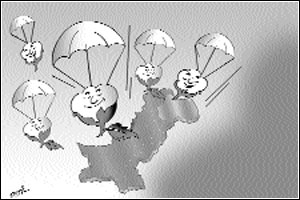 Cotton requirements of our textile industry are growing at a fast pace. There has been large-scale balancing and modernization of the industry apart from addition of new spindleage in the recent past which has considerably raised the consumption of cotton.
According to trade circles, the mill consumption of cotton has gone up from 9.4 million bales in 1999-2000 to 11.0 million bales in 2002-03 as may be seen in the following table:
The figures in the above table indicate that the mill consumption of cotton has grown at the rate of about half a million bales per year during the last four years. The cotton requirements of the mills are being placed at 12 million bales in the current season and around 15 million bales after the year 2005.
As against the fast growing cotton requirements, the local production of cotton has stagnated around 10 million bales (ex-gin) during the last four years as may be seen in the following table:
The growing imbalance between demand and supply of cotton has necessitated imports which have gone up from 0.5 million bales in the year 1999-00 to 1.6 million bales in 2001-02 and 1.1 million bales in the year 2002-03 as indicated in the following table:
We have been hearing a lot about the increase in production of cotton and the evolution of better varieties of cotton. But the fact is that a surplus cotton-producing country has been reduced to a net cotton-importing country and we have miserably failed to maintain an equilibrium between demand and supply of cotton. Surely, something is wrong somewhere.
This fast growing imbalance between demand and supply should be an eye-opener for the policy makers and planners and reasons for our failure in this regard should be identified and corrective action should be taken.
For instance, our yield per acre at around 550 lbs. of lint is still very low being one-third of what it is in countries like Australia and Israel. While we may not be able to achieve the yield per acre in the above mentioned countries but we can surely increase it considerably if high yielding varieties of cotton with high ginning outturn are evolved without compromising the desired characteristics of cotton like micronaire, staple length, strength, etc.
A serious neglect on the part of concerned authorities is that they have failed to introduce bt cotton while India has already introduced it in 37 districts and 60 per cent of the acreage in the USA, China and Australia is said to be under bt cotton because it protects cotton from boll worm attacks, economises in the use of pesticides and considerably increases the yield per acre. It appears that seed mafia is too strong to allow the introduction of bt cotton and they appear to have convinced the concerned authorities in a negative way.
Cotton is the backbone of our economy and in fact, Pakistan is a mono-commodity country very heavily dependent on cotton. No price is too great to develop this sector of the economy. In terms of importance, it should rank second after defence and accordingly large financial allocations should be made to achieve self-sufficiency in production of cotton.
The Nuclear Institute of Agricultural Biology will have to come up to the expectations of the nation by evolving a miracle cotton variety. Efforts should also be made to introduce extra long staple cotton in suitable climate zones. Corporate cotton farming should also be encouraged. Apart from concentrating on intensive cultivation, attention should be paid to extensive cultivation by bringing more acreage under cotton in new and non-traditional but climatically suitable areas of Balochistan and NWFP. However, the development of new cotton areas will require an active role for TCP to procure the lint cotton produced in such areas at least in the initial years to encourage such venture. If we do not act now and do not take corrective action it will be too late.




























