0
0

PESHAWAR, Oct 11: The Pukhtunkhwa Milli Awami Party said on Saturday that its political struggle was aimed at achieving maximum national autonomy for the Pukhtun nation rather than seeking a separate geographical unit for them.
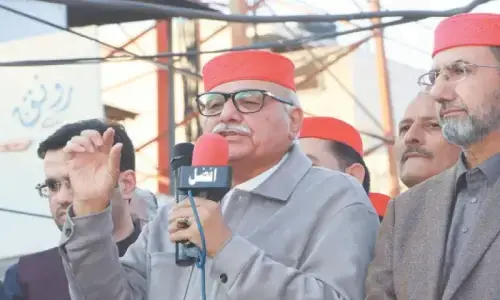
Speaking at the national convention of the Pukhtun Students’ Organization at the Nishtar Hall, PMAP Chairman Mahmood Khan Achekzai said his party was struggling for a better future for the Pukhtuns of the north and south Pukhtunkhwa, the tribal belt and parts of Punjab along river Sindh.
Delegates of local and foreign students’ organizations also attended the first session of the two-day convention.
Mr Achekzai said: “We don’t want to break the country, instead we want to live like free people within Pakistan. We are opposed to every form of servitude in the name of religion or the nation. We want our rights and authority on our resources for the betterment of our people. We hold good wishes for other people living in Pakistan. We pray for their prosperity and happiness.”
The Pukhtun youth, he said, would fight as the vanguard of their national movement as the state of affairs had put a great responsibility on their shoulders to meet the future challenges.
He advised the youth to equip themselves with modern technological and scientific knowledge. He said a meaningful education system, reflecting the aspirations and requirements of the people, was the need of the hour.
The PMAP took politics as a struggle against oppression, he said. He said politics was not a game of sentiments, as propagated by some non-political entities, but a way of national and social service.
He advised the students to play their due role in the national affairs.
He said all the local languages spoken from Kohistan to Quetta were dear to him and all the ethnic groups residing with the Pukhtuns would enjoy equal rights in the Pukhtunkhwa.
Referring to the role of the bureaucrats, newsmen, politicians and judges, he said all the four pillars of the state were about to collapse.
He said the PMAP opposed the intervention of the armed forces and their agencies’ network in political affairs.
Besides the powerful Central Investigation Agency, the United States had one of the biggest armed forces, but no US citizen was ready to give a political role to the military generals and the spying agents, he said.
He said the armed forces had no political role to play in the country.
They were doing unconstitutional and illegal acts in the name of national security, he said.
He flayed the arrest of Wazir tribesmen in Southern Waziristan and urged the government to release them forthwith.
He denied that the Pukhtuns had been involved in any ethnic or sectarian violence in Pakistan or Afghanistan.
The Sikhs, Hindus and Parsis had been living with the Pukhtuns in all parts of the Pukhtun lands, but they had not been killed on ethnic or religious basis, he said.
The PMAP chief said his party was against the construction of the Kalabagh Dam and termed it a dacoity upon the river water of the northern Pukhtunkhwa.