0
0

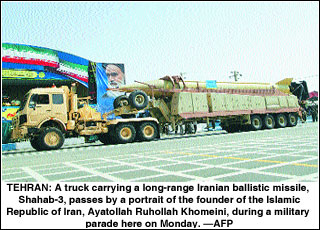 TEHRAN, Sept 22: Iran marked the anniversary of the outbreak of its long war with Iraq on Monday with a powerful display of military might, showing off its latest ballistic missiles sporting anti-Israeli and anti-US slogans and vowing not to back down to mounting pressure over its nuclear programme.
In a military parade kicking off “Sacred Defence Week,” seven of the Islamic republic’s new Shahab-3 missiles were rolled out on mobile launchers.
The sand-coloured Shahab-3 ballistic missiles, towed along to the accompaniment of rousing military music, were the climax of a lengthy march-past to commemorate the start of the bloody 1980-88 Iran-Iraq war.
In September 1980, Iraqi forces invaded south of Iran and started a devastating war which continued until Aug 1988, when a United Nations-brokered ceasefire was accepted by both sides.
The war killed hundreds of thousands on each side and according to Teheran, the war inflicted damages of 1000 billion US dollars on Iran, including the country’s strategic infrastructure complexes.
According to a commentary given over loudspeakers lining the parade route, the missiles have a range of 1,700 kilometres and are capable of hitting the heart of the enemy, an AFP journalist at the scene said.
Addressing the crowd gathered at the parade area, just south of the Tehran near the mausoleum of Iran’s Islamic Revolution leader Ayatollah Ruhollah Khomeini, President Mohammad Khatami stressed the need to boost the country’s defences.
“Even if we don’t give a pretext to the enemy, they will find one,” said Mr Khatami.
“Despite all the pressure from our enemies, we will pursue our policy of detente, but we also insist on becoming stronger — militarily, politically and economically.
“We are ready to defend our country. Whether in organization, strategy or material, the armed force have reached self-sufficiency and will not allow anyone to threaten our land, our nation, our people, our sacred revolution or our values,” Mr Khatami declared.
But the president also reiterated denials that the country was seeking to acquire nuclear weapons, amid United States-led charges that the country was using an atomic power project as a cover for developing the bomb.
“We are opposed to the spread of weapons of mass destruction and the very existence of atomic weapons,” said Mr Khatami, whose country has been slapped with a deadline from the UN’s International Atomic Energy Agency (IAEA) to account for its suspect civil nuclear programme.
Mr Khatami echoed widespread anger here over the IAEA’s Oct 31 deadline, contained in a resolution passed on Sept 12 that calls on Iran to answer all the agency’s questions regarding its enrichment activities, provide unrestricted access to UN inspectors and a detailed list of its nuclear-related imports.
Many officials here have presented the resolution as an effort to scupper the development of civil nuclear technology, with some going as far as to advocate pulling out of the nuclear Non-Proliferation Treaty (NPT).
“We will not renounce our right to become stronger in the domains of science and technology,” Mr Khatami said to the gathering, which featured thousands of troops, tanks, missiles, helicopters and jets.
“The Iranian people, who are pacifists and have a love of justice, have always said their military strategy was defensive and that they do not want weapons of mass destruction. Yet it is they who are subject to international pressure by those who support Israel — the centre of terrorism and weapons of mass destruction,” the president said.
“It is the Zionist regime which possesses considerable atomic arsenal and uses the worst forms of terrorism in Palestine while we are partisans of peace, stability and a region free of atomic weapons,” he added.
The development of the Shahab-3 missile has sparked alarm in Israel, which shares US suspicions over Iran’s atomic activities.
A final test of the Shahab-3 — which brings Israel well within range of the country’s armed forces — was conducted earlier this year.
On July 20, Iran’s Supreme Leader Ayatollah Ali Khamenei presided over a ceremony that saw the missiles handed over for operation to the elite Revolutionary Guards, the ideological spearhead of the 25-year-old Islamic regime
IRAQ SITUATION: Mr Khatami said it was still not too late for the United States and Britain to withdraw from Iraq to avoid further crisis in that country.
The Iraqi people themselves could decide their fate if coalition forces were to leave, Mr Khatami said.
Mr Khatami recalled that 23 years ago, Iraq, with US support, tried to topple the Islamic Revolution of Iran by invading the country. He said it was now clear what happened to the Baath regime of Saddam Hussein and even to the Americans.—Reuters/AFP/dpa