0
0

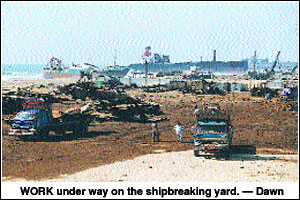 KARACHI, Sept 15: While successive governments have willingly pocketed the large sum of money earned by the shipbreaking industry on the Gaddani beach in Balochistan over the years, they have done little to better the lot of those associated with the trade.
Locals point out that the government seems ill prepared to tackle more business that the ship-breakers at Gaddani might obtain because of the ban on single-hull vessels.
In 1999, the Maltese-flagged oil tanker Erika collapsed. Erika was a 25-year-old single-hull vessel, chartered by oil company TotalFina. It leaked more than 10,000 tons of heavy oil, polluting 400km of the coast of Brittany in France. After this accident, the International Maritime Organization decided to phase out all single-hull oil tankers. A large number of these single-hull vessels could end up at the Gaddani beach where they would be broken up for scrap.
Locals told Dawn that no government agency had done anything to provide civic facilities to those associated with the shipbreaking trade as well as those living near the Gaddani beach.
“The shipbreaking yard, which has about 127 plots where vessels could be beached, is at a distance of 42 kilometres from Karachi. All the same, the area is not given enough electricity to run industries. Isn’t it ironical that the Hub Power Company, which generates more than 1,200 megawatts, is just at a distance of 12 kilometres? There are no streetlights along this beach,” they said.
Uzair Khan, a 50-year-old Kohati-born upstanding Pathan, told Dawn that accidents occurred frequently at the shipbreaking yard. “There is no hospital in the area. We have no option but to rush the injured first to Hub Chowki for first aid and then to Karachi for comprehensive treatment. We lost many skilled hands because of the absence of health facilities at Gaddani,” he said.
The Gaddani beach in Balochistan — the province with the largest natural gas reserves in the country — has no gas connections.
According to the locals, while most government organizations procure their contributions from the area, they do nothing for the residents of Gaddani. “The Balochistan Development Authority charges ship-breakers Rs22 per ton. This enables the BDA to earn a lot of revenue despite the fact that the shipbreaking industry has been in recession for quite some time,” they said.
Environmentalists have been drawing the attention of the government towards the hazards ship-breakers expose themselves to. They point out that in the 1970s shipbreaking was concentrated in Europe. Performed at docks, it was a highly mechanized industrial operation. But the costs of upholding environmental, health and safety standards increased. So the shipping industry moved to poorer Asian states.
The environmentalists say that a lot of ships end on the once pristine beaches of India, Bangladesh, China, Pakistan and Turkey. Workers there scrap the ships without any protection. Toxic waste is released into the environment.
An official of Osman Enterprises, the firm which will dismantle the second-largest vessel in the world over the next four months, insists that ship-breakers ensure that the process poses no threat to the environment.