EU takes advantage of Africa’s weakness to impose conditions
NAIROBI: The European Union is taking advantage of Africa’s weak bargaining power to bloat the list of conditions — attached to development aid — with further demands.
Washington Akumu, a senior economic writer and columnist with a Kenyan newspaper, says most of the EU conditions border on tokenism and “the urge to be perceived as politically-correct among the community of nations”.
“Time and again, the West and the EU in particular has supported and traded with African states not on the basis of their adherence to good governance, but in the pursuit of their own overbearing self-interest,” he observes.
“Nothing can become of these conditionalities unless the EU assists African institutions like the AU (Africa Union) and NEPAD (New Partnerships for Africa’s Development) to develop monitoring mechanisms that work. In any case, they are nearer to the ground and have relatively cleaner hands,” remarks Akumu.
Job Ogolla, of the Nairobi-based Africa Economic Research and Development Consortium, contends that some of EU’s terms, such as involving civil society and faith groups in projects proposal writing, are welcome, since they are meant to guard against corruption by governments.
“The government is placed on check right from conceptualization of ideas to proposal writing. When the proposals are approved and money sent, other parties, apart from the government, will be aware of it and chances of squandering it are therefore reduced,” he says.
“But some of the EU terms require change of legislation and establishment of new institutions. This might not be an easy task for recipient countries,” notes Ogolla.
EU has often demanded privatization, procurement laws and civil service restructuring as conditions for providing aid to developing countries.
The EU has maintained that economic and institutional reforms are necessary to attract international funding, and has been asking recipients to intensify the reforms to boost investor confidence.
More than 50 per cent of EU’s support in Africa targets the creation of a favourable and sustainable environment for private sector participation to revitalize economy, complains local development officials.
Road infrastructure, tourism and trade are some of the key areas the union looks at in regard to boosting economy.
Ogolla has accused the European Union of manipulating Africa when it comes to trade. “They tell us that we will enjoy non-tariff rate for our raw materials getting into the European market. When you look at this critically, Africa is condemned to remain a raw material economy, because it supplies the west with raw goods, the west manufactures and exports the goods back to Africa, which is not right,” he says.
Some African countries have disagreed with EU officials over aid sanctions. Last year, Kenya fell out with European Union, one of her key development partners, over contents of a draft copy of a “country strategy paper”, which spelled out aid terms.
The paper, prepared by the local EU delegation, spelled out unattainable conditions in exchange for aid.
Government officials insisted that the terms were humiliating and touched on sovereignty.
The disagreement happened after 10 years of “donor boycott” but Kenya never went on bended knees. During that period, the plunder of the country’s economy by its leadership was at its best. “We suffered an economic melt-down but survived because of the resilience of the people,” Ogolla says.
EU has frozen aid to countries accused of human rights abuses and some African nations have fallen prey.
Donor funds to Zimbabwe, for example, have been frozen due to, among other things, its policy on land, where farms owned by 4,500 white commercial farmers have been parcelled out to landless black people.
In July, the European Union froze development aid, running into “hundreds of millions of euros”, to Africa over the insistence that Zimbabwean President Robert Mugabe attend meetings between EU and Africa.
Mugabe has been banned from travelling to Europe in accordance with EU sanctions, but African leaders say Europe could not dictate who should attend meetings.
The first EU-Africa meeting was held in Cairo, Egypt two years ago. This year’s meeting was supposed to take place in Lisbon, Portugal.
EU spokesperson Michael Curtis indicated that despite the cancellation of the meeting, dialogue will continue between the union and African countries, most of which share a lucrative multi-billion Euro aid and trade deal with the union.
The EU work with Africa through the Cotonou Agreement, whose main objective is to alleviate poverty through increased and better-targeted aid, a new trade partnerships and political dialogue.
The agreement was signed in Benin’s capital, Cotonou, in June 2000, and links 77 countries in Africa, the Caribbean and the Pacific (ACP) with the 15 EU member states. The agreement, which provides the framework for EU’s cooperation with the ACP countries, also seeks to liberalize trade between the two blocs.
France and Germany, two of largest countries in the 15-member EU followed in the Union’s footsteps by increasing the financial assistance they give to Africa.
Germany, Europe’s biggest economy, has granted an additional 215 million euros to fight HIV/AIDS on the continent, in addition to 300 million euros it has already pledged to international health funds operating in Africa.
French President Jacques Chirac said Paris would also triple its contribution from 50 million euros to 150 million euros. Aid to sub-Saharan Africa fell from $16 billion in 1996 to $12.7 billion in 2000.
Oxfam, the largest British charity, says aid spending in Africa needs to increase at least $25 billion a year if the region is to meet the intended target of halving the number of people living on less than a dollar a day by 2015.—Dawn/The InterPress News Service.
More autonomy for smaller provinces: Asfandyar Wali
ISLAMABAD: The following is the edited text of the Dawn Dialogue interview with Awami National Party (ANP) president Asfandyar Wali Khan:
QUESTION: The ANP was a leading party in the NWFP but in the last general elections it could not send even a single representative to the National Assembly. What was the cause of this defeat and what are your plans to rectify the situation?
ANSWER: It is a fight between a human being and an angel and, of course, the angel is always going to win instead of the human being. I resigned as party president, and in spite of all the reservations I had regarding the conduct of the elections, I want to turn a new leaf in the political spectrum, and I will not say that rigging has taken place. I accepted complete responsibility and I resigned. It was, yes, an engineered election.
Q: Who were the angels?
A: If you have lived in Pakistan for 56 years and you don’t know who the angels in Pakistan are, then I don’t know.
Q: You mean the elections were engineered to bring the MMA into power?
A: Yes, the elections were engineered to bring the MMA to power. There are two aspects to the whole thing. If you look at the overall scenario that has emerged after the elections, all forces that worked for provincial autonomy got hit the most. Two, how would they tackle the fundamentalists except by bringing them to power, knowing that whoever comes into power can never ever live up to the expectations of the people because we don’t believe in collective things. We believe in personal things, personal postings, personal jobs and things like that. No government is in a position to deliver. So what better way then......
Q: Have you any plans to restore your party’s position in the next elections?
A: Yes, we are working on that. I think the biggest sign you can have is that (former ANP president) Ajmal Khattak has come back, saying it was a mistake to part ways. Human Rights Commission of Pakistan president Afrasiab Khattak has also come back to the party. So we are surely working on getting all the people back on the same platform.
Q: Are you satisfied with the present state of the Pashtuns and provincial autonomy?
A: No, no one can say he is satisfied with the way the federation is being run or that powers have been transferred to the provinces. Until and unless smaller provinces have a sense of participation in the body-politic of Pakistan, I feel we will be heading in a very wrong direction. Nuclear power will not put the country together.... It will be done by the nation. Whether we like it or not, it is a fact that Pakistan is a multi-ethnic and multi-national state. The rights of the nations, or nationalities, or whatever you call them, have got to be protected. Are they protected today? The three provinces, or provincial assemblies, passed unanimous resolutions against the Kalabagh Dam - that is consensus. When we passed the resolution, the PML, the JUI, the Jamaat-i-Islami, the People’s Party all voted against Kalabagh. But one province insists on Kalabagh. And you have heard President Musharraf saying “today or tomorrow, Kalabagh Dam will be built”. Now what is the message?
Q: You mean to say he advocated the interests of the larger province?
A: Yes, of course. We in Pakistan have never ever differentiated between morality and legalities. We have gone in for legalities, and never cared for morality. And I feel morality is more important than legalities. Morally, the president represents the federation of Pakistan, all the four federating units. How does he then turn around to the smaller provinces and say whatever you are saying is rot, I don’t give a damn?
Number two, a few days back you must have heard that we were putting a ban on wheat going into the smaller provinces, specially the NWFP. And what do they say? We ban wheat because wheat will be smuggled out. When a smuggler can take out wheat, why can’t he take out flour? Are there not enough forces with the state of Pakistan to control smuggling? No, we are being supplied flour instead of wheat so that even the few flour mills we have in the province are today shut because they don’t have wheat. How, then, can I say that the smaller provinces are satisfied? FATA means Federally Administered Tribal Areas. It is not a provincially administered tribal area. Now when I sit down with Wapda, at source they deduct all electricity charges of Fata from my province. Why should I be responsible for the liabilities of Fata when I do not have rights over it? Let the federal government pay its bills.
We fought the elections on two fronts. We used to say all right we are fighting for the rights of the province and for the wealth that belongs to this province, and it is somewhere else, and we want to bring that wealth back. The MMA said no, the elections are a fight between Islam and ‘kufr’. I think in the parliamentary history of the world, (it is) the first instance when during the last budget session (of the NWFP assembly), the parliamentary party leader of the ANP got up and moved a resolution that because there had been no NFC award, the budget should not come. And as a protest I walked out. Except for the speaker, the government and the opposition combined walked out. That shows where the sentiments of the political entities are.
And then one point I will really want to put across is that when I fight for the rights of the provinces, for provincial autonomy, for transferring powers from the federation to the provinces, will that power also not be transferred to Punjab? It is not only our battle. It is the battle for all the provinces that we are fighting. The same powers will be transferred to Punjab, and it should feel happier because due to more financial autonomy, they will have more money in their own kitty.
Q: If there are constitutional amendments, would you like to plead for more provincial autonomy?
A: At a recent seminar in Islamabad, I asked (former law minister) Abdul Hafeez PirzadA: You say that the 1973 Constitution was unanimous (but) was it unconditional or was there a condition? Mr. Pirzada said, yes, there was a condition because the smaller provinces were not satisfied with the quantum of autonomy given in the 1973 Constitution and we asked them that because of the conditions of the country and dismemberment — Bangladesh coming into being and all that — let us pull on for 10 years after which we will reopen the subject of provincial autonomy. He said that was an agreement. Because of that agreement the opposition agreed to sign the Constitution.
Q: Was it a verbal agreement?
A: Yes, it was a verbal agreement. Mr Pirzada said after 10 years we were not there, it was General Zia-ul-Haq sitting there, and the chapter was closed. Now, leave the story aside, everyone of you must remember the speech given by General Musharraf when he said there is a sense of deprivation in the provinces and I want to remove that. Today, powers have devolved from the provinces to the districts but the second phase still remains - where power from the centre is going to be devolved to the provinces.
We were fighting over the part of the Constitution that related to provincial autonomy when (former National Reconstruction Bureau chairman) General Naqvi came and handed over the little powers that the provinces had to the districts. Devolution everywhere has got to start from the top and then starts coming down.
Q: Have you any plans of merger of nationalist or Pashtun- based parties standing for provincial autonomy?
A: Why confine it to the Pashtun-based parties? Let us face facts. If elections are held in the country tomorrow, there will be a government either of the PPP or the PML. Why can’t you face facts?
Q: What is the hurdle in the ANP joining the ARD?
A: We were one of the founding members of the ARD, and the second or the third point of the nine-point agenda was maximum provincial autonomy within the ambit of a federation, and we had a big row then. There were certain people who said no provincial autonomy (should be) within the ambit of the 1973 Constitution, and we said no, it should be within the ambit of a federation. Now we have asked the ARD to sit down with us. I know we will today share our fight. But to be very frank, the fight for democracy in Pakistan is a fight for Punjabi domination.
Q: Why not Sindh, if Benazir comes into power?
A: No, I am not talking about individuals. The provinces are made up in such a manner that Punjab has the majority. Punjab on its own has the majority in the (lower) house. Now we just want them (the ARD) to sit down with us and further clarify as to how much provincial autonomy they are prepared to give us.
Q: Are they not prepared to tell you about it?
A: No, we formed committees, but these days they are more and more engaged with other things. I think after that (there will be some progress).
Q: What are your comments on Pashtun leader Mehmood Khan Achakzai’s proposal for the creation of a Pashtun province including Pashtun areas of the NWFP, Balochistan and Fata?
A: The ANP has always said that there should be re- demarcation of the provinces on the basis of language, culture and history. This is part of our manifesto.
Q: So you would like to have one province having some areas of the NWFP and Balochistan?
A: Yes, certainly. What we have suggested at the central executive of the party is that a referendum should be held in the Pashtun belt of Balochistan and in Fata and let the people of those areas decide. Suppose if Fata wants a separate province - it has enough population for that - it should be a separate province. But it is the right of the people to decide. If you are fighting for the rights of Kashmiris, how can you deny your own people the same right?
Q: Do you subscribe to the view that there should be a Seraiki province?
A: We are the only political party which... treats Seraiki (areas) as a separate province.
Q: There used to be talk even in the NWFP that the whole of the Frontier is not ethnically Pashtun. There are other ethnic entities also there. What do you say?
A: Yes, if they want to join someone else, I do not have any objection. Let those people decide. But what is the percentage (of those people)? In Balochistan, what is the percentage of the Pashtuns and Baloch? Is it still not called Balochistan? What percentage of Baloch lives in Sindh? What about the areas of Punjab like Dera Ghazi Khan and Rajanpur? Are they not Baloch?
Q: Do you see any chance of the ongoing LFO controversy being resolved to the satisfaction of both the parties?
A: The only problem that I feel with the LFO is the ego problem of all parties involved. The ego problem is there, and we have to overcome our egos. Our stand is that we only accept those amendments to the Constitution which come in a manner which the 1973 Constitution prescribes. After the LFO comes to parliament, then issue by issue the ANP will get up and vote for it. They say the Supreme Court has given them power. Does the Supreme Court itself have the power to amend the Constitution? Let parliament decide, two-thirds of both the houses.
Q: How do you see the performance of the MMA government in the NWFP and what are your chances in the next elections?
A: The MMA government, I feel, is today fighting my political battle and not its own political battle. If you look at the Shariat Bill they have presented, it is an exact replica of the 1991 bill presented in the National Assembly by Mian Nawaz Sharif. Today they are fighting for provincial autonomy, which is a political fight and not a fight between Islam and ‘kufr’.
Q: What do you feel about the Hasba Act which the MMA wants to bring?
A: We have studied the Hasba Act and we will oppose it because it sets up an absolutely parallel judiciary and police force. The district mohtasib, or whatever you call him, will decide a certain case and you will not be able to go to any court of law against it.
Q: What is your comment on the situation in Afghanistan vis-a-vis border clashes with Pakistan?
A: If you pick up the British-era Durand Line border demarcation, the Gundamak Treaty, there are two basics you have to keep in mind. The Durand Line is not a line that has been drawn; you cannot say, here, A to B is the Durand Line.
Q: What should be done to create confidence between Pakistan and Afghanistan?
A: We in Pakistan want to continue the status quo. Our political leadership does not have the political will or the political courage to solve issues. That is why issues keep building up and are becoming bigger and bigger. The Afghan government is claiming that people from this side of the Durand Line are coming across and creating problems and then coming back. You have got to satisfy them that this is wrong.
Q: Do you agree with the US and Karzai government views that the Taliban are operating from here?
A: They are operating, that is what I am saying. If they are saying it, why can’t the government of Pakistan put its own word across to them, that, look, we are not involved. Is anything hidden these days? The amount of satellites that are up there, everyone knows what is taking place.
Q: Why can’t your party still play a role for Pashtuns who became victims of the operations in Afghanistan?
A: Whatever little contacts we have, we are working for them. All Pashtuns are Afghans but all Afghans are not Pashtuns. This is a fact. Tajiks, Uzbeks, Turkmen, and Hazaras are also Afghans. Now if you start thinking on those lines that the Turkmen of Afghanistan join up with Turkmenistan and the Uzbeks with Uzbekistan, and the Tajiks with Tajikistan...on the lines of a division of Afghanistan on ethnic or linguistic basis, Pakistan will not survive then. Then the Pashtuns of Afghanistan will look around and say all right when the Uzbeks, the Tajiks, and the Turkmen have gone, where are the other Pashtuns which we can join now? And this is a very dangerous game that is being played. Today, our government — our information minister time and again — is raising this question of Pashtuns and non-Pashtuns in Afghanistan. Suppose tomorrow the government of Afghanistan turns around and it takes up this issue of Pashtuns and non- Pashtuns in Pakistan, how would you feel about it? They had lived together for centuries. For centuries, the Oxus has been the border. Their Uzbeks, their Tajiks, their Turkmen and their Hazaras, across the Hindukush you don’t have any Pashtun, except the Pashtuns who were taken there by Sardar Daoud Khan to be settled in Kunduz and Asadabad. So today if Pakistan or the government of Pakistan works on the lines of dividing Afghanistan on ethnic and linguistic basis, the repercussions are going to come to Pakistan. That is a very dangerous game.
Q: Don’t you think the Northern Alliance was behind recent anti-Pakistan demonstrations in Afghanistan?
A: How many Northern Alliance people are there in Kandahar? Kandahar is a 100 per cent Pashtun city. If it had happened in Mazar-i-Sharif, then you could have blamed the Northern Alliance. Why is it happening? That is my question to you. Why do we have to blame someone else for everything? Jalalabad is a 100 per cent Pashtun city.
Q: Do you see prolonged tension on the Pakistan-Afghan border or can there be a solution to this issue?
A: I hope these issues are resolved. If you sit across the table, there is no issue you cannot resolve if you have political will and political courage. More importantly, you need the political courage to sit across the table with someone and accept the facts, with both saying that this is what we did wrong, we accept it and it will not happen again.
Q: Is the issue at present only in Mohmand Agency?
A: That is the volatile area today, but trouble is not going to be confined to it. If you don’t resolve it, it is going to spread.
Q: What are your views about the current peace efforts between India and Pakistan?
A: We are the people who have always been dubbed as enemies of Pakistan because we used to say that we should sit down with India and talk to them. Some called us rebels, some dubbed us enemies of Pakistan, and some dubbed us as enemies of Islam. Today, I am happy to see people across the political divide, saying sit down for a dialogue with India. Now at least that one charge that used to be heaped upon us is gone. Do you accept Kashmir as a political issue or not? And can you give me a single instance in history where a political problem has been solved militarily? Did you not go for a dialogue in Tashkent in 1966? Did you not go to Shimla in 1972?
Q: Some western powers say the UN resolutions on Kashmir are now obsolete.
A: Before going to Shimla, Zulfiqar Ali Bhutto got a vote of confidence from the National Assembly. When he came back, the Shimla Accord was put before the National Assembly, which unanimously approved it after discussing it clause by clause. We think the Shimla Accord is a binding document till the day you once again bring it to parliament and let parliament throw it out. The Shimla Accord says bilateral talks should be held to settle disputes with India. The Shimla Accord and the Lahore Declaration are two completely different things. Basically, the purposes are the same. But the Lahore Declaration was between the two prime ministers while the Shimla Accord - that is what I want to emphasize - is an accord that has been approved by your parliament.
Q: Did the Indian parliament also approve the Shimla Accord?
A: Yes, it was presented before both parliaments and both unanimously approved it.
Q: What do you think are the hurdles in the implementation of the accord?
A: There are forces, very powerful forces, on both sides of the border which do not want peace.
Q: Can you identify those forces?
A: They are there in civil society, in the military bureaucracy, and in the civil bureaucracy. Everywhere, you have forces that are not prepared to let the two countries move along.
Q: There are complaints that our intelligence agencies are interfering in politics and have been manipulating elections. Do you subscribe to that view and is this practice continuing?.
A: Governments have been formed but power has never been transferred. When Benazir got power in 1988, she had to accept Ghulam Ishaq Khan as president and Sahabzada Yaqub Khan as foreign minister. If newspapers say that senior officials of the ISI have been sitting in on the dialogue between the ruling party and the MMA, don’t you think that it continues?
Q: Do you believe an agreement reached between the government and the MMA (in these circumstances) will be acceptable to the people?
A: Once it has the backing of parliament, once an amendment comes the way the 1973 Constitution has said, then the people will accept it.
Q: Anything else you may wish to say?
A: Yes, if the president of America can get up and say that I am proud of being an Irish American, why can’t I get up and say I am a Pashtun Pakistani? Why am I abused when I say this? I am a 7,000-year old Pashtun, no one can deny this, but when I say I am a Pashtun Pakistani, I am abused. There is a need to change this trend. Number two, if I oppose an individual, that does not mean I oppose the state. These two are basics that I think we will have to accept today.
Q: What are your specific demands on provincial autonomy?
A: Our demand is that the concurrent list should be finished off. The ANP says four subjects — defence, foreign affairs, which includes foreign trade, communications and currency - should remain with the centre and the rest should go to the provinces. I have a province which has a very small agricultural percentage — minerals and natural resources, that is what I have... (and they) are part of the federal government. The only agriculture product I have is tobacco. Now according to official figures for last year, the excise duty on tobacco was Rs 38 billion. That is taken by the federal government and put into the divisible pool. Why not then put excise duty on cotton, rice, fruits (and)... all agricultural crops and let all of it come into the divisible pool so that I get a share of the cotton produce of Punjab and Sindh? Although I produced 25 per cent of tobacco, my excise duty is put in the divisible pool. That is where I feel we are being hit.
The interview panel comprised Raja Asghar, Ahmed Hassan and Amir Wasim.
Consensus or controversy?
IN the backdrop of the Kalabagh dam controversy, Kawish writes that the government has launched a campaign to evolve a consensus on the disputed water project. President Gen Pervez Musharraf is holding meetings with irrigation experts, farmers and leaders of public opinion in Sindh and the Wapda chief also has invited experts to present their objections on the issue. On the other hand, efforts are being made to find a short cut to get the project approved and bypass consensus among the smaller provinces.
According to this strategy, the daily says, preparations are being made to discuss the project in the National Security Council instead of the Council of Common Interests. The CCI is the suitable forum to settle disputes among the provinces, but its formation has been delayed for the last several years.
The paper advises the government to refrain from taking the Kalabagh issue to the NSC as its approval will not lend the project legal or public acceptance.
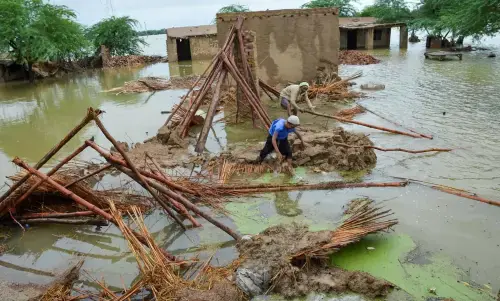
Referring to the relief operations in the rain-hit areas of Sindh, Sindhu points out that the district Nazims have rejected the relief committees formed by the Sindh government. At a recent meeting with the provincial chief secretary, the Nazims of Badin, Dadu, Khairpur and Sanghar complained about political interference in the relief bodies, nepotism in relief distribution and non-cooperation of the district coordination officers.
The paper says that the stand of the Nazims suggests that relief is not being provided to the deserving people which is also evident from the holding of protest demonstrations by the affected people.
Sindhu refers to press reports that relief goods are being embezzled and urges the Sindh government to initiate an investigation.
Koshish laments that no efforts have yet been made to contain the spread of gastroenteritis in the rain-hit areas though the death toll is rising. It says that the failure to provide clean water for drinking purpose is contributing to water-borne diseases assuming epidemic proportions, particularly in the Badin district where the closure of canals for fear of breaches has left the population with no option except consuming polluted water from Sim drains.
The daily says that the irrigation, public health engineering and health departments should wake up to the situation.
Referring to the expected recruitment in provincial government departments, Awami Awaz proposes that age relaxation should be announced for candidates as a large number of them have crossed the prescribed limit due to the ban on the recruitment for a couple of years.
Sach welcomes the settlement of the Nareja-Jagirani dispute and calls on other tribes and communities of Sindh to follow suit as tribal feuds are leading Sindhi society towards collective suicide.
Sensitizing police to human rights abuses
LAST Friday, a manual for sensitizing police officers to violence against women was launched at a ceremony in the Capital where the adviser to the prime minister on women development was the chief guest. The manual, written by the superintendent of police, Islamabad, aims at increasing police officers’ awareness of their responsibility in protecting women.
The manual is a commendable effort, but it would appear that the police needs to be sensitized not only to violence against women alone but to violence against people in general. Given the number of reports in the press about police torture and worse still, torture to death while in police custody, a manual sensitizing our police officers to the basic principles of human rights is equally if not even more needed.
Despite a conscious effort by the government in recent years to increase the efficiency of the police, the latter’s image does not seem to have improved much. The common man’s perception that the police more often terrorize the victim rather than going after the criminal is best illustrated in the recent report in Dawn about a couple who was kidnapped outside Aladin Park in Karachi and the woman criminally assaulted. The couple feared going to the police because they felt this would only mean jumping from the frying-pan into the fire.
The common man’s fear of the police was also aptly portrayed in a skit in a programme over one of the satellite channels on Independence Day. A good Samaritan, who helped a man who had been beaten up by bringing him to the hospital, was himself detained and tortured by the police for beating up the man. The next time he saw a man lying injured on the roadside, he looked the other way and didn’t do anything to help for fear that he would be victimized by the police again.
Reports in the press about police torture are still aplenty, despite much hype by the authorities about improving the working of the police. The latest victim of police torture within the locality of the twin cities is a taxi driver who had been taken into police custody on suspicion of being involved in stealing cars. He is now lying in the Pakistan Institute of Medical Sciences (PIMS), unable to pass urine or motion due to serious injuries sustained during torture.
In July, there were at least two reports of illegal detention and torture in Rawalpindi. One was of a woman who was illegally detained and tortured by the police in Rawalpindi for several days before her father managed to get her released by approaching a senior federal government officer and the deputy inspector-general of police, Rawalpindi.
The other case was that of a man who was illegally detained and tortured for two days until he was recovered by a court bailiff to whom the mother of the victim had sought the help of. The police had apparently detained the man to pressurize his brother, wanted in a criminal case, to surrender.
In June, a man who went to the police for help in a property dispute with his brother was instead detained for six hours and beaten up. He was tortured because the concerned police station was annoyed with him after he had gone to the DIG, Rawalpindi, for help after it had earlier refused to entertain his complaint. An inquiry into the incident led to the registration of FIR against the SHO, ASI, SI and four other police officials.
In April, a young helper in an auto-workshop had also landed up in PIMS after being tortured by the police. The police had picked him up on the complaint of a retired army officer who said the man had a brawl with him when he went to the workshop for repair of his car.
Another victim of police torture, a tailor in Rawalpindi, was less fortunate. The victim, wanted in a robbery case, was dumped by the police at the emergency ward of a hospital in Rawalpindi in December last year and he died there soon after.
Cases of police torture have been reported in other areas of the country as well in the past several months from Larkana and Dadu to Sialkot, Lahore, Faisalabad and Peshawar.
In early August, a labourer was tortured to death by the police in Jalalpur for stealing two cows which belonged to a local influential, a case which the Human Rights Commission of Pakistan (HRCP) has demanded an open judicial inquiry into.
The silver cloud in the lining is that the police officers involved in torture are being punished. In March this year, a court had handed down the death sentence to an SHO and an ASI for kidnapping and torturing to death an innocent man.
But such punishments to police officers is rare and the process through which the police officers guilty of abuses are being investigated, judged and punished is laboriously slow. The above death sentence, for instance, has been awarded to the police officers nearly six years after the incident. The incident, in which the victim was tortured to death and his body thrown into the canal, took place in October 1997.
In Europe, there exists a committee for the prevention of torture (CPT) which has the right under a European Convention to enter custody centres in 44 members of the Council of Europe any time to prevent torture. Amongst the cases of abuses the CPT has studied and revealed, is that the police in Ukraine, uses torture methods such as kicks, electric shocks, burns with cigarette lighters and suspension by the legs or arms.
Within the Eastern European countries, there is a project called “The Police and Human Rights Project” financed by the European Union. Activities of this project include the organization of seminars designed to give police officers training in the basic principles of human rights, with interactive discussions based on real life scenarios.
In Bulgaria, there even exists an organization called the Assistance Centre for Torture Survivors (ACET). Established in 1995, it aims at preventing the practice of torture by law enforcing officials and the provision of medical rehabilitation for the survivors of torture. Its efforts concentrate on providing specialized training for police officers, which include holding seminars and workshops on human rights and good policing for police officers.
The civil society in Pakistan needs to get its act together in working to prevent police torture and promote more ethical policing. This could first be done through studying the causes of police abuses. Is it due to character flaws in the police officers who carry out the abuses? Or does it arise from the conflict in policing inherent in the need to maintain law and order? Or can it be attributed to the legacy of military dictatorship governance?
Whatever the causes, the police in this country need to be sensitized not only to violence against women but also to the basic principles of human rights and how they relate to better policing. This could be done through better training techniques, workshops and seminars for all police officers. Part of this training could involve getting together the torture survivors and the family members of those who died from police torture to relate their experiences.