0
0

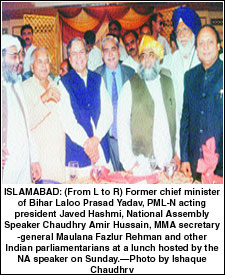 ISLAMABAD, Aug 10: Parliamentarians from almost all major political parties of India and Pakistan on Sunday pleaded for peace and friendship between the two countries at the start of a two-day non-governmental conference discussing ways to rid South Asia of conflict.
While Indian Prime Minister Atal Behari Vajpayee, in a message, called for cooperation to replace confrontation, some Pakistani politicians linked their wish for peace to a settlement of the Kashmir dispute.
The inaugural session, at which National Assembly Speaker Chaudhry Amir Hussain was the chief guest, was followed by an off-the-record session that was not open for press reporting.
But in a session of brief presentations by several party representatives, former chief minister of India’s Bihar state, Laloo Prasad Yadav, stole the show with his rustic and outspoken style in a speech in which he called for demolishing the Berlin Wall-type “wall of hatred” between the two countries.
Mr Vajpayee said the common yearning for greater interaction must be used to “lessen the misconceptions and mistrust between us”.
“Cooperation rather than confrontation is the answer to our common problems of development and poverty alleviation,” he said. “Violence and bloodshed cannot provide any enduring solutions. We can live together only if we let each other live.”
He said India and Pakistan should heed the “winds of change in today’s world” where regional associations and economic groupings were being formed in the most developed as well as poorest regions and “sub-regional alliances have become the building blocks of a multi-polar world order”.
“We should not defy logic and distort reality to avoid mutually beneficial cooperation,” he said. “We cannot deny our people their right to peaceful and cooperative economic development.”
PML-Q president Chaudhry Shujaat Hussain lamented the failure of “many direct talks” between the two countries in the past and said 50 more years might be needed to resolve their issues if things remained the same.
“Running buses, trains and exchange of cultural delegations between the two countries cannot bring peace without a resolution of the core issue of Kashmir,” he said.
Chaudhry Shujaat assured the conference of PML-Q government’s full support to what he called “the peace initiative of the international community”, but said: “Peace in this region can only be achieved when the core issue (of Kashmir) is resolved to the satisfaction of the Kashmiri people.”
Recalling the disappointment caused by the collapse of the Agra summit in 2001, he said: “The political leadership both in India and Pakistan must rise to the occasion and work out a lasting and peaceful settlement of all pending issues.”
Parties ranging from secular to perceived fundamentalists to communists were represented at the conference of parliamentarians, journalists and experts jointly organizd by the Pakistani and Indian chapters of the South Asian Free Media Association (Safma) with the sponsorship of a Norwegian non- governmental organization, NORAD.
Messages were sent also by former prime minister Benazir Bhutto and Indian opposition leader Sonia Gandhi indicating the stance of their parties on the state of bilateral ties.
Ms Bhutto, in her message that was read out by People’s Party Parliamentarians president Makhdoom Amin Fahim, called for replacing “the infrastructure of war with the architecture of peace” between the two countries, including the Kashmiri people in any consultative process about the future of their disputed territory and demilitarizing the Kashmir valley under agreed procedures.
She said the Line of Control between the Pakistani and Indian armies could “transform itself into a socially agreed area where, without prejudice to the views of India and Pakistan on the Kashmir dispute, the people of Jammu and Kashmir on both sides... (of the LoC) could be socially united. This could create a soft-border zone of peace and trade-driven prosperity.”
She said it was time to “jettison the cold-war paradigm for a new security framework investing in people instead of weapons of mass destruction”.
Sonia Gandhi called for the use of the 1972 Shimla Agreement to discuss all issues and build a durable friendly relationship, but said “cross-border terrorism must cease” to create a conducive atmosphere for meaningful talks.
Muttahida Majlis-i-Amal secretary-general Maulana Fazlur Rehman called for greater parliamentary interaction between the two countries in view of what he called a serious danger faced by the parliamentary system. He appeared to be referring to the prevailing constitutional controversy in Pakistan.
PML-N acting president Javed Hashmi said his party’s exiled leader and former prime minister Nawaz Sharif would have greeted the Indian parliamentarians with the same warmth as he showed to Mr Vajpayee when the Indian prime minister made a historic bus trip to Lahore in February 1999 “but he is not allowed (to come back to his country)”.
Former president and Millat Party chief Farooq Ahmed Khan Leghari said the Kashmir dispute could not be resolved by military might but it could also not be left on the backburner. He rejected Indian allegations of “cross-border terrorism” and described the revolt against India in Kashmir as indigenous.
Mr Yadav said he and other members of 59-member Indian delegation had brought “a message of love and brotherhood” and that he did not feel like a foreigner in Pakistan.
He called for continuous and sincere talks between the two countries to settle their disputes and said: “We have to demolish the wall of hatred.”
The NA speaker urged the parliamentarians to lead the way in the peace process between the two countries, which he said must settle their old disputes amicably and search for new vistas of cooperation and betterment of the masses.
But many eyebrows were raised when he said the Senate, the National Assembly and the provincial assemblies in Pakistan were “functioning in a satisfactory manner.”
Earlier, Safma secretary-general Imtiaz Alam said certain peace approaches between the two countries had not worked well and must give way to “more realistic approaches”.
His proposals made on behalf of Safma included resolution of conflict and differences through peaceful means and negotiations, dialogue without conditions and interruptions, inclusion of concerns of both sides in the agenda and addressing issues of Kashmir as well as of terrorism and repression.
He also called for some immediate confidence-building measures, including revival of rail and air links, an end to hate campaigns from both sides, and bus services between Lahore and Amritsar and between Muzaffarabad and Srinagar.