



 0
0

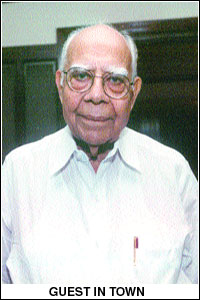 ISLAMABAD, Aug 10: Ram Jethmalani, currently on a peace mission here as head of India’s Kashmir Committee, is one of the most colourful and provocative politicians of India.
The 80-year-old Jethmalani, who even contested the Indian Presidential election, is a sitting member of the Indian Parliament’s upper house, Rajya Sabha, and a former BJP law minister.
He was elected to the House with the support of the Rashtriya Swayamsevak Sangh (RSS). A defender of the RSS and its philosophy of the Hindutva, Jethmalani said in a Rajya Sabha debate in March 2000: “RSS is the basic tenet of the Constitution.” However, later that year in an interview to the Indian Rediff website Jethmalani said: “BJP will keep Hindutva on backburner for Muslim votes.”
He is also the co-author of the BJP election manifesto calling for repeal of Article 370 of the Indian Constitution that accords special status to the dispute of Jammu and Kashmir. The manifesto also advocated construction of the Ram Temple in Ayodhya and introduction of a uniform legal system for Hindus and religious minorities in India.
He is reputed as the incorrigible maverick politician. In his authorised biography, published this January by Penguin India, he has been described as a “brilliant, flamboyant and controversial lawyer-politician.” In July 2000, he fought back vigorously and unconventionally over his ‘induced’ resignation as minister of law. While defending his position he comprehensively violated the Official Secrets Act, in fact he attached secret documents and circulated those to the entire Indian parliament! No one could really touch him, legally or otherwise. He trashed all criticism maintaining his right to defend himself.
On key issues his position was at variance with the official position. He opposed the Prevention of Terrorism Bill, recommended by the Law Commission, and also gave his qualified support to the Jammu and Kashmir autonomy resolution.
Jethmalani has direct access to the BJP leadership. He is a rakhee brother of the Indian Deputy Prime Minister L. K Advani’s wife and has been Advani’s lawyer in a corruption case.
Jethmalani has demonstrated an ability to rise above political divides to maintain human relations. He worked in partnership with A.K Brohi in a law firm. Jethmalani remained the elderly figure in the A.K. Brohi family long after the key Pakistani lawyer died. Last year, Jethmalani, along with India’s National Security Advisor, consistently supported extending the visa of a Pakistani analyst Nasim Zehra who was then also a member of the National Kashmir Committee.
A noted criminal lawyer, Jethmalani captured news headlines for his defence of Kehar Singh, the main accused Sikh in the famous Indira Gandhi assassination case and for his startling revelations in the Rajiv Gandhi Bofors scandal case.
Hours before departing for Pakistan Jethmalani advocated a ‘give and take’ policy’ to resolve the Kashmir dispute. He declared the Indian parliament’s position on reclaiming and maintaining control of Kashmir while having “forgotten land of the country already in China’s hand” as being “hypocritical.” He recalled: “After the 1962 Chinese aggression they captured about 50,000 square mile of India’s land. The then parliament unanimously adopted a resolution that India would not sleep over the issue till it takes back the last square mile of it from China’s hand.”
While dramatic, this statement compares two vastly dissimilar situations. In the Kashmir case the territory is disputed and people have been denied their UN-sanctioned right of self- determination. India is not called upon to be magnanimous and forget its territory but indeed is expected to follow ‘rules of the game’ defer to international law and international agreement for the settlement of the multi-party Kashmir dispute.
In March 2003 before meeting his Pakistani counterpart Sardar Abdul Qayyum he told PTI on March 12 that the Clinton solution to Kashmir “democracy with guaranteed human rights for the minority...should be acceptable to all parties.”
Describing Qayyum as a “very reasonable man” he said, “Let’s talk to him to find out what’s there in the minds of the people on the other side of the Kashmir.” He also supported the recommendations of the Kashmir Study Group as a “great starting point.” He has argued that President Musharraf is the “only way” in which to get Pakistan “to modify its position, and that means abandoning the foundations on which it was created.” He reportedly argued at the Centre for Strategic and International Studies in Washington that: “If he is (Musharraf) replaced, things in Pakistan will deteriorate, with great implications for the security of the world and of India.”
Jethmalani’s position on Kashmir is dynamic and changing! During his stay here Jethmalani certainly needs exposure to Pakistan thinking on Kashmir and from him Pakistan can learn some more about the semi-official Indian thinking on the Kashmir issue.





























