0
0

ISLAMABAD, April 25: Federal Information Technology Minister Awais Ahmad Khan Leghari on Friday said Rs1 billion research and development fund of the PTCL would be made available to fund projects with long-term benefits for the local science and technology industry.
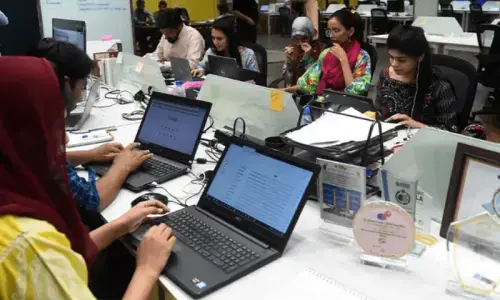
He was speaking at the concluding session of an international workshop on bioinformatics, organized by the Comstech-PTCL Frontier Technology Research Centre (CPC) at the Comstech headquarters on Friday.
The minister said: “We are ready to fund any project prepared by the private or public sector that envisages development of human resource alongside transfer of technology to ensure long-term benefits to the national economy in general and the IT and telecom sector in particular.”
He invited the OIC member countries to enter into partnerships with Pakistan for the development of science and technology.
Pakistan, he said, was a source of strength for the whole Muslim World, given its special status as the only nuclear power among the OIC member countries.
Mr Leghari said the peaceful nuclear programme carried out by Pakistan, in the face of pressure and lack of resources and technology, had shown that everything could be achieved by the nations with persistent struggle and dedication.
He called for more research and development of new technologies to get maximum result in fields like agriculture that offered a huge potential for shoring up the national economy.
The minister lamented that lack of quality seeds and application of proper techniques and tools had been the bane of agriculture sector in the country. He referred to the emergence of leaf curl virus which made hundreds of researchers sit and invest huge amounts in seeking ways to control it. But, all their efforts proved to be abortive due to unprofessional attitude of the bureaucracy.
He underlined lack of vision and awareness of science as the main reasons for the decline of the Muslim countries, and urged them to understand the importance of science and technology as the key to prosperity and economic growth. “In the context of the current geo-political situation, it is extremely important that Muslims wake up from slumber,” he said. He maintained that knowledge and its application, and not natural resources, were the “key to our survival and growth”. He urged the Muslim world to tap their key resource, the human mind, to undertake research and development in the larger interest of their peoples.
“Our aim should be to produce in these newly emerging technologies well-qualified and trained scientists who can face the future challenges and contribute to the economic progress besides helping in narrowing the distance between the Muslim and the developed world,” Mr Leghari added.
He said it was the power of information technology tools that frontiers were being explored and astounding discoveries made. Information technology, biology and biotechnology had come to predominate all areas of human activity, including society, industry and trade, he added.
“The profound benefits of these technologies in the areas of medicine, diagnostics, evolutionary studies, human health, etc., are becoming evident day by day,” he said.
The minister said biotechnology would be, perhaps, the most important area of rapid growth in the next few decades.
Earlier, speaking on the occasion, Comstech coordinator general Dr Attaur Rehman said the emerging discipline of bioinformatics, combining biology and computational sciences, would revolutionize every aspect of life and have profound effects on the future economics.
“There is an urgent need to create awareness in the OIC region about the possible impact of and potential offered by this discipline on socio-economic development,” he added.
Dr Rehman said bioinformatics was poised to change the entire dynamics of biomedicine as until now doctors had been merely intervening at the level of symptoms instead of fighting diseases like cancer, stroke or heart attack.
He said bioinformatics had made it possible to extract extremely useful data from human genome for diagnosis and treatment of major disease like cancer, tuberculosis, HIV, malaria and genetic disorders.