0
0

RAWALPINDI, April 14: Formation commanders on Monday discussed India’s continued threats of a pre-emptive strike against Pakistan and decided to maintain full military vigilance.
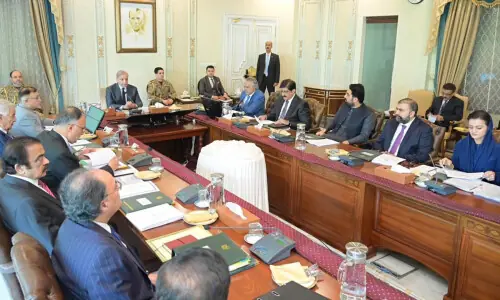
The decision came at a 2-day meeting of formation commanders that started with President Gen Pervez Musharraf in the chair on Monday.
The meeting was told that armed forces were in the state of high alert despite withdrawal of troops from the borders, informed sources told Dawn.
The commanders took into account the statements being repeatedly given by India’s Deputy Prime Minister and Interior Minister L.K. Advani and Defence Minister George Fernandes. The meeting was told that Pakistan’s armed forces would continue to exercise restraint though they could launch a pre- emptive strike against the enemy.
Sources quoted the president as having told the meeting that Pakistan was in touch with its friends, especially the United States, China and Saudi Arabia, about the growing threat perceptions in the region.
Gen Musharraf said Pakistan wanted peace and security but it could not be careless about its defence owing to India’s continued belligerent attitude.
The meeting was told that it was perhaps the political expediency of the BJP government to maintain hostile attitude keeping in view the forthcoming elections in 11 Indian states.
According to the ISPR, the president dwelt on various international and national issues. He declared that due to unswerving faith of the armed forces in Allah, their devotion to duty and professionalism, the defence of the country was impregnable.
The president said that during the recent escalation India was compelled to withdraw its forces from international borders without achieving any aim. He directed the commanders on various areas of focus.
SECOND SESSION: In the second session, Foreign Minister Kurshid Mehmood Kasuri spoke on the improved stature of Pakistan in the world accruing from the stand taken by the government to support it against terrorism.
He stated that never in the history of the country had there been support from all across the world. He said Pakistan harboured no ambitions to attain regional or global power status. “Our deep desire to create a peaceful and prosperous South Asian region took President Musharraf to Agra in July 2001 with the firm resolve to seek a just settlement of all outstanding issues with India, including the core issue of Jammu and Kashmir. Intransigence of a faction of the ruling BJP unfortunately scuttled the bright chances of a comprehensive agreement,” he asserted.
In reply to a question about Indian leaders’ recent statements, the foreign minister said India seemed to be disconcerted at Pakistan’s prominence and wanted to exploit the situation arising out of Iraq war and undermine the Kashmiris’ indigenous struggle for their right to self-determination. He said Pakistan had already warned India of grave consequences if it tried any “misadventure”.
ECONOMY: At another session held to discuss the economic situation, President Musharraf said Pakistan’s foreign and economic policies would remain unchanged.
Sources quoted the president as having stated at the meeting that the political government would continue to follow his foreign and economic policies.
He said it was good to see that Prime Minister Mir Zafarullah Khan Jamali was assuring bilateral donors, the World Bank and the Asian Development Bank of continuing the reform agenda to avoid suspension of assistance.
The adviser to the ministry of finance, Dr Ashfaque Hasan Khan, briefed the meeting about the economic policies. He informed the meeting that Pakistan sustained huge fiscal deficit and current account deficit for a long time due to which debt servicing increased to 66 per cent and the country was left with 33pc resources for all other areas. “And this situation led to cut in development budget from 9 per cent to 3 per cent in 1981 due to which growth slowed down, investment declined and poverty increased,” he continued.
He said overseas Pakistanis were bringing their capital back, stock market was buoyant and external balance of payments was in comfortable position.
He said Pakistan’s $10 billion foreign exchange reserves were sufficient for 11 weeks of imports. Pakistan’s credit rating in the international market, he pointed out, had improved and Pakistan had been the most profitable stock market in the world.