0
0

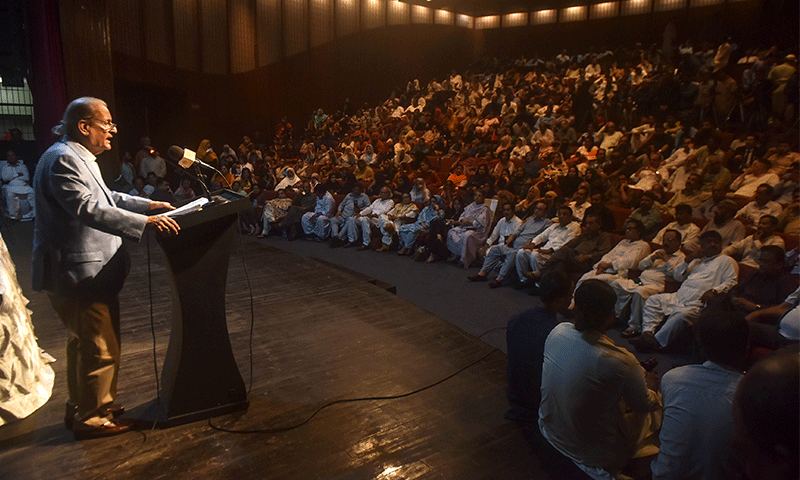
KARACHI, April 13: Speakers at a workshop on Sunday rejected the Industrial Relations Ordinance (IRO), 2002, in its present form, as it was against the fundamental rights of the workers.
They were speaking at a consultative workshop on “Labour’s view on the IRO 2002”, organized by the Human Rights Commission of Pakistan (HRCP), that was attended by representatives of labour organizations, media, lawyers and civil society organizations.
They said that IRO 2002 would further undermine the trade union movement, reduce the size of organizied labour force and would, as a consequence, adversely affect the economy. They urged all sections of civil society to actively support the worker’s struggle for the attainment of their rights.
The speakers demanded the removal of certain provisions of the IRO 2001, which, they said, were contradictory to the fundamental rights of the workers, as guaranteed not only by the Constitution, but also by various conventions of the International Labour Organization (ILO), which had been ratified by Pakistan.
The speakers said that the regime which repealed the IRO 1969 and introduced IRO 2002, had lost its legal or moral authority to legislate after Oct 12 general elections, in view of the Supreme Court’s decision.
They said that IRO 2002 lacked any democratic sanction. They said that the ordinance denied to workers the right to form trade unions in many of the organizations, which was in violation of the Constitution, ILO Conventions and the Labour Policy, announced by the government in September.
They said that under the ordinance, the workers’ right to reinstatement after wrongful termination had been abolished.
It undermined the legal protection that was available to the union leaders, in particular, and workers, in general, they said.
They held that the abolition of the Labour Appellate Tribunal was against the workers’ interests.
They pointed out that through the ordinance the position of the contractors, who hire labour for employers, had been strengthened to the disadvantage of the workers. They said that the government intended to control the trade union movement by putting embargo on the registration of trade union federations.
The speakers denounced the government’s decision to ignore the tripartite agreement of 2001, and the assurances given in the Labour Policy announced in September 2001. They criticised the government for drafting the new IRO without any consultation with the workers or the with joint council of employers and workers.
They demanded that Section 27-A of the Banking Companies Ordinance, 1962, and Section 2A of the Services Tribunal, Act 1973, be withdrawn as both were in violation of the Constitution and the ILO conventions and also against the recommendations of the Justice Shafi-ur-Rehman Commission.
The speakers further demanded that ban on trade union activities in Pakistan Internationa Airlines, Pakistan railways, Security Printing Corporation, Karachi Electricity Supply Company, Pakistan steel Mills, banks and financial institutions, as well as in other public sector organizations, be withdrawn. They also demanded that 7th Wage Board Award be implemented among the workers of the newspaper industry immediately.
Former judges of the High Court, senior trade union leaders, lawyers, and representatives of civil society organizations including Justice (retd) Rasheed A Razvi, Justice (retd) M L Shahani, S P Lodhi, Abdul Hameed Chhapra, Habibuddin Junaidi, Fareed Awan, Saleem Raza, M Ayoob Qureshi, M Arif, Shaukat Ali, Shaikh Majeed, Haji M Younis, Sirajul Haq, Saeed Ahmad, Faqeer M Himayati, M Rafiq Malik, Mirza Maqsood, Saeed Ahmad, and others also spoke at the meeting, which was presided over by the HRCP’s Hussain Naqi.