0
0

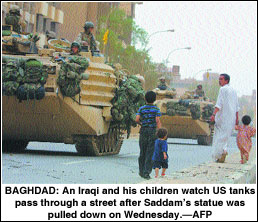 BAGHDAD, April 9: US tanks and troops poured into the heart of Baghdad amid scenes of jubilation on Wednesday as Iraqi President Saddam Hussein’s government collapsed under a blistering three-week onslaught.
US forces met little Iraqi resistance as they took over swathes of the city, with looting erupting as it became clear that President Saddam’s rule was disintegrating.
Tanks rolled into the heart of the city, with US soldiers helping jubilant Iraqis to start tearing down a giant statue of the president at the Al Fardus Square.
They slung a thick rope noose around the Iraqi leader’s neck, and controversially draped the Stars and Stripes over his head.
Civilians queued up to hammer blow after blow into the plinth supporting the statue, while nearby soldiers chatted to journalists, the hatches of their tanks open, although other marines on foot took up precautionary positions.
Troops spread through the city to crush remaining pockets of resistance, facing snipers and isolated units prepared to make a last stand.
US President George Bush was said by an administration official to be pleased with progress in the campaign, while his vice president, Dick Cheney, warned that “hard fighting” could lie ahead.
British Prime Minister Tony Blair warned: “This conflict is not, however, over yet.”
Mystery still surrounds the fate of the Iraqi president, who it is thought may try to make a last stand at his home town of Tikrit, north of Baghdad.
White House spokesman Ari Fleischer said President Saddam had “missed his chance” to go peacefully into exile, hinting the administration believed the Iraqi leader was still alive.
“We still don’t know his fate,” said Mr Fleischer.
A spokesman for Mr Blair said Iraq’s command and control structure appeared to have broken down in Baghdad, adding that scenes of chaos and looting in the capital “tell their own story”.
But he warned resistance to advancing US troops could still be quite “stubborn and fierce” after days of bloody fighting to wrest control of the capital of five million people.
In the streets of Baghdad, people dared to utter the words “Traitor!” “Torturer!” “Dictator!” in reference to the Iraqi president.
“We’re ecstatic to get rid of him after all these years of war and deprivation,” said Dinkha Khosina, joining hundreds of Iraqis to greet US troops racing from Baghdad’s northern entrance to the heart of the capital.
In the north of the capital, citizens rampaged through the interior and irrigation ministries, gutting the offices, reporters said, while symbols of Saddam’s iron grip on the country took the brunt of people’s anger.
In other parts of the capital, Baghdadis tore up a giant portrait of Saddam, men brandished Kalashnikov rifles as they signalled their delight at the government crumbling, while one white-haired man was seen laughing as he repeatedly hit a poster of Saddam with a sandal.
Another man intoned the name of “Saddam” and ran his finger across his throat in a mock gesture of execution. But two others appeared to support the embattled Iraqi president: “Saddam Hussein good,” one said.
City residents, hardened after almost 13 years of crippling economic sanctions, started looting symbols of Saddam’s power, notably the irrigation and interior ministries and the headquarters of the Iraqi Olympic Committee, run by Saddam’s elder son Uday.
US troops, moving up the eastern bank of the Tigris, approached the centre of the capital, where they were expected to join units controlling the western side of the river, witnesses said.
Marines had seized Baghdad’s eastern zone, though Iraqi snipers were still posing problems, a US military official said. The rapid march through the capital came after Iraqi fighters abandoned their positions.
But US warplanes still flew over the capital as smoke filled the skies, bringing air support to ground troops moving through the east and north of Baghdad where Iraqi forces had abandoned positions.
Dozens of Iraqi and Arab fighters in civilian clothing were still holed up behind buildings or in sandbagged positions on the western side of the Al Jumhurya bridge spanning the river Tigris, which snakes through the capital.
“Baghdad has not fallen and will never fall,” said Mohammed al Dahruj, a 24-year-old Syrian who volunteered to fight US-led forces.
US tank fire and artillery pounded the area, as automatic weapons crackled, with US forces trying to crush resistance from the Iraqi position blocking the eastern exit of the bridge.
SADDAM’S TOWN BOMBED: To the north of Baghdad, warplanes struck Iraqi positions around President Saddam’s home town of Tikrit, a potent symbol of his rule.
At Sulaymaniya, streets erupted into a carnival atmosphere as tens of thousands of Kurds danced and sang at the news that US tanks had taken control of the centre of Baghdad.
In the south, the country’s second largest city, Basra, was not yet totally under British control, Mr Blair said. “It is not secure for our troops yet, fully,” he said. “(But it is) more under control today than it was yesterday.”
SADDAM’S FATE: Nothing has been heard from President Saddam since a US bomber on Monday obliterated the building in Baghdad where he was believed to be with his two sons.
Major General Stanley McChrystal, with the US Joint Chiefs of Staff, said the air strike had been “very, very effective”, but it was not known if the targets were still alive.
The Times of London said British intelligence believed Saddam had left the targeted building just before it was bombed.
The Washington Times quoted a US official as saying intelligence officials were “in a state of euphoria” because “there is no doubt he (Saddam) is dead”.
In London, Mr Blair said: “It is extremely difficult as we speak to know what is left of the governing higher ranks of Saddam’s regime.”