0
0

UNITED NATIONS, April 3: Pakistan on Tuesday criticized India for the arms buildup in South Asia, causing growing imbalance in conventional military capability, and stressed that “the principal threats to international peace and security now emanate not from an ongoing strategic confrontation between the major powers but from regional conflicts and tensions.”
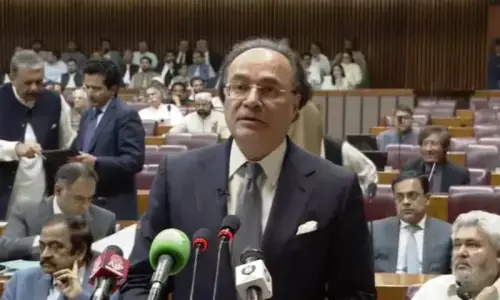
Addressing the inaugural meeting of the Substantive Session of United Nations Disarmament Commission (UNDC), Pakistan’s Ambassador to the United Nations, Munir Akram, asserted that Pakistan opposed a debilitating arms race in South Asia.
He said the reckless buildup of conventional and strategic weapons by the one state in South Asia, “which seeks political, military and economic hegemony over the entire subcontinent, is escalating tensions and the threat to peace and development in our region”.
He noted that reliance on international treaties as a medium for disarmament and arms control had also eroded and the role of multilateral forums, both for deliberation and negotiation, had become stalled and the scope was narrowing as the capabilities of the United Nations for independent analysis of disarmament issues appeared to be eroding.
Mr Akram said that in the new international circumstances, many of the premises of disarmament, arms control and non- proliferation were being questioned, if not discarded. “For instance, the concept of nuclear deterrence has changed from a static bipolar equation to a dynamic multipolar calculation involving not two, not five but at least eight nuclear-weapon states,” he added.
Saying that the threats to international peace and security now emanate not from an ongoing strategic confrontation between the major powers but from regional conflicts and tensions, he observed that “it is both, the impetus for global power status as well a regional ambitions and confrontations which now fuel the conventional and often the nuclear arms race.
“Special attention, therefore, should focus on the probable flashpoints of conflicts and confrontation i.e. the Korean Peninsula; the Middle East and South Asia,” he added.
Noting that in recent years, the levels of security enjoyed by various states have become increasingly asymmetric - some enjoy absolute security, others none at all. Asymmetric security is accompanied by asymmetric means of conflict, including the regrettable use of terrorism, Mr Akram underscored that “conflicts are still about territory, but increasingly ideology, beliefs and value systems are also being invoked to justify state policy or state conduct, including acquisition of armaments and the use or threat of use of force.”
He stressed that the UNDC session should be utilized to reverse at least some of these disturbing trends which will significantly erode international and regional peace and stability over the long-term.”
He said in the nuclear arena, the two major nuclear powers needed to quickly ratify and implement the Moscow Treaty, and the implications of the demise of the ABM Treaty and the search for effective missile defences should be examined to ascertain whether a mix of offensive and defensive weapons was consistent with the preservation of stable nuclear deterrence in a multipolar context. The issue of missiles must be addressed within a comprehensive a cooperative framework responsive to the security needs of all concerned states.
Until nuclear disarmament is achieved, credible military, political and legal modalities ought to be evolved and agreed to present a deliberate or accidental use of nuclear weapons.