0
0

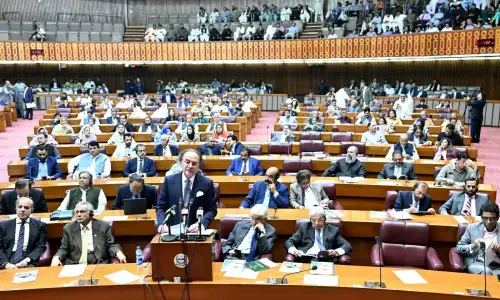
ISLAMABAD, April 3: Speakers at an open dialogue envisaged a disastrous future for South Asia if growing religious extremism was not checked in the region.
The dialogue, titled “ Religious Extremism in South Asia: The impact on regional security and cooperation”, was organized by South Asian Union in collaboration with Friedrich-Ebert- Stiftung, at a local hotel on Thursday.
A number of people from different walks of life, including retired bureaucrats, intellectuals, students and journalists, were present on the occasion. Pakistan Muslim League (Nawaz) chairman Raja Zafarul Haq was the chief guest.
The speakers were of the opinion that religious extremism was posing a serious threat to the region, comprising 1/5th of the world population. It is unfortunate that religious intolerance and bigotry have plagued the region. They asked people to promote the culture of peaceful co-existence, respect and tolerance.
They were unanimous that development and prosperity in the impoverished South Asia would remain elusive if religious extremism remained unchecked.
Former foreign secretary Niaz A. Naik observed that South Asian countries shared common past, history and heritage, deeply influenced by religions like Islam, Hinduism and Buddhism. He regretted that despite such huge commonalities, the region remained marginalized in the world due to mutual conflicts and distrust.
Tracing the history of religious extremism in Pakistan, he said Soviet intervention in Afghanistan triggered Jihadi culture. Extremism reached its climax when Taliban seized power in Kabul and harboured Al Qaeda cohorts.
In India, the speaker said, decline of liberal and secular Congress resulted in rise of Hindu extremism. He said due to geo- political and strategic reasons, the BJP let extremism defile secularism in India.
He identified Sri Lanka as a symbol of religious harmony where different religions finely blended with one another. He underlined the need for revitalizing Saarc to tackle regional problems.
Sanaullah Baloch, a parliamentarian from BNP, accused state machinery of stoking religious extremism through all means, including state media. He lamented that establishment used religion to promote national integrity when it could have been done simply through social justice.
He said the BJP adopted religious chauvinism based on Pakistani pattern to quell centrifugal forces. He suggested formation of Union of South Asians to initiate dialogue among South Asian countries and nationalities.
Former ambassador B.A Malik said religious extremism was a state of mind in which one assumed oneself as infallible and did not listen to other people’s views. He said, theoretically, all religions taught love, justice and tolerance, but, practically, the situation was horrible.
He said religious extremism must be controlled for the sake of regional cooperation and security. He said Quaid-i-Azam envisaged democratic, progressive and Islamic Pakistan, and not a retrogressive state. He maintained that both Pakistan and India should work together to settle all outstanding issues.
Deputy High Commissioner of Bangladesh embassy Nazimul Konain said religion was not a political force in his country. “Religion is only a part of our social culture,” he added.
Sohail Altaf, vice-president of Federation of Pakistan Chamber of Commerce and Industry, said religious extremism came to light after 9/11.
Ahmad Raza Kasuri of Pakistan Tehrik-i-Islam said Indian leaders should take a pragmatic approach and work with Pakistan to change the destiny of South Asia. He also asked Pakistan government to adjust itself to the status of India and let it play a role of big brother if the latter shed its hegemonistic designs.
Raja Zafarul Haq said South Asia could become a peaceful region if all the people followed their respective religions in true spirit, as no religion promoted intolerance and extremism. He said religion became a destructive force, whenever it was distorted for vested interests. He said now even secularist Saddam gave calls for Jihad which was ridiculous. — Junaid Bahadur