



 0
0

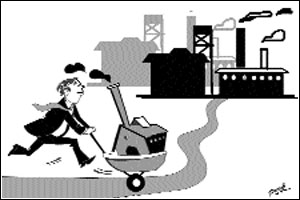 THE Punjab government wants to encourage industry to minimize unemployment and boost growth. However, the task is hobbled by the high cost of energy and investment capital. The operational costs in potential growth points remain high in the absence of proper linkages within these areas and difficulties in getting utilities.
While infrastructural weaknesses and tariff anomalies constitute some of the biggest constraints, the key question is what type of industry,labour- or capital-intensive, should be promoted. Against the challenge of free trade, export of value added products can play a crucial role in revitalizing industrial development. It can also galvanize the traditionally labour-intensive small- scale sector, promoting employment and reducing poverty. However, will the government be ready to provide the necessary incentives and improve access to cheap capital so as to reduce the cost of business in backward areas?
Incentives tailored to the needs of industry can promote profitability. But it is a moot point whether this would be easy in the light of the IMF guidelines which reportedly want the parliament to do away with exemptions as part of the new budget to be presented in June.
Industrial production to be viable has to be export-oriented. For the time being, the situation has been complicated by the American-led aggression against Iraq which has cast a fearful shadow on the search for markets and provision of cheap energy. But efforts to stimulate industry cannot go far without steps to lower tariff and provide easier access to raw material at world prices.
A study of the incentive structure suggests that except for a few large-scale manufacturing items like textiles and leather, industry is unable to compete internationally because of its inward-looking orientation. Consequently, it can grow no faster than domestic demand. The large-scale sector does not provide employment opportunities in relation to the resources it absorbs, at least in the short term. Small and medium enterprises can help to reduce poverty and unemployment by producing non-traditional items.
However, loans for setting up such units are not affordable in view of the high mark-up rate. Notably, backward areas in the South Asian context cannot develop without a significant reduction in the cost of production and easier access to working capital. India recently granted concessions for small units in many areas of Himachal Pardesh and Jharkand.
Tax exemptions can reduce costs and encourage labour- intensive projects.However, not only is there a multiplicity of taxes and levies that discourage investors, but great difficulties also have to be faced in getting refund of sales tax, income tax and excise duty in the absence of one-window facility. There are industries which require import of machines or capital equipment which discourage the investor. Also, there are difficulties in importing raw material not available in the country.
In the past, however, incentives provided to industries using imported raw material failed to overcome the anti-export bias in the trade regime. Export industries based on domestic raw material were provided with an additional incentive through raw material (cotton and hides and skins) at below world prices by placing restrictions on their export. Consequently, most investment in export industries in the 1980s went into cotton textiles and leather. While earnings from these two industries grew at 11 per cent per annum in value terms between 1988-89, earnings from other manufactured exports grew at only about three per cent.
The setting up of engineering units in Punjab is hampered by a variety of taxes as well as difficulties in sales tax and duty drawback and lack of credit facilities and other incentives for non-traditional exports. Manufacturers, fearing tax officials, are afraid of exporting their goods. A policy package for electronics has so far been ineffective. However, engineering industry, micro chips and computer software can be developed, and there is potential in small and medium enterprises based on indigenous technology which can absorb surplus rural labour.
Currently, investment in modernization is also affected by lack of finance and sluggish business. Earlier, exporters of Gujranwala, who have potential of exporting items like leather garments, textile products, sanitary fittings, air coolers, utensils, ceramics and washing machines, said they have to pay extra charges on the import of raw material through Port Qasim . De-stuffing of containers is delayed at the port which further increases the cost and delays output.In these conditions, small and medium manufacturers cannot think of exporting even if they have orders from foreign buyers. Banks do not encourage small investors but have a crucial role to play in the improvement of exports by slashing the lending rates.
Reducing the difference between borrowing and lending rates of banks as well as increasing the number of loans should be important goals for meeting the needs of small and medium enterprises. Moreover, banks will have to simplify their loaning procedures. Redress of complaints regarding GST levy and collection across the country is another requirement.
However, for meeting the long-term needs of investment capital. innovative strategies focusing on capital generation and acquisition of new technologies and industries like electronics, upgrading of products like garments and textiles are required. Revival of public investment, as in China, can greatly boost industrial finance development.There are industries which require import of machines or capital equipment or components as well as raw material or technology.Projects which can be integrated with the agricultural economy and foster linkages between similar ventures as well as large industries can address the needs of employment generation and equitable asset distribution. Potential growth points can be identified in each region to focus on development of those areas. Currently, not only operational costs are forbidding, but getting utilities can be very time-consuming. Roads, railways, air cargo, power supply and transportation can improve production quality and upgrade units.
Exports are unlikely to grow when profits are squeezed. Markets are currently flooded with forign products and parts. The share of smuggling, under-invoiced and mis-declared products in the local market varies from 40 per cent to 90 per cent in the auto parts sector alone. Moreover, the high raw material prices are preventing budding entrepreneurs from investing in manufacturing facility for exports. Relations with firms which could locate some of their processes in Pakistan and increase employment without large-scale investment could develop export-oriented external collaboration.
Many local investors are not conversant with the kind of schemes that can be started and therefore need counselling and training to undertake projects. Arrangements for this must be provided as part of a comprehensive policy to develop industries.




























