



 0
0

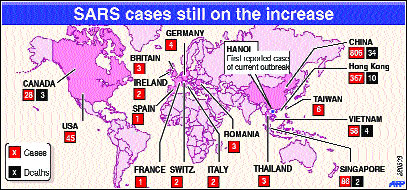 HONG KONG, March 28: Asian governments quarantined more people and beefed up health checks on Friday as they battled to contain a deadly and highly contagious pneumonia virus that has killed 54 people worldwide and infected around 1,500.
Singapore nearly doubled the number of people ordered to stay home to 1,514 as it tried to break the cycle of the deadly severe acute respiratory syndrome (SARS) virus, which has claimed two lives in the city state.
It is also blamed for 34 deaths in China, 11 in Hong Kong, four in Vietnam and three in Canada.
“We’re facing an unprecedented situation, this is a nine-eleven (September 11) for health, and we’re not going to go back to the pre-SARS situation for some time — we’re in for the long haul,” said Singapore Health Minister Lim Hng Kiang.
Thailand and South Korea became the latest countries to issue travel warnings urging their citizens to avoid visiting China, Hong Kong, Singapore and Vietnam — worst hit by the disease — until the health crisis was brought under control.
The epidemic has forced the cancellation of concerts, holidays and business travel to many parts of Asia, in a blow to the region’s already sickly economies.
A Singapore analyst said lost retail sales and hotel bookings would cost the city $1.1 billion if the crisis lasted three months, but others accused the region of over-reacting.
“They’re bombing Iraq and you still see people walking around on the street out there,” said Chinese businessman Wang Junyao, the head of a private dairy company. “And the foreign media says you shouldn’t go to China?”
China, where the virus emerged late last year, has been accused of hiding the problem but the World Health Organization said the country had now agreed to make detailed daily reports.
OFFICES CLEARED: In Hong Kong, computer giant Hewlett-Packard Co closed one of its main offices and sent 300 workers home after an employee was suspected of having contracted the disease. HSBC bank sent home 26 workers from an elite private banking counter at its headquarters building after a teller caught the deadly disease.
The WHO has stressed the need to screen travellers in places where the virus has killed people, including China’s Guangdong province, neighbouring Hong Kong, Singapore, Hanoi and Toronto.
Thailand said people visiting the worst-affected countries should wear a mask.
“Avoid visiting crowded public places like shopping malls or cinemas,” said Thai Public Health Minister Sudarat Keyuraphan.
SARS, which scientists say is caused by a new virus strain, has been carried to parts of Asia, Europe and America by travellers.
Desperate to halt infections, Singapore and Hong Kong, which have the highest number of infections outside mainland China, closed schools and quarantined those who may have been exposed to the virus, including the family and friends of patients.
British rockers the Rolling Stones called off two concerts in Hong Kong but the city’s annual Rugby Sevens tournament, which usually draws about 40,000 spectators, began on time on Friday.
At least three Hong Kong universities said they would shut their doors from Saturday, and a second hospital chief was admitted to hospital on suspicion of having caught the disease.
CHILDREN GO SHOPPING: But the school closures may not work as planned. Instead of staying home, many Singapore children left at a loose end headed to shopping centres and cinemas.
“My mum said to watch out for places which are crowded and where people might be sick,” said Laura Van Langen, 11, who was out shopping with three friends. She and her friends said they were not worried about the virus.
Hong Kong’s health department said on Friday it had recorded 425 infections so far. People unrelated to existing patients have fallen ill, a sign the virus is spreading widely in the city.
Companies have begun issuing surgical masks to front-line staff. Bus drivers have been wearing them for the past week.
Malaysia reported on Friday its first suspected SARS case, a nurse working in neighbouring Singapore. It said it would post health inspectors at border crossings to the city-state to screen visitors for the symptoms of the disease — high fever, a cough, chills and breathing difficulties.
Singapore, Taiwan and the Philippines have imposed strict health checks to ask air passengers if they had come from affected areas. Hong Kong’s tougher checks begin on Saturday.
Hong Kong is a major world transportation hub. The airport handles about 550 flights a day and some 90,000 passengers.
In the Philippines, the government said it would ask people arriving from infected countries to voluntarily quarantine themselves at home for seven days after arrival.
“We are wearing masks and we are in our own country, we have to protect our own country from this disease,” said Teresa Sakdalan, a Filipina who arrived from Hong Kong.
(With additional reporting by Carrie Lee, Jacqueline Wong, Alice Hung, Ho Binh Minh, Peh Soo Hwee, Nopporn Wong-Anan and Jason Szep)—Reuters





























