



 0
0

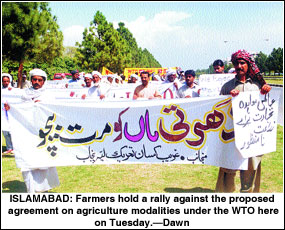 ISLAMABAD, March 25: A peaceful rally organized by a civil society network of voluntary organizations was held here on Tuesday to voice their concern over the proposed agreement on agriculture modalities under the WTO, demanding protection against some of the transnational corporations’ (TNCs) plot to destroy the agricultural economy of Pakistan.
Organized by the Sustainable Agriculture Action Group (SAAG), a conglomerate of about 17 voluntary organizations, the rally was marked by evocative banners. It was attended by about 600 small farmers representing different farmers rights groups and public interest organizations from across the country.
The protesters were carrying placards, banners and posters inscribed with slogans like: “Agreement on Agriculture Crushes the Small Farmers”, “Agriculture should be out of WTO mandate”, “We reject Harbinson Draft on AoA”, “We want subsidies only for subsistence farming”.
A sizable posse of police remained present throughout the two hours that the farmers and their urbanite sympathizers spent alongside Jinnah Avenue. The police made sure that the participants of the rally remained away from the Parliament House.
The small farmers urged the government to reject the current Harbinson draft modalities as an acceptable basis for negotiations, and proposed that they should work to create new trade rules in agriculture that would address the real source of distortions in world agricultural markets.
The new trade rules should fully take into account food security and food sovereignty, allow developing countries to protect their poor farmers against low world prices and recognize the special role of culture in food production and distribution in different communities, it was stressed.
The SAAG members said the modern technological interventions and the trade rules introduced by the WTO in agriculture sector were widening the gulf between the rich and the poor in the developing countries. Such economic imbalances could be disastrous and needed to be rectified, they warned.
The proposed agreement, SAAG contended, did not change the underlying structure of agriculture trade rules which were causing widespread hardships for farmers and discouraged sustainable models of agriculture.
The current agreement and the Harbinson text, they said, aimed at legalizing dumping, while at the same time eroding the developing countries’ only defence against dumping — tariffs and other border measures. Moreover, it did not acknowledge the central role played by women in food production.
It also ignored the increasing stranglehold exerted on agricultural trade by a handful of TNCs which, in turn, results in depressed prices around the world.
The farming community of the NWFP was strongly represented by two officials each of farmers’ organizations led by Ittehad Zamindaran-0-Kashtkaran. Talking to this reporter, its president Jan Nisar Khalil rolled out a host of grievances.
“We reject the WTO’s anti-farmer decisions. This time, we brought only office-bearers of farmers’ organizations. If later, there is a call for all the farmers, they, too, will come here,” he declared.
Other matters that apparently agitated the farmers related to water tax, electricity rate, prices of their produce including sugarcane, sugarbeet and tobacco. Mr Khalil, seconded by other farmers, said the recovery rate of sugarcane this year had risen from 8 per ent to 11.5 per cent, but the sugar industrialists refused to raise the purchase price.
The alliance had raised the issue with all relevant authorities, including ministers and chief minister, but to no avail. Similarly, the NWFP was the source of revenue worth Rs22 billion through 2 per cent central excise duty, but the companies had refused to raise the purchase price.
They also alleged that the water rate in the NWFP was Rs600 per acre against only Rs177 in Punjab. The NWFP farmers were made to pay water rate even for canals that were dry.



























