0
0

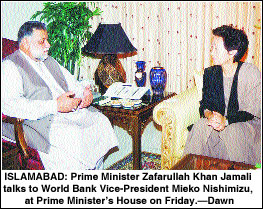 ISLAMABAD, March 21: Prime Minister Mir Zafarullah Khan Jamali has assured the World Bank that Pakistan will remain fiscally responsible, and there will be continuity of reforms in the country.
He told the Vice-President of World Bank Mieko Nishimizu, who called on him on Friday, that he believed in the consistency and continuity of reforms process initiated three years ago.
According to a handout issued by the prime minister’s house, the World Bank vice-president discussed with Mr Jamali matters pertaining to the economic development of Pakistan.
Prime Minister’s Adviser on Finance, Shaukat Aziz, and State Bank Governor, Dr Ishrat Hussain, were also present on the occasion.
Mr Jamali shared with Ms Mieko his vision for Pakistan, and said that from now on, the fiscal and economic policies will not be changed at the whims of certain individuals.
He also discussed the role of education and health sectors in improving the quality of life of the common man.
The WB vice-president highly appreciated the economic reforms, and observed that if Pakistan had not started the reforms process three years ago, it would have gone bankrupt by now.
Meanwhile, in her meeting with three federal ministers, Ms Mieko observed that Wapda and KESC “represent biggest risk to fiscal situation in Pakistan”.
According to sources, she urged them to bring financial discipline in the state sector enterprizes, particularly Wapda and KESC.
Last week, a four-member IMF review mission had expressed its reservations over Wapda and KESC, and called upon the government to improve their financial health so that they could be privatized as early as possible.
The World Bank vice-president, who was otherwise all praise for the Pakistani economy, said that line losses of both the state sector power utilities needed to be removed, the sources said.
She said that an early corporatization of Wapda could help it remove its losses. She opposed any free or favourable power tariff for Fata, and urged improvement in the utility’s billing collection.
Shaukat Aziz, the PM’s adviser on finance, said on being contacted that Ms Mieko strongly dispelled the impression that economic recovery of Pakistan was a result of the financial support offered by US and other countries in the aftermath of 9/11.
The World Bank has promised to offer increased funds for undertaking more development projects in the country, he said.
However, the sources said, she urged Pakistan to allocate substantial funds for alleviating growing poverty and adequately meeting the education and health-related targets.
Ms Mieko, who is leading a high-level delegation, held a marathon meeting with federal ministers, governor SBP and chairman Wapda, and discussed with them future WB assistance to Pakistan.
She said that financial, structural, administrative, capital market and tax reforms over the last three years “have enabled Pakistan to absorb economic shocks,” an official handout said.
“Had these reforms not been pursued, Pakistan today would have seen higher unemployment, higher poverty and higher inflation which, in turn, would not only have impaired the government, its economy but also the poor man,” she said.
Mr Aziz welcomed the support extended by the World Bank, which has averaged around US $600 million per year, as well as extensive technical assistance for capacity building.
He updated the World Bank vice-president on Pakistan’s development priorities in key areas like health, education, agriculture, water and electricity, social and physical infrastructure.
The government, he said, was also working to improve investment climate by removing irritants and reducing cost of doing business. Interest rates and tariff had been substantially reduced, and several other measures were underway, he added.
Education Minister Zobaida Jalal explained Education Sector Reform (ESR), which is focused on improving the quality of education.
The health minister briefed the WB mission on the health infrastructure being built at the gross-roots level. This would enable the government to expand health cover, improve immunization programme and the infrastructure.