



 0
0

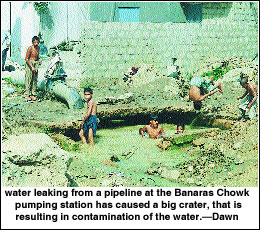 KARACHI, March 21: Like elsewhere in the world, the World Water Day will also be observed in Pakistan on Saturday (March-22).
The goal of the UN-recognized water day this year is to inspire worldwide political and community action and encourage greater global understanding of the need for more responsible water use and conservation.
The theme for this year year’s event is “water for the future”, calling one and all to observe sustainable approaches to water use for the benefit of the future generations.
Speakers at seminars and conferences in the city would discuss the gravity of situation in respect of depleting water resources and its quality as policy-makers have failed to ensure adequate number of water reservoirs, recycling plants and desalination plants.
According to international standards, the mega-city of Karachi needs 54 gallons per capita per day for a population of 11.66 million, i.e. 630 mgd, while at present it is drawing about 500mgd on average from two sources.
Deducting the wastage and leakage, which is taken as part of water transmission and distribution system by water supply body and that ranges between 30 and 35 per cent, the city is getting 45 to 49 per cent less water than its requirements.
The available infrastructure from the Indus source up to Gharo can provide 600 mgd to Karachi, but due to limited availability of infrastructure onward up to the city, the KWSB, is drawing about 30 per cent less than the permissible quantity from the Indus.
KWSB’s DMD technical Suleman Chandio told Dawn that the KWSB, with a financial assistance of the federal government, had already started physical works for expanding the Indus water conveyance system, under K-3 project, while paper work for another mega-project (K-4), had also begun.
He said that the water board had also moved authorities for an increase in water share of Karachi from the existing 12 cusecs to 2,400 from Indus to meet the needs of the projected population from 2005 onwards up to 2025.
To add to the episode of unhealthy and unsafe water, among other factors, there are increasing reports of mixing of sewerage in the KWSB pipeline supply, which could be attributed to high rates of seepage from the sewerage system, mainly due to lack of repairs and sanitary seal on lines.
However, KWSB official said that the quantity of impurities or turbidity in piped water was very negligible and water being provided to citizens was safe and hygienic.
“We have five filter plants for Indus water, while chlorination is also carried out at maximum in routine”, he said, adding construction work on a filter plant, meant for Hub Dam water was also continuing.
A recent UN study on water stated that while the world population continues to surge, the availability of fresh-water was shrinking and in the next two decades, many of the countries in South Asia, the Middle East and Africa would face the water crunch.
The report said in just 20 years, the average supply of water per person worldwide would have dropped by one-third, affecting almost every nation and specially those already on the economic edge.
Water contaminated with faecal, bacteria, parasites and other microbes causes about 6,000 deaths everyday, including 1.4 million children under age of five, said the UN report prepared by 23 agencies, under UNESCO, in two years’ time.
The report further said that the key to the water problems was a better understanding of water’s pervasive importance, intelligent investment and a broader implementation of the UN dictum that access to clean water was a human right.
It is said that while water in the urban areas was infected because of contamination during its transportation, the rural population is exposed to health hazards caused due to pollution at sources, including ponds, rivers and other channels.
During the last few years, the country, in general, and Sindh, in particular, had been hit by a long drought. Scientists found that with the zero discharge down the Kotri Barrage, the total dissolved solids in Indus water rose steeply and reached the limits of 3,200 ppm at Sujawal bridge, while the safe limit of 500ppm had been recommended by the WHO for drinking water. They also termed the TDS above 2,000 ppm not fit for irrigation purposes.
Expert suggest adequate use of chemical agents, including chlorine to prevent the piped water from getting diseases.
They urge the government to set up chlorine boosters in the city at least at a distance of every 5 to 6 km as the existing system of chlorination of water was not helpful in providing a safe drinking water to the end users at a distance of 15 to 20 km.
They also call for promoting the use of solar radiation treatment system, in addition to chlorine tablets and iodine, for water disinfection in rural areas, including deserts of Tharparkar, Cholistan and other Arid region where the potable water was very little and that too contaminated most of the time.
Apart from water pollution, the arsenic pollution of ground water in the country and province has also been reported.
Experts said the government should deal with arsenic poisoning before it takes any critical turn.
Experts exhort that a government that gives priority to investment on water will end up with better productivity and more stable economy.
Due to shortage of funds, the EPA Sindh had been failing to have an extensive and regular monitoring of surface water quality. However, during the second half of 2002, it undertook a water analysis project, with the funding of the National Drainage Programme, Sindh, under which water samples were collected at some locations, including barrages, NDP drains, Indus River, major wetlands and other critical places to determine the present level of water pollution and evaluation of existing level of water quality. The results of this four-month project works are still awaited.
The case of Karachi is not too different from other big cities, when it comes to reviewing the water situation.
In 1985, Karachi was getting 324 mgd that increased to 352mgd in 1990, to 374 by 1995, 447 mgd by 1999, but reduced to 435 mgd in 2000.
An additional supply of 100 mgd water was made from the Indus source about four years back, but that too could not create a healthy impact as another source of supply of 100 mgd water — Hub Dam reserves — diminished due to drying up of the reservoir.
Water is very important for human life. Without clean water, people cannot survive, and industries are jammed.
It is energy and life, provided it is available adequately in healthy condition and used judiciously. Shortage of water also harms the flora and fauna.
Unfortunately, water and sanitation, two important factors for a sustainable development, remained on a very low priority of governments in many countries of the world, including Pakistan.
Scientists believe that the greater the water is disinfected, the more are the chances of freeing human health from water-borne chemical toxicity and microbial problems.




























