0
0

 KARACHI, March 17: Several thousand oil tanker operators went on strike early Monday to protest against the increase in the prices of petroleum, oil and lubricants and vowed to remain off the road unless the government reversed its decision and met their demands.
“Within the next 24 hours all power houses in the country will be forced to close due to absence of fuel supply and the oil tankers’ strike will plunge the country into a serious crisis within the next 48 hours,” claimed Mir Mohammed Yusuf Shahwani, the chairman of the All Pakistan Oil Tankers Association, told a news conference in Karachi Press Club.
Goods transporters and inter-city bus owners have also joined in the strike. The Sindh Goods Truck and Trailer Owners Association threatened to block the National and Super Highways if the demands were not accepted.
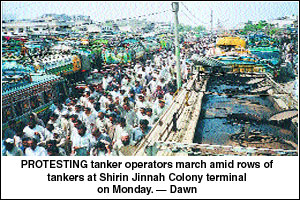
Hundreds of oil tankers were seen parked all over Shireen Jinnah Colony and Keamari area around oil terminals, which made the road and vicinity inaccessible. Thousands of people associated with the transport sector staged sit-ins and marched on the streets to give vent to their sentiments.
This was despite the assurance by the Sindh Chief Minister, Ali Mohammed Mahar, to take up the matter with the federal government for the resolution of their problem.
Government functionaries had alleged that some protesters had used strong- arm tactics against those operators who were not supporting the strike. But the Oil Tankers Owners Association’s chairman denied the allegation.
Accusing the bureaucracy of corrupt practices, Mr Shahwani threatened that from Tuesday 38,000 oil tankers in the country would remain at a stand still.
“Supply to the whole country will remain suspended and we will not call off the strike unless the government meet our demand,” said the Oil Tankers Owners Association chief.
Mr Shahwani alleged that “growing incidents of dacoities, kidnapping and killing of drivers, illegal oil agencies, rapidly increasing prices of high speed diesel and non-revision of carriage charges have forced oil tanker operators to go on strike till the acceptance of their demands.”
His demand was to bring POL prices down to the level of 2002, end to the deregulation policy, which, he claimed, destabilized POL prices. He also demanded abolition of the oil advisory committee. They also demanded that OMC oil companies should adhere to the agreement with transporters and urged the ministry of petroleum to see that directives were implemented.
He alleged the country was being deprived of substantial revenue and resources under the pretext of transporting oil at cheaper rates to Afghanistan. He claimed that most of it never reached there.
A spokesman for the Pakistan State Oil said special arrangements had been made to ensure supply of oil to upcountry through the railways.
Earlier, in the day the Sindh chief minister assured the transporters of redressal of their grievances on a top priority basis and the question of prices and fares would be taken up with the federal government.
The chief minister gave the assurance when a group of transporters met him at the Chief Minister’s House. They were led by Sindh minister of education Irfanullah Khan Marwat.