



 0
0

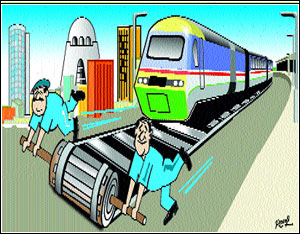 Now there is a ray of hope that the present government of Sindh—a rural-urban happy blend—will take genuine, and not half-hearted, steps to re-model the moribund Karachi Circular Railway (KCR) and extend all possible support, including financial prop, to the extent necessary for keeping the Chinese entrepreneurs satisfied and engaged in the project, beyond the ‘evaluation’ and ‘survey’ stage.
The Communication Ministry’s the Rapid Transit Cell (RTC) had made the assessment of revenue yielding traffic in 1976, even for the situation that could be visualised to obtain in 2000 A.D., provided the KCR was converted into a truly urban railway system, so as to handle commuter traffic by means of electrically-operated fast trains running in quick succession on double line tracks.
It was felt that to justify the project financially, it was necessary to treat the capital-intensive mode as the main transport to carry the bulk of traffic in its ‘command’ area, with buses and mini-buses of all descriptions playing the supplementary and supporting role. Prior to the RTC’s attempt to draw up a complete and integrated mass transit plan for Karachi, both for 1985 situation and that expected to obtain in 2000 A.D., foreign consultants’ approach had been the rudimentary railway facility that was available, and focussing attention on the cheapest and easiest alternative of inducting more and more buses on widened roads with better signalling and improved road traffic management.
There were two reasons for this kind of approach: first and foremost was the railway administration’s unwillingness to have anything to do with the rail commuter services in Karachi. It was a World Bank ‘mantra’, or sacred incantation, that the railway should carry only freight traffic, not even long-distance inter-city passenger traffic because in America the railroads, except the government-owned the track were devoted only to carrying goods traffic either in bulk or in containers. Commuters and even cross-country passengers in the US have to rely on their personal automobiles or on long-chassis inter-city buses.
The second reason was that ‘planners’ were mostly imported from North America, courtesy UNDP or the World Bank. They believed religiously in the inferiority of the railway and superiority of the super-highway. Thus no thought was given to improving or re-building the urban railway on the embankment already available with culverts and bridges having enough space to permit laying of a second track.
Actually, the blame for neglecting the KCR and allowing it to lapse into obsolescence lies squarely on the high-ups of the Pakistan Railway in the mid-seventies of the previous century, who taking refuge under the World Bank’s directives, washed their hands clean of the KCR, so much so that when Mr. Bhutto wanted an organization to be created for studying the transport problem of Karachi and examining the feasibility of building a ‘metro’ on surface or on subterranean level,the Railway Ministry politely declined to set up such an organization in its own headquarters and instead, agreed to provide the expertise for the job by transferring the required personnel to the Communications Ministry although the latter was the least concerned with the rail-oriented project that Mr. Bhutto had in mind and for which he had invited railway experts from Japan to assist the RTC in carrying out the technical feasibility.
Those who do not recognise the availability of a railway system, however deficient and decrepit, right in the heart of the city, as a boon are either wanting in judgment or wanting in honesty. In big cities where such facility does not exist on surface, the only choice is to have a grade separated railway, either elevated or underground,because it is well-nigh impossible and cost-wise prohibitive, to demolish the buildings that occupy the surface and then construct the railway.
There is no escape from having such a mass transport mode like the railway that can cater to the high volume of traffic during the morning and afternoon peak hours. Thus, if an efficient, fast and high-frequency train service can be provided on surface at modest cost in a city of Karachi’s size and population then nothing like it. The question is whether this defunct KCR can be turned into such an urban railway system and whether the investment could be rewarding for the entrepreneur whose resources will be laid out in the project.
The RTC had examined such a project and evaluated its financial prospects. It was found that if the KCR, as it exists today, is double-tracked, and electric traction and electronic signalling are introduced,as also the Pakistan Railway’s approved scheme of quadrupling the main line from Karachi to Pipri (Bin Qasim) materialisms, then the re-modelled KCR will attract a little more than a million person trips a day, according to the following break-up:
Railway’s main line:
Pipri-Landhi 220,000 daily person trips
Landhi-Karachi 135,000 daily person trips
Karachi Circular Railway:
Eastern Sector 200,000 daily person trips
Western Sector 190,000 daily person trips 1,045,000 daily person trips
Person trips are different from passenger volume.The former mean the number of persons performing journeys,both ways,on an average per day.




























