



 0
0

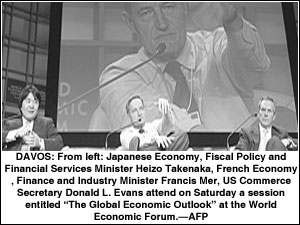 DAVOS, Jan 25: Top economic policy makers from the world’s major industrialized economies rejected on Saturday widespread criticism that they were dragging their feet on efforts to restore growth.
Ministers from the United States, Japan, Germany and France all said sound policies were now in place to stimulate long-term growth of their economies. But some conceded that short-term prospects were far less rosy.
“There is no magic way but we are moving in the right direction,” Japanese Economics and Financial Services Minister Heizo Takenaka said.
“In the next two years, we will be steering the adjustment period, but beyond that we will be able to restore our potential growth path of two per cent or so,” he told the World Economic Forum.
The meeting has highlighted sharp divisions between policy makers and some private sector economists who have urged far more aggressive measures to reignite the global economy which has been dragged down by the sluggish performance of the United States, Japan and Europe.
Prospects have also been clouded by investor fears of a war against Iraq and widespread scepticism at the pace of structural economic reform in the major nations.
“I have heard a general lack of proposals to do anything about the short-term,” said Paul Krugman, professor of economics at Princeton University, for years one of the harshest critics of Japan’s economic policies.
“Japan should be throwing the kitchen sink and the rice cooker at the problem,” he said.
Obvious divisions between the United States and European nations over Iraq have also added to concern.
“It is obvious here at Davos that there are very significant divisions between Europe and the United States,” said Peter Sutherland, Chairman of Goldman Sachs International.
“From a business point of view, it is very important that this not be allowed to contaminate the economic relationship.”
US Commerce Secretary Donald Evans shrugged off forecasts of a sub-par US economy and said American growth was underpinned by strong productivity gains which now appeared to be anchored in the economy. President George W. Bush’s newly unveiled package of tax cuts would add a short-term stimulus.
“We have got the fundamentals in place for America to continue to grow,” Evans said.
In addition to widespread concern that Japan’s economy has been stagnating for several years, economists have increasingly criticized European policy makers, particularly in Germany, France and Italy, for dragging their feet on structural reforms.—Reuters




























