0
0

The bottom line on Iraq
NOW that Jan 27, the deadline for the submission of the UN inspectors’ report, is around the corner, it is important to be clear about the bottom line on Iraq.
The bottom line in the current crisis is not the need for eliminating weapons of mass destruction from the armoury of President Saddam since this is something on which the UN has already agreed and the UN mandated process is already underway. At the same time, there does exist an understanding of the fears and concerns of the authorities and people in the US, Britain and elsewhere of being targeted by terrorist elements with the help of such weapons.
There is also an awareness of the negative record of the Saddam regime both in the brutal treatment of its own people and in the unacceptable occupation of Kuwait, which gave a unique opportunity to the US to realize its goal of entrenching itself militarily in the energy-rich Gulf while acting as the saviour of the smaller Gulf States.
None of the above-mentioned factors, however, can justify the arbitrarily-held conviction of President Bush and Prime Minister Tony Blair (without reference to the still awaited inspectors’ report) about the continuing culpability of the Iraqi regime in the matter of weapons of mass destruction.
The present stage of the UN inspectors’ mission does not justify the level of military forces already dispatched to the Gulf, clearly in excess of the quantum needed, if the purpose was only to back up diplomacy by show of force.
There is also no justification for treating Jan 27 as the zero hour since the Security Council Resolution 1441 did not envisage this date as a cut-off point for diplomatic processes but a designated stage for a status report, beyond which a further inspection time-span of a few months has already been visualized by the inspectors themselves and by Secretary-General Kofi Annan. In the absence of an agreed UN position, any US-led attack against Iraq would conclusively end the moral authority of the United Nations and usher in a world order based only on superior force.
The bottom line in the situation, however, is none of the above factors but the tragic prospect for the hapless Iraqi people. They have already gone through unprecedented sufferings and terrible privations as a consequence of the Gulf War of 1991 brought on no doubt partly with the suicidal folly of the Saddam regime itself.
No quibbling over Saddam’s transgressions or claims of a non-extendable deadline, the arbitrary conviction of Bush and Blair or the sad inability of the millions of decent Americans and Englishmen and women to block the impending war can justify another Armageddon within a decade being visited on the same Iraqi people, who have already lost a whole generation.
MAHDI MASUD
Karachi
‘Stops’ at Lahore airport
ON my recent trip to Pakistan after three years, I made a few observations on both my inbound and outbound international flights at Lahore airport.
On landing at the airport, I found that long passenger queues had many crying children. There were not enough immigration officers to stamp passports and it made the passengers wait for hours in the queues. Some officers were kind enough to offer water to harried mothers and their crying children.
The most frustrating part was the time the immigration officers took to add the passengers’ data in their computer. After getting the passports stamped and submitting their white forms with other pertinent details, the passengers proceeded to locate their luggage.
It was a completely inhuman sight near the conveyor belt. The baggage cart was driven towards the conveyor belt. On the outbound flight from Lahore, the following were the stops a passenger had to go through:
Stop 1. Customs. It would have been nice had the airport authorities clearly defined what needed to be declared to the customs. This is the way all civilized countries function. Otherwise, custom officers can exploit passengers in any manner.
Stop 2. Boarding pass and baggage checked in.
Stop 3. Exit stamp on the passport. Here’s where the traumatic experience began again. I was unable to understand the rationale for having latest Dells without an efficient database system.
Stop 4. Green card/visa/passports re-analyzed. At this desk, an officer was sitting in his comfortable seat in a very casual manner.
Stop 5. ECL. A shrewd fellow was assigned to grab passengers’ passports and punch in their numbers to check against the existing ECL.
Stop 6. Luggage tags checked and punched. This was the most annoying step before a passenger left the main hall, where they had already spent enormous amount of time moving from one desk to another.
Stop 7. Waiting lounge.
Stop 8. Shuttle bus drive to the aircraft. All tags were reconfirmed and rechecked before the passenger embarked on the plane.
This whole process took at least two and a half to three hours to catch my outbound flight.I was flying via Emirates and they provided the passengers with an excellent service and were on time everywhere.
The best part of the airport ordeal was seeing two young women immigration officers, who were diligently performing their task side by side slow male clerks.
ZAHRA JAMSHED
New Jersey, USA
Why drink costly mineral water?
THE municipal water supplied to our cities is generally considered safe for drinking. But it is surprising to see bottles of mineral water placed in front of our rulers at official meetings and public gatherings even in cities like Islamabad and Lahore.
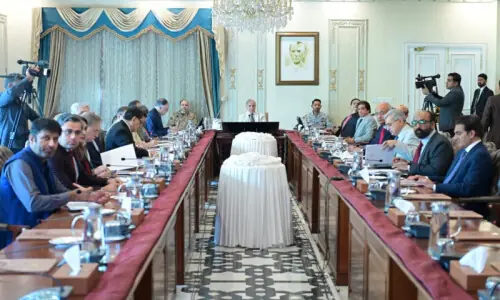
A PTV news bulletin on Jan 18 showed the president addressing the provincial cabinet members at the Governor House, Lahore. The president with the chief minister and other dignitaries sat at the head table adorned by mineral water bottles in front of everyone.
The question arises: if the water supplied even to the Governor House is not considered safe for drinking by the president, what about the 10 million common people of Lahore who have to contend with Wasa water since they cannot afford the expensive bottled water? If this is the quality of water supply in Pakistan’s second largest city, the plight of the people of other cities and towns could be well imagined.
Is it not a proof of failure on the part of the Punjab governor and the chief minister to supply safe drinking water to the city of Lahore? Instead of providing mineral water bottles, why did they not reprimand the officials concerned to ensure safe potable supply to Lahore? Why is the big ‘white elephant’, Wasa, being sustained by ever-increasing water rates paid by the Lahoriites if it cannot supply potable water?
The solution of the problem seems simple. The president, the governors and the ministers must ban forthwith the use of bottled mineral water in official meetings and gatherings. Instead, they should insist on being served from the common municipal water supply system. The officials concerned must be compelled to ensure requisite water quality as their basic responsibility.
(Engr) B. A. MALIK
Lahore
Pemra & cable operators
THIS is with reference to the editorial, ‘Cable worries’ (Jan 10). We share your concern for cable operators.
Pemra (Pakistan Electronic Media Regulatory Authority) is a subscriber-friendly organization, be it cable operators or any other licensees.
As an independent institution, Pemra safeguards the interests of its licensees as well as end users, i.e. the public. In fact, amongst regulatory bodies in Pakistan, it is unique in respect of public participation in the form of council of complaints.
Pemra condemns the unfortunate incident in Peshawar, and has taken up the matter with the NWFP government, which has assured the authority that it will take all possible steps for the protection of licensed cable operators in the province. The government has also promised to ensure that such incidents do not take place again.
It is also pointed out that, while the authority is a facilitator for the private media, it is also a guardian of audience interests. If people complain against a media network for showing a programme, which hurts their sensitivities, someone has to listen to them to redress their grievance.
Every sane citizen would dislike a programme which encourages violence, terrorism, racial, ethnic discrimination, sectarianism and hatred. Someone duly authorized by the law has to step in to stop the showing of such a programme.
MUHAMMAD SALEEM
Deputy General Manager (PR), Pemra,
Islamabad
‘All this and MMA too’
I DIFFER from A. B. S. Jafri’s views in his article titled “All this and MMA too” (Jan 19).
The writer has bitterly criticized “Madressah graduate MMA leaders dilating on almost everything under the sun about which they hardly have a clue.” But what about many of our completely uneducated leaders, who have sat in the driving seat as ministers, and are passing orders on matters of vital national interest?
I remember one education minister who could not sign his name. And what about the majority of our highly educated elites running the affairs of this country in public and private sectors who do not have a clue about what it means to be a Muslim?
They call themselves Muslim because they were born to Muslim parents, follow a few religious rituals, and that’s all. I know what this kind of “highly educated” people feel and think, because I have been one of them.
The writer says: “The MMA thinks the people of Pakistan are short of morals.” Yes, it is true the Muslims who created a homeland called Pakistan have fallen short of Islamic morals. In today’s world when Muslims in all parts of the world are being persecuted for being Muslims, it is time to find out what Islam really is. The holy Quran is not a textbook of science, politics and philosophy. It is something above all these things.
I differ with Mr Jafri when he says that the MMA victory in the general election was simply the result of anti-American slogans. I think it was also due to a spirit of re-awakening among the people of Pakistan about the need to rethink and remodel their lives and society according to the principles of Islam.
DR M. SHAHAB ATHAR
Karachi
Vengeance
ARDESHIR Cowasjee should refrain from facetiously referring to Mohammad Ali Sayeed, an esteemed lawyer, a retired judge of the Sindh High Court and the seven times president of the SBC, as “my friend”. Had he been a friend, he would have known that advocate Sayeed was severely ill, and yet had the integrity to represent his client, Dr Qadeer Khan.
Discerning readers could hardly have taken Mr Cowasjee’s personal attacks on the lawyer’s health seriously. They were in bad taste. His remarks were the domain of the podium at Hyde Park, where any loser can splutter out his own demons.
Is Mr Cowasjee a superhuman? Has he never coughed or sneezed in his entire life? I can only wish him good health for it is not my place to do otherwise. But vicious attacks do have a sinister way of catching up with you. “Vengeance is mine,” says my Lord. “I will repay.”
SHAISTA SHAFQAT
Karachi
Following EU example
CAN I appeal to the people of Pakistan to persuade their government to leave the question of Kashmir in abeyance and start building good relations between our countries and peoples?
We should abolish the visa requirement and allow free movement of people, capital and trade in line with the European Union. We should cut the defence expenditure and use these resources to improve the living standard of our peoples. After all, we are the same people and used to be one nation.
If Germany can become a friend of the Europeans immediately after the World War II, what’s wrong with us and why can’t we get together?
We accept that the question of Kashmir need to be resolved, but we have tried to resolve it during the last 53 years and are still continuing our efforts. If we have waited all these years, we can wait for another few years while we build cordial relations between the two countries. We must first meet the basic needs of our people such as education, health, food and the necessary infrastructure by diverting the resources from the defence expenditure.
Pakistan or India can never use nukes to kill our own brothers and sisters. Even, the US refrained from using them against Germany. Unless we start encouraging our peoples to follow this line, we would remain a poor country.
While other nations are getting together, we are just fighting among ourselves. We must not allow religion to formulate the policy of a nation. The politicians use it only to gain power and glory for themselves while we are starving and cannot get medical treatment or provide education to our children. Let us not leave these matters to politicians alone.
P. K. VERMA
Cardiff, UK
Pakistan’s squad
WE at the PCB take strong exception to Col (Retd) Rafi Nasim’s diatribe against the PCB in his letter, ‘Another cricket record’ (Jan 23).
For one, the retired colonel may not know, but Saeed Anwar is not the only Pakistani cricketer to have made the pages of Guinness Book of Records. There are several others as well, but this is not the right place to mention them, nor is it the purpose of this rejoinder.
And we are sure that seven officials, not nine, (as Col Rafi has mentioned) on a cricket tour, specially as important as the World Cup, is not a record by any standard.
Front-line cricket teams such as Australia and England have a host of officials providing back-up and support to their squads, specially when they are on long and important tours, where the probability of wear and tear, both physical and emotional, is extremely high, not to mention the requirements of usual coaching and counselling.
We at the PCB assure you and the people of this country that not a single member of the team is a joyrider. All of them have well-defined roles and duties, and all of them would surely contribute to the team’s sense of well-being during the World Cup.
KHALID BUTT
Manager, Public Relations, PCB,
Karachi
Challenges before Ibad
IF the appointment of Dr Ishratul Ibad as governor of Sindh is a good omen, it is an acid test for him as well.
The new governor has manifold challenges to meet and many commitments to fulfil. Karachi is the nucleus of Pakistan. It holds paramount significance in all dimensions, and can play a crucial role both in shaping the destiny of the country and in making it stronger ideologically, economically and politically.
Solving problems of Karachi is not an easy task. Governments in the past have a track record of paying lip-service to these problems. Karachiites are hoping to see the governor utilize his capabilities and endowments to fulfil the expectations of the people.
Dr Ibad needs to set his priorities with a view to solving the city problems and providing much-need relief to the people. If he really wants to solve these problems, he will have to get through the climate of political polarization in the province.
As he has already affirmed that he would foster a policy of tolerance, candidness and coexistence, he has to uplift the image of his party at the national level. He should also generate an atmosphere of goodwill and confidence between the federation and the province.
S. Q. AFZAL RIZVI
Karachi
Pensioners
THE Pensioners Benefit Accounts Scheme announced by the CDNS (Jan 20) has come as a great disappointment to hard-pressed pensioners. The return on deposits comes to actually 9.36 per cent, as against 11.04 per cent being claimed by the authorities. This is a meagre profit rate considering the cost of living, which is fast increasing.
M. ZAFRUL HASAN
Karachi
War on terror
IN his column, ‘Who’s winning the war on terrorism?’, Mazdak has taken upon himself to become Osama bin Laden’s mouthpiece for justifying his views.
Osama turned against Americans because of a very simple reason; their presence in the Muslim holy land, Saudi Arabia. He came to Afghanistan, originally, to defeat the Soviets but he discovered that his erstwhile allies had wormed their way into the holy land. This was the origin of his differences with Americans.
Mazdak needs to be careful about historical facts before making such sweeping statements.
TARIQ SHEIKH
UAE
Adoption laws in Pakistan
I AM writing on behalf of many US citizens in general and the US citizens of Pakistani origin in particular, who express a great deal of interest in adopting children from Pakistan. However, it is virtually impossible to complete local adoption requirements, as there is no set mechanism under Pakistani laws about this matter, making it impossible to obtain an adoption visa for a child.
I have first-hand knowledge of the situation because I work for a lawyer, who specializes in US immigration laws. American agencies have experienced a steady decline in the number of children available for adoption. Americans are increasingly turning to international adoptions, from countries such as China, Russia, Rumania, Korea and Ecuador. Under the US immigration laws, in order to obtain immigration benefits for an adopted child, the petitioning parent must be a US citizen or a permanent resident. However, only parents with the US citizenship can petition for an orphan.
The parents petitioning for an adopted child must show that they adopted the child while the child was under the age of 16. They must also show that they have had legal custody of the adopted child for two years and that the child has been residing with them for two years.
The advantage of an orphan petition is that a US citizen can bring a child into the US immediately. There is no requirement that the child has lived with the parent for two years, and there is no requirement of two years of legal custody.
In order to bring an orphan to American, a US citizen must comply with the laws of the child’s country of birth and obtain a local adoption there. Because there is no law of adoption in Pakistan, Americans may not adopt children from Pakistan and provide for their immigration to the US.
In 1993, the Hague Conference on Private International Law proposed a multilateral treaty to protect the rights of internationally-adopted children, called the Convention on Protection of Children and Cooperation in Respect of Intercountry Adoption. It received unanimous approval from all national delegations, including the United States.
I think it would be of great national interest if Pakistan established comprehensive adoption system under the auspices of the Hague Convention to facilitate visa issuance to the adopted children from Pakistan.
RIZWAN AHMED
New York, USA