0
0

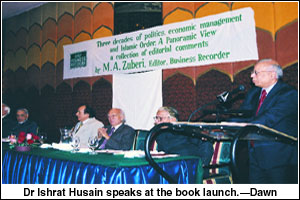 KARACHI, Jan 11: Members of the provincial and national assemblies should adopt a collaborative approach and work closely with the Nazims to ensure that the present three-tier system operates efficiently.
So said the State Bank’s governor, Dr Ishrat Husain, at the launching of a book by Business Recorder’s editor on Saturday afternoon. The book — entitled “Three Decades of Politics, Economic Management and Islamic Order: A Panoramic View” — is edited by the daily’s executive editor M.A. Akhyar and contains selected editorials by its editor, M.A. Zuberi.
“Today the MNAs and MPAs feel threatened by the Nazims and vice versa,” said Dr Husain. “They should not feel threatened. If the MNAs, MPAs and Nazims work together there’s no reason why the existing system, involving federal, provincial and local governments, should fail in fulfilling the needs of the people.”
Like several speakers before him, Dr Husain said in the last three decades there were several problems which had been identified in these editorials, which ironically remained unresolved even today. Among them are the issues of provincial autonomy, role of the armed forces and devolution of powers.
The State Bank’s governor said Mr Zuberi was among the first to point out that the country’s debt burden was assuming serious proportions. “Then the country’s debt burden was only $10 billion.”
Presiding over the book launching ceremony, Dr Husain said these editorials had very rightly opposed general subsidies and had called for the widening of the tax net. In his editorials he also cautioned against deficit financing.
The State Bank’s governor was of the view that Mr Zuberi, while writing editorials, depended only on cold logic and reasoning. “Unlike some columnists of today who get too emotional, Mr Zuberi always remained methodical and logical.”
He added that these editorials had suggested several steps which had been adopted recently by the government inadvertently.
Speaking on the occasion, the former chief editor of Dawn, Ahmad Ali Khan, said Mr Zuberi had launched an economic and business newspaper when the market for such a daily was very small. “The success of this newspaper, under very difficult circumstances, speaks volumes of Mr Zuberi’s abilities.”
Mr Khan said the Business Recorder’s editor had pointed out several flaws in the political system. “For instance, he pointed out that even though education and health were concurrent subjects which were largely taken care of by the provincial governments, there were large ministries at the federal level too, which cost a lot in terms of pecuniary burden.”
He said Mr and Mrs Average’s problems remained unresolved even today. “About 90 per cent of Pakistanis don’t get potable water. We may have made some progress but if we cannot even provide safe water to our people what good is this progress?
“Most of the problems have been festering for the last three decades. It’s the duty of people like Mr Zuberi to guide the people.”
He opined that the free market economy system wasn’t necessarily the best, and therefore, the last economic system to be seen by the world. “Man has been experimenting with various economic system. A time may come when we will realize that even this system has flaws.”
Journalist Sultan Ahmed said Mr Zuberi was a champion of economic and political freedoms. “His editorials on corruption and international financial institutions are as relevant today as they were when they were written.”
Introducing the book, Mr Akhyar said that it had been divided into seven sections and only those editorials had been selected for publication which were close to writer’s heart. These selections deal with issues in constitution, policymaking, taxation, Islamic order, governance, financial institutions, etc.
Briefly speaking on the occasion, M.A. Zuberi said he had always tried to faithfully follow Quaid-i-Azam Mohammad Ali Jinnah’s instructions that were given to him at the beginning of his journalistic career.
Yusuf Shirazi, Ferozuddin Cassim and Feroz Qaiser also reviewed the said book.