0
0

Change of guard in Sindh
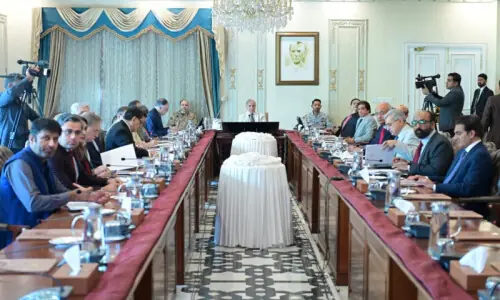
DR Ishratul Ibad has taken the oath as governor of Sindh. Political analysts and his supporters are of the view that the urban-rural divide in the province will now come to an end and the Sindhi and Urdu- speaking people will be able to live in harmony.
The people of Sindh, too, are hopeful that important issues such as unemployment, corruption, water scarcity and law and order will top the list of his priorities.
A most immediate and important task is the induction of a cabinet. It is regrettable that, despite the passage of more than two months since the general election, a cabinet has not been formed yet in the province.
It will be a good gesture on the part of the new governor to shift from the Governor’s House to a modest accommodation and set an example of austerity.
Should he choose to do so, he will become more accessible to the common man and will be in a better position to assess the situation in the province.
The Governor’s House can be used as a museum. It was the residence of Quaid-i-Azam Mohammad Ali Jinnah as the first governor-general of Pakistan and has some relics, including the Quaid’s office furniture.
Last but not least, the governor’s movements should be swift and unobtrusive. No wailing sirens and no stoppage of traffic, as has been the practice so far.
Traffic jams caused by the former governor’s movements were resented by all sections of society. It is sincerely hoped that, being a member of a political party which has stood for the poor and the downtrodden of Karachi, in particular, and Sindh, in general, Dr Ishrat-ul-Ibad will take positive steps to bring about a marked improvement in the province.
AZAM SULTAN AHMED
Karachi
THE appointment of Dr Ishratul Ibad (an MQM nominee) as governor of Sindh is the last nail in the coffin of the so-called good governess trumpeted by Gen Pervez Musharraf for the last three years.
A person against whom a number of serious criminal cases were registered has been brought back from England only to secure the backing of the MQM in the formation of pro-Musharraf governments at the centre and in Sindh.
The nation would like to know as to why the alleged wrongdoings of a person like Dr Ibad have been ignored for the sake of political expediency and why PPP Chairperson Benazir Bhutto and PLM-N leader Nawaz Sharif have been forced to call it a day and quit the country.
If the politics of hypocrisy, self-interest and ‘Musharraf first’ continues to be practised, what can you expect from the new government which is facing countless problems?
BULEND AWAZ KHAN
Toronto, Canada
Year 2002 in review
THE year 2002 was a bleak and frustrating one for Pakistanis, most of whom remained in the grip of unemployment, increasing poverty, lawlessness and double standards. The policies of the military government failed to yield any positive results for the people.
Our sovereignty as an independent state was violated very frequently. The rate of suicides had never been as high as it was during the outgoing year. Our youth, too, became more dejected than they were in the previous years.
Instead of good governance and ‘real’ democracy promised to us by Gen Musharraf so many times, what we saw was lawlessness and self-promotion. Many state-owned semi-autonomous corporations were manned by those who have a history of financial embezzlement.
By blatantly murdering merit, individuals not possessing proper qualifications were given senior executive assignments. The way honest, hardworking and qualified civilians were denied and discriminated against had never been witnessed before the year 2002.
However, we must not lose faith in Allah Almighty. The Quaid’s dream of a welfare state will come true someday and all men irrespective of their caste, creed or faith will have equal rights and the people of Pakistan will be the masters of their own destinies.
MOHAMMAD SALAHUDDIN
Islamabad
HRCP & doctors’ arrest
I WONDER why the Human Rights Commission of Pakistan seems so choosy in taking up issues of human rights violations.
For example, one has to search hard to find in the newspapers whether or not the HRCP has protested against the recent arrest of doctors by the FBI in Pakistan.
The HRCP has so far shied away from condemning the killing of innocent people in Gujarat, Kashmir and Afghanistan, etc., on the pretext that it is concerned only with human rights violations in Pakistan.
May I ask the HRCP if the doctors who have been arrested by the FBI are not Pakistanis or human beings? Should it not have condemned their illegal arrest and detention by a foreign agency operating in Pakistan?
Given the HRCP’s silence on this important matter, one may conclude that the human rights body is too wise to offend its Western donors.
An examination of the way the HRCP has been working in the country will show that it is most vocal whenever human rights violations can be manipulated to degrade Islam.
I accept that everyone has the right to express their point of view but to act with partiality and then claim neutrality is not fair.
(Engr) M. ZAFAR IQBAL
Karachi
CSS exam subjects
SOME letters have appeared in these columns about the FPSC policy to encourage some subjects and discourage others by giving out-of-course questions.
According to reports, the disciplines of international relations, constitutional law and geography are at present at the top of the FPSC’s hit list.
One example is the paper of constitutional law given in the CSS-2001 examinations. In this paper which was both difficult and out-of-course there was no question from the constitutions of Pakistan, France and Russia. On the contrary, questions were included about the constitutions of Turkey and Switzerland, which are not part of the CSS syllabus.
Moreover, all the steps of the compulsory question were given in the form of blanks, instead of MCQs which was the practice in previous years.
In the CSS-2001 examinations, all the optional papers, except for constitutional law and Indo-Pak History-II, contained the compulsory objective questions in the form of MCQs, which are comparatively easier because, under this method, four/five choices are given to candidates.
If it is a policy of the FPSC to discourage some subjects, it should be clearly announced in the “instructions to the candidates” provided by the commission with the examination form so that the future of hardworking candidates is not ruined due to failure or minimum scores in such subjects, as happened in the CSS-2001 examinations.
NABEEL KHAN KAKAR
Abbottabad
Investment in Pakistan
ISN’T it strange that we all know about our problems but refuse to do anything to solve them? For example, many non-resident Pakistanis save money all their lives by working very hard abroad and then buy property in Pakistan in the hope that someday they will retire and be able to return to their homeland.
But a few years later they find that someone has occupied their property or house before their return to their country. Or, people to whom they rent out their houses refuse to vacate them on their return.
President Pervez Musharraf, recently speaking at the annual dinner meeting of the Pakistan Physician’s Public Affairs Committee (PAK-PAC), called for enhanced investment by Pakistani Americans in the country and assured them that the government would not commit any of the past mistakes like the freezing of foreign currency accounts by the Nawaz government. “Your money will be safe and it will not be misused,” he said.
When even a house is not safe and may be occupied by someone having no legal claim on it, what guarantee do Pakistani expatriates have that their monetary investments will be safe in Pakistan? What incentives are these expatriates offered to invest their capital in Pakistan? And why should they invest in the country when they have reliable security systems in foreign markets?
KHALID MAHMOOD
Redwood Shores, USA
Bush doctrine: an election ploy
The American political history has seen many presidents turn hawkish during critical times while neutrality remained the paramount pillar of their foreign policies but only on paper.
Successive American administrations have responded to the voices of jingoism whenever raised in either the House of Representatives or the Senate under such circumstances. The story began with James Madison, who responded to a call of war in 1812.
If we turn the pages of history, one thing will become clear to us: such voices/doctrines were always raised in the first term of a president. It can, therefore, be concluded that these doctrines were put forward and cashed in on mainly for winning the next presidential election.
Currently, the Bush doctrine aims to impose a world order in which the US will use international trade and military force to impose its will on so-called “rogue states” and on its allies alike.
Mind it, this doctrine, too, has been presented in the first term of President Bush W. Bush.
M. SAEED SARWAR
Lahore
SINCE when has it become the norm for one man alone to decide who will have what? Israel can, Iraq cannot. Pakistan will not keep any weapons, India will. North Korea is not allowed to build missiles but Yemen may buy them.
This is just like the old days of the bully-on-the -block, who decided everything for everyone. One of the participants on ‘BBC Correspondents’ called it extremely arrogant to tell others to rid themselves of (something dangerous) but hold on to its own.
Jimmy Carter has said that if the US wants others to do away with ‘theirs’, then it, too, must get rid of them.
KHURSHID ANWER
Lahore
Palestinian reforms
THIS refers to a new item (Dec 17) which said Tony Blair had invited Palestinian leaders to London to discuss progress on reforms in Palestinian areas and the international community’s role vis-a-vis the reforms’ programme.
The idea is not bad provided that these reforms are, as per aspirations of the Palestinian people, are introduced and implemented by a democratically -elected assembly, otherwise it seems that Western countries, specially the United States and the United Kingdom, are trying to buy time on behalf of Israel.
Z. A. KAZMI
Karachi
Pakistani passport
THIS refers to the letter, ‘Pakistani passport’ (Dec 21), by Ahmed Arif. He says Pakistani passports are the only one in the world wherein the name of the holder and his photograph are on different pages.
He also says that the world over, particulars in passports are written by machines whereas in Pakistan these are handwritten.
I am a Pakistani and a very frequent traveller. What causes problems to me at foreign airports is the illegible writing in which entries have been made in my passport.
When we ask our relatives to send photocopies of their passports for arranging visit visas, the entries are extremely difficult to read and one is unable to differentiate between ‘a’ and ‘o’.
This often results in different spellings of the same name and other particulars in the visa and the passport, causing unnecessary botheration at every stage.
Perhaps, no one has taught the staff in the passport office that entries in passports should be made in block letters so that their holders do not face any difficulties at airports abroad.
SHAHNAZ
Karachi
Income tax on NSS profits
IT has been reported in the newspapers that profits from national savings schemes and from other regular savings schemes will be liable to full income tax, besides the withholding tax which is already being charged.
It has not been made clear whether or not profits from the savings certificates purchased before the announcement of this decision, too, will be liable to income tax.
The government will be completely unjustified in levying income tax on savings certificates which were purchased before the announcement of this decision, because people bought those certificates with the understanding that profits would be subject to only a 10 per cent withholding tax.
When profit rates are revised, rates on previously -purchased certificates remain the same as what they were at the time of their sale.
This being so, no new taxes should be imposed on profits from the certificates other than what was applicable at the time of their purchase.
One of the factors inhibiting investment in Pakistan is our inconsistent national policies.
The imposition of a new tax on savings schemes is likely to affect the flow of investment in the country.
RAFI AHMED
Karachi
Murtaza Malik murder case
DANIEL Pearl was an American citizen, whose killers were apprehended, tried and given punishment — all within a few weeks.
Dr Ghulam Murtaza Malik, a great religious scholar, was a Pakistani citizen and killed in Lahore a year ago, but the police have not apprehended his killers yet.
It seems strange that the media has not picked on the poor performance of the police vis-a-vis this murder case.
S. ZAHID HUSSAIN
Lahore
Jinnah and secularism
ACCORDING to a news report, Federal Minister Mahmood Ali have criticized those who say that Quaid-i-Azam Muhammad Ali Jinnah was a secularist, and added that “he (the Quaid) never spoke about secularism and was a true Muslim”.
I am of the view that a Muslim, too, can be a secularist. Jinnah was a secularist, as evidenced by one of his pre-partition statements that it (Pakistan) was not to be “a theocracy to be ruled by priests with a divine mission”.
He never envisioned that Pakistan would become the kind of retrograde theocratic state that Ziaul Haq turned it into.
Thus, all oppressive laws must be repealed in accordance with Jinnah’s vision of a liberal, secular and democratic state.
SHAMIM MIRZA
New York, USA
Waiting for NIC
I SUBMITTED an application to a Nadra office in Muzzafargarh for a computerized identity card in March 2001 but have not received my card yet.
On inquiry, the office staff always tell me that there must be in my application some fault which has delayed the delivery of the card. They ask me to wait for some more time. It seems this wait will never end. The authorities concerned are requested to redress my grievance.
M. A. KHAN
Muzaffargarh
Garbage disposal in DHA
RECENTLY, the DHA launched a cleanliness campaign during which garbage was removed from plots and notices were put up, asking the residents not to use plots as garbage dumps.
Also, polythene bags were banned and garbage bins were placed outside houses for proper garbage disposal. The authorities even made a dumper truck available but the so-called elite of DHA Phase V (where I live) failed to cooperate with the authorities and garbage is still being thrown on plots.
It is amazing that people who are always talking about clean streets and roads in the foreign countries they have visited make absolutely no effort to do the same here.
Maybe, this is because the notices issued by the DHA were in Urdu and our educated elite simply cannot understand them. I urge the authorities concerned to re-issue notices in English so that our educated elite can easily follow their instructions.
SAAD FAROOQ
Karachi
Crimes against women
THIS is with reference to the news report, ‘Murder most foul’ (Dec 17), which gave a detailed account of how a woman, Shamshad Kehar, was mercilessly killed.
She was beaten with sticks and bricks allegedly by her uncles and other relatives. Then her hands were chopped off before she was stoned to death. Her alleged crime was that she had supposedly danced with a male member of her tribe on the occasion of Eidul Fitr.
One reason for the frequent happening of such incidents in our society is that culprits escape punishment by greasing the palms of those who are tasked with and paid for bringing them to justice.
One way of bringing such inhuman practices to an end is to create awareness about women’s status and their rights. Men in our society need to be taught that women, too, are human beings and deserve respect.
The government must ensure that offences committed against women do not remain unnoticed and unpunished.
NABIL HOODBHOY
Karachi
THIS refers to a news item (Dec 23) about a woman who was arrested under the Hudood Ordinance, and the Human Rights Commission of Pakistan’s report on the menace of karo-kari in Sindh for the year 2002.
The HRCP’s report shows that girls as young as from three to 10 years were among those killed on the pretext of their being a “kari”.
The report says that out of 200 people arrested for their alleged involvement in ‘honour killings’, only eight were prosecuted and punished.
Sadly, incidents like the aforementioned one have become a routine. Action is taken in only those few cases which draw public attention but justice is not done in most cases.
This indifference being shown towards violence against women and other women-related issues is very sad. It seems that we are still living in the Stone Age.
NISHAT NAQVI
Karachi