0
0

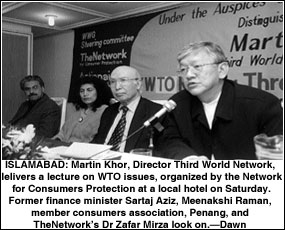 ISLAMABAD, Dec 28: The developing countries should launch a joint struggle against the hidden manipulation of the World Trade Organization (WTO), as it is an agreement against the poor economies due to which the lives of consumers is being affected.
This was stated by an eminent economist and director of Third World Network, Martin Khor, while speaking at a lecture on “WTO Regime, Threats and Opportunities”. here on Saturday. The lecture was organized by WTO Watch Group, a coalition of Pakistani NGOs including WTO Watch Group and Action Aid. Mr Martin termed the WTO a criminal agreement, which was hurting the farmers of developing countries as well.
He clarified at the start that his organization was not against the globalization or liberalization but the kind of globalization and liberalization taking place had many weaknesses detrimental to the economies of the developing countries thus bringing bad name to the WTO itself.
He emphasized the need for exploring more and more information about the WTO implications over the developing countries saying that the WTO should be a forum where these countries could exercise their right. He also asked the civil societies in the third world to contribute so that their governments could be strong to withstand the manipulative pressures by the developed countries.
Mostly in the developing countries, the WTO was considered a technical economic issue but it is going to affect every thing in relations to jobs, food, policies and strategic advantages, the economist said adding currently the developing countries were incapable to participate with full potential in the process of WTO, which was going to be implemented from the year 2005.
He said huge multinational corporations intended to enter in the developing countries to capture their market and once they were in, these agreements would prohibit governments of the developing countries to regulate them meaning that these companies could move their cash in and out free without any check.
“The agreement would also prohibit the local companies to get any advantage over these multinationals.”
Secondly, the agreement would also ensure that the multinationals also enjoy a slice over government expenditures through equal chance in government procurements, which were usually more than the imports, he said.
The former finance minister, Sartaj Aziz, while concluding the programme said the rich countries were not treating developing countries fairly.
Meenakshi Raman, a well-known lawyer and member of the consumer association of Penang, also spoke on the occasion.