0
0

WASHINGTON, Oct 28: PPP Chairperson Benazir Bhutto on Monday urged the United States to review President Gen Pervez Musharraf’s performance since Sept 11 last year when he had dumped Pakistan’s Taliban allies to join war on terror.
Talking to journalists and intellectuals in Columbia, Maryland, Ms Bhutto said that despite Gen Musharraf’s support to the US forces in the region, both the Taliban and Al Qaeda elements had already started regrouping.
“There have been attacks on US and Western targets in South Asia, Yemen and Bali. It’s only a matter of time before there’s another attack,” Ms Bhutto said, adding that it was in America’s interest to “support a democratic forces, and not a military man, in Pakistan”.
Ms Bhutto, who was scheduled to meet some senior US officials later in the day, is visiting Washington to persuade the Bush administration not to support the military government.
The former prime minister agreed with intellectuals that Washington still saw President Musharraf as its ally in South Asia and would continue to support him, but urged the Americans to review their policy.
She said that religious parties would have a majority in the Senate which would allow them to have their man elected as chairman of the upper house.
If this happened, she pointed out, it would bring about a major change in the political scenario. “The Senate chairman takes over as the acting president when the president is out of the country. As acting president, he will also have the power to appoint the army chief,” Ms Bhutto said, suggesting that such a development could turn Pakistan into a religious state.
She further said that if Pakistan became a religious state, it would affect the entire region. “Talibanization of Pakistan would also affect Afghanistan and Central Asian states. It will encourage Muslim insurgency elsewhere and destabilize the entire region.”
“Unfortunately, the United States has put all its eggs in one basket,” Ms Bhutto said, urging Washington to revive its contacts with political forces in Pakistan to deal with these possible developments.
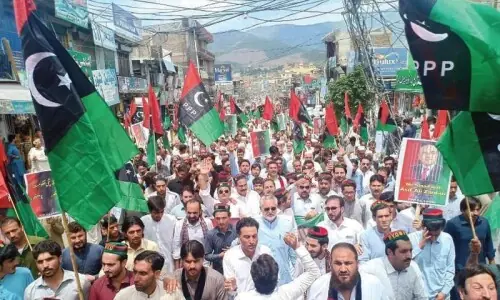
She attributed the emergence of the religious parties as a strong political force in elections to “a backlash against US policies in the region but only to a certain extent”.
She claimed that the military government had decided before elections to give the NWFP to the religious forces. By bringing Muttahida Majlis-i-Amal on the forefront, she said, the military government wanted to tell the Americans that they should continue to support the army if they wanted to prevent extremists from taking over the country.
The PPP leader said that the military regime did not want to transfer power to an elected government and would soon go to the Supreme Court saying that since the politicians had failed to form a government, it should allow the army to hold fresh elections.
“In the absence of secular political parties, the religious parties may emerge as a stronger force from the fresh elections. They may also be given Punjab and Sindh,” she warned.
She said that MMA’s victory would not directly affect Pakistan’s foreign policy as it was a federal subject and the MMA did not have enough seats in parliament to form a government at the Centre.
“But it may affect the US campaign (against Al Qaeda fugitives) in the tribal areas of the NWFP where the MMA is in a position to form the provincial government,” she said.
Law and order, she said, was a provincial government and an MMA government in the NWFP could prevent the US and Pakistan forces from continuing their search for Al Qaeda fugitives in those areas.