



 0
0

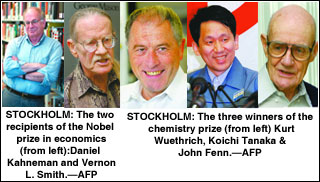 STOCKHOLM, Oct 9: Daniel Kahneman and Vernon Smith of the US won the Nobel economics prize on Wednesday for their work on how psychology affects people’s buying decisions and for developing laboratory experiments in economics.
The Royal Swedish Academy of Sciences said on Wednesday the two Americans will share the one million dollars prize for ground-breaking studies taking economics beyond the traditional assumption of rational human behaviour driven by self interest.
Smith, 75, born in Wichita, Kansas, is a professor of economics and law at George Mason University in Virginia.
“He has developed an array of experimental methods, setting standards for what constitutes a reliable laboratory experiment,” the academy said.
Smith spearheaded “wind-tunnel” tests where trials of new market designs, such as a deregulated electricity market, are carried out in a lab before being implemented in practice.
Kahneman, born in Tel Aviv, holds US and Israeli citizenship. He is a professor of public affairs at Princeton University and the first Israeli to win the Nobel economics prize.
“Kahneman has integrated insights from psychology into economics, thereby laying the foundation for a new field of research,” the academy said.
He discovered how human judgment may take shortcuts that systematically depart from basic principles of probability.
Jorgen Weibull, a Boston University economics professor and member of the academy, told Reuters that the two research fields developed by the laureates were now being combined.
“You test a new model on how people make decisions in the lab and use experimental methods designed by Vernon Smith,” he said.
AMERICAN HEGEMONY: Americans have scooped up most of the honours by far since the economics prize in memory of Alfred Nobel, the Swedish industrialist who invented dynamite, was first awarded in 1969.
Kahneman’s work on “heuristic shortcuts”, or rule of thumb decision-making, sheds light on why big moves may occur on stock markets without any obvious reason.
“An investor who recognizes that a fund manager beats the index two years in a row may conclude that the manager is systematically more competent,” the academy said.
Such shortsightedness in interpreting data is not borne out by true statistical implications, but might explain unwarranted financial market swings, according to Kahneman.
His work also helps explain some people’s willingness to drive many miles for a few dollars’ discount on a minor purchase, but reluctance to do so in order to save the same amount on a more expensive buy, the academy said.
Smith’s economics wind-tunnel tests, developed already in the 1960s, have been used in a lab environment to test auction mechanisms for privatisations and public procurement.
“Since these mechanisms are frequently complex and it is difficult to assess their performance solely on the basis of theoretical considerations, the experimental method becomes particularly useful,” the academy said.
PROCESS OF LIFE: John Fenn of the United States, Japan’s Koichi Tanaka and Kurt Wuethrich of Switzerland won the Nobel Prize in Chemistry on Wednesday for advances in understanding the process of life.
They share the one million dollars prize for developing powerful analytical tools to study large molecules like proteins, which can lead to new drugs to tackle disease, the Royal Swedish Academy of Sciences said.
“Their work has paved the way for the future finding of a cure for cancer,” said Bengt Norden, chairman of the Nobel committee for chemistry. “Without it, there would be no modern pharmaceuticals.”
The scientists developed techniques that can be applied to diagnose cancer early, monitor sports doping, analyse environmental pollution and improve control of foodstuffs.
Fenn and Tanaka created a process to ascertain the size and quality of proteins, one of the building blocks of life contained in cells, by developing the widely used technique of mass spectrometry to analyse large molecules.
Wuethrich developed a tool which identifies the structure of proteins in the cells, making it possible to study proteins in an environment similar to that of the living cell.—Reuters





























