0
0

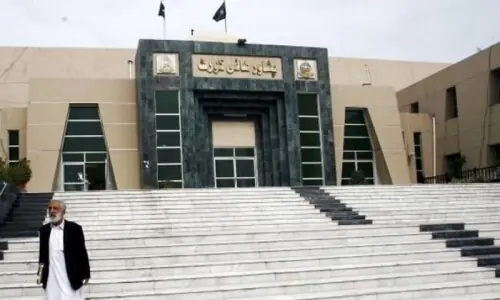
PESHAWAR, Sept 1: The Supreme Court has declared the detention of dozens of doctors by the provincial government in 1998 a violation of the constitution.
In its detailed judgment, in the cases of termination of services of three office-holders of Pakistan Doctors Association (PDA) and Pakistan Medical Association (PMA), a full bench of the apex court observed that the authority, instead of adopting amicable/cordial methods to resolve the crisis, put majority of the doctors behind bars and got them incarceration for about three weeks.
The court observed that this attitude of the authority was certainly violative of Article 14 of the Constitution which upheld the dignity of man as his inviolable right. “The stigma of incarceration for such a long period would certainly haunt their future career,” the court added.
The short judgment was delivered on July 18 by the bench comprising Justice Mian Muhammad Ajmal, Justice Tanvir Ahmed Khan and Justice Sardar Muhammad Raza Khan, while dismissing three petitions of the NWFP government for leave to appeal filed against a consolidated judgment passed by the NWFP Services Tribunal, Peshawar, on April 21, 2001. The detailed judgment was released on Aug 30, 2002.
The three doctors — provincial president of PDA, Dr Liaquat Ali, former president of PDA, Dr Kamal, and provincial president of PMA, Dr Hussain Haroon — were dismissed from service by the provincial government in May 1999 following which they filed appeals before the services tribunal, which were accepted.
The court also took note of the direction to the three respondents to appear before the secretary health, and observed that the application of the respondents (doctors) for the change of authorized officer was not attended to for reasons best known to the authority.
The court ruled that it was an age-old fundamental principle of law that justice should not only be done, but should manifestly and undoubtedly be seen to have been done.
To achieve this objective, it is of prime importance that a judge equipped with the authority to take decision, should not be someone who could has personal interest in the outcome of the case before him. The court observed that it was an established principle that no person should be a judge in his own case. As strike was observed against the appointment of a non-technical secretary health, therefore, it was not in the interest of justice to appoint secretary health as authorise officer in their case.
The bench also gave its findings about the doctors’ strike stating that they should always resort to legal means to vent their feelings and should avoid being an instrument in the obstruction of medical assistance to innocent people.