0
0

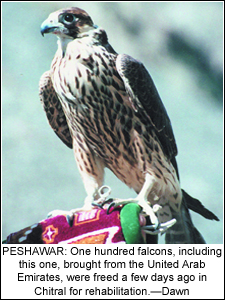 PESHAWAR, May 23: Falcon’s population is on the verge of extinction due to its unabated smuggling from Pakistan and Central Asian states to the Middle East, falconers and wildlife conservators have said.
Traders and trappers in Peshawar say that despite the ban on the export of different species, falcons are smuggled mainly to United Arab Emirates (UAE), and that Islamabad and Karachi are the main outlets for illegal trade of the bird.
The bird, which migrates from high lands to plain areas due to cold weather, is mostly found in the plain areas of Pakistan and Afghanistan. Trapping season starts in August and continues until December when the bird re-migrates to high altitude lands.
At present, most of the falcons traded in Peshawar have been brought from China and Afghanistan, according to official reports.
As the falcons have become non-existent in Pakistan, trappers now have moved towards a Chinese territory along the Pakistan border areas, a best sanctuary of Saker and Peregerine, the best quality falcons.
Some two years back, two illegal trappers from Peshawar lost their lives in an attempt to catch falcons in the border areas of China. Presently, the Chinese government hands down severe punishments to illegal falconers.
Gul Badshah, local falconer, who has been in the business for 15 years, told Dawn, “The bird is extremely rare owing to its smuggling to the oil-rich sheikhdoms.”
Makri Bazaar, in the slums of Peshawar, is famous for the business of falcons. A few years back, Arab falconers frequently visited the bazaar to buy fine quality birds, and used it for hunting Houbara bustard. Now, the market has lost its attraction due to opening of new smuggling routes in the region, particularly Afghanistan. “I have never seen a single Sheikh (Arab) in the locality for the last seven years,” said Badshah.
Under the policy, only dignitaries from the Middle East are allowed to export 250 falcons from Pakistan every year — 180 from the NWFP and 70 from Punjab. A couple of days back, the UAE government sent around 100 falcons, which were set free in Chitral. Conservators fit transmitters with falcons to monitor their movement in the natural habitats.
An official of the wildlife department said that during the Taliban government, Afghanistan’s southern city of Kandahar had become a major market for falcons, found only in those parts of the globe. “Once Arab falconers airlifted over 300 falcons from Kandahar to Dubai (UAE).”
The official said the Convention on International Trade in Endangered Species of Flora and Fauna (CITES) — an international wildlife conservation body — was also concerned about the falcons’ smuggling from the region, and had imposed a one-year ban on its export to the UAE with a view to discouraging illegal business of the bird.
The wildlife department asked the federal government to review the prevalent export policy of falcons to Middle East to end the Arabs’ monopoly.
The provincial government has recommended to the federal government to abolish quota restrictions and simplify procedural requirements for export permit for Pakistanis to help them earning foreign exchange.