



 0
0

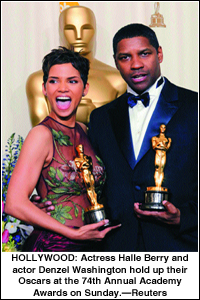 LOS ANGELES, March 26: Oscar glory bathed black stars as never before on Sunday, as African-American performers claimed the top acting awards for the first time, and Sidney Poitier was saluted as the first leading man to cross Hollywood’s colour barrier.
The combination of a strong cast and a director, Ron Howard, known for his bouncy optimism proved to be the right formula for a “A Beautiful Mind,” earning it the best picture Oscar here Sunday.
“This moment is so much bigger than me,” a shivering Halle Berry exclaimed through tears as she accepted the first best-actress statuette ever presented to a black performer. She won the prize for her role in the racially charged film “Monster’s Ball.”
“And it’s for every nameless, faceless woman of color that now has a chance because this door, tonight, has been opened,” Berry, 33, said. “I am so honored, and I thank the academy for choosing me to be the vessel for which this blessing might flow.”
Moments later, Denzel Washington, 47, claimed the second Oscar of his career, and his first as a lead actor, for playing a corrupt cop in the gritty drama “Training Day.” He became only the second African American to win the best-actor prize, nearly four decades after Poitier became the first to do so for “Lilies of the Field” in 1964.
“Two birds in one night, huh?” Washington said as he emerged smiling on stage. “Forty years I’ve been chasing Sidney. They finally give it to me. What do they do? They give it to him the same night. I’ll always be chasing you, Sidney. I’ll always be following in your footsteps. There’s nothing I would rather do.”
ADDED TRIUMPH: The nomination of Washington, Berry and Will Smith, for his biographical boxing portrait in “Ali,” marked the first time since 1973 that three black performers were nominated in lead acting categories in the same year. And the Oscar victories of Washington and Berry — only the seventh and eighth statuettes ever taken home by African Americans, was an added triumph.
The theme of racial diversity in Hollywood even figured prominently in the evening’s humor from Oscar host Whoopi Goldberg, herself one of only eight blacks ever to win an Oscar for acting.
Dressing in a maid’s costume to introduce best-picture nominee “Gosford Park,” Robert Altman’s ensemble satire on the British class system, Goldberg said the film was “a movie about 15 maids, butlers and clerks, and not one of them is black.”
And she joked that in “The Lord of the Rings: The Fellowship of the Ring,” an epic film about dwarfs, elves, fairies and hobbits, there were no black characters, “not even black hobbits ... also called blobbits.”
Introducing the special tribute to Poitier earlier in the evening, Washington said the 75-year-old acting legend earned a special place as “the first solo, above-the-title African American movie star.”
“Before Sidney, African-American actors had to take supporting roles in major studio films that were easy to cut out in certain parts of the country,” Washington said. “But you couldn’t cut Sidney Poitier out of a Sidney Poitier picture. He was the reason a movie got made.”
Following a pre-taped segment featuring leading African American stars — Berry and Smith to Spike Lee and Laurence Fishburne — saluting Poitier, the actor walked onto stage to a prolonged, rousing standing ovation.
MIXED HISTORY: “I arrived in Hollywood at the age of 22 in a time different than today’s — a time in which the odds against my standing here tonight .. would not have fallen in my favor,” he said. “Back then, no roots had been established where I was hoping to go. ... No custom for me to follow. Yet here I am this evening.”
Hollywood has a mixed history of portraying blacks on screen — often depicting them in past decades as servants or singing and dancing adjuncts to white stars. But Sunday’s Oscars highlighted strides made by black performers since Hattie McDaniel broke the Oscar color barrier by winning the award for best supporting actress in 1939’s “Gone with the Wind.”
African-American stars assumed a high profile rare for the Academy Awards after Washington, Berry and Smith all were nominated this year. The last time three blacks were nominated in lead roles was in 1973, when the lineup was two actresses and one actor — Diana Ross for “Lady Sings the Blues” and Cicely Tyson and Paul Winfield for “Sounder.” None won.
In 74 years of Oscar history, only 26 African Americans have been nominated for acting, and only seven, including Washington and Berry, have won. Washington became the first to win two Oscars. He took home his first in 1990 for his supporting role as a Civil War soldier in “Glory.”
BEAUTIFUL MIND: “In the case of “A Beautiful Mind” the person and the story are important to me. To receive an award for making this movie is a miracle,” said co-producer Ron Grazer.
The film, nominated for eight Academy Awards, took home four from the Kodak Theatre in Hollywood, including best director for Howard, best supporting actress for Jennifer Connelly and best adapted screenplay for Akiva Goldsman.
It was a fairytale ending for the decidedly un-fairytale story of the Nobel prize-winning Nash, whose descent into schizophrenia nearly destroyed what was touted as the most promising mind of his generation.
The film produced by Universal Studios opens in 1948, when Nash, played by New Zealand-born Russell Crowe, enters Princeton University as a graduate student, beginning his quest for that one truly original idea.
Nash closes in on a hypothesis for an economic theory and becomes a star in the math world.
Bosnian winner: Bosnia’s “No Man’s Land” won the Oscar for best foreign language film.
“No Man’s Land”, directed and written by Danis Tanovic, is a bittersweet anti-war film about two soldiers, one a Bosnian Muslim, the other a Serb, who end up stuck in an abandoned trench between the frontlines during the country’s 1992-95 war. Tanovic has said the film’s primary objective was “to raise a voice against war.”—Reuters/AFP



























