0
0

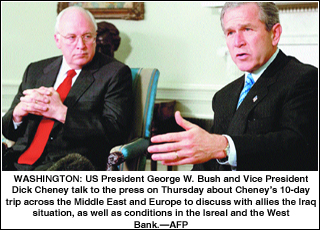 WASHINGTON, March 21: US Vice President Dick Cheney said on Thursday that he was ready to return immediately to the Middle East to meet Palestinian leader Yasser Arafat, if the Palestinan leader keeps his pledge on achieving a ceasefire.
The key to whether Cheney travels will be US Mideast envoy General Anthony Zinni, the vice president said, who will “make his judgment based on whether or not” Arafat is implementing a proposal by CIA Director George Tenet concerning a ceasefire.
“If he’s doing that, living up to those requirements and General Zinni signs off on it, then I’m prepared to go back almost immediately for a meeting,” Cheney said. “But it will depend on whether or not Arafat is complying.”
US President George W. Bush, speaking after a working breakfast with Cheney, had tough words for Arafat.
“We set some strong conditions and we expect Mr. Arafat to meet those conditions,” Bush said. “I frankly have been disappointed in his performance.”
Bush, however, said he was “hopeful” that Arafat will listen to Cheney’s message — “that in order for us to have influence in terms of achieving any kind of peaceful resolution,” Arafat “must do everything in his power to stop the violence.”
The Tenet understanding sets out a mechanism for implementing a ceasefire, after which the Mitchell plan — a blueprint for getting the peace process back on track — can be put into effect.
Cheney said before leaving Israel for Turkey a truce required Arafat’s full compliance with security proposals put forth last June by Tenet, adding, “I would expect the 100 percent effort to begin immediately.”
The withdrawal was a major condition posed by the Palestinians for a ceasefire to end the conflict.
IRAQ SITUATION: US Vice President Dick Cheney said on Thursday that Arab leaders whom he met on a recent tour to the region were “concerned” by Iraqi leader Saddam Hussein’s efforts to acquire weapons of mass destruction.
“I think (the Arab leaders) are uniformly concerned about the situation in Iraq,” Cheney said, “in particular about Saddam Hussein’s failure to live up to the UN Security Council resolutions ... that he pledged to at the end of the (1991 Gulf) war, (saying) he would get rid of all of his weapons of mass destruction.”
The leaders “are concerned as we are when they see the work that he has done to develop chemical and biological weapons, (and) his pursuit of nuclear weapons,” Cheney said.
“I went out there to consult with them, seek their advice and counsel to report back to the president on how we might best proceed to deal with that mutual problem,” Cheney said. “That’s exactly what I’ve done.”
Speaking after a working breakfast with Cheney, President George W. Bush emphasized that the United States is “resolved to fight the war on terror”.
“This isn’t a short-term strategy for us,” Bush said, noting that Cheney “delivered that message.”—AFP