



 0
0

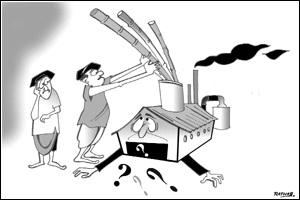 After textiles, there is a large network of sugar industry in Pakistan, which plays an important role in the economy through about 77 sugar mills in the country.
These mills provide job opportunities to more than 0.2 million people and pay more than Rs10 billion to the government annually in the form of taxes and cess funds. Currently, there is more than one million hectares of land used for sugarcane cultivation which produces more than three million tonnes of white sugar annually.
The socio-economic growth of the majority of rural population in the provinces of Sindh, Punjab and NWFP is linked with the sugar industry. The sugar industry is perhaps the only industry which can be cited as a model for agro-based industries in the country.
Some of these sugar mills are in direct contact with farmers solving their seed, fertilisers and pesticides problems. However, for the last few years, there is a confrontation between growers and millers over the issue of price.
Growers demand higher price for their raw material and millers complain of the higher cost of production and the import of sugar by the government which affects the market price of sugar. The situation is quite complex but I would like to throw some light on the issue on the basis of my long association with growers and millers.
Growers are the persons who produce sugar in their fields and unfortunately our national sugarcane yield is hardly 46 tonnes per hectare,— lowest in the world. Similarly, sugar recovery is also on the lowest side. However, even with present acreage and recovery, we can easily produce four million tonnes of sugar if sugarcane yields are increased to 60 tonnes per hectare. Though there is potential of 75 to 80 tonnes of cane yield and 10 per cent sugar recovery as compared to our present 8 to 8.5 per cent.
As the raw material is produced by growers, they should know that millers need sugarcane and not ‘cane’. Growers, plant high cane-yielding and low-sugar recovery varieties, which badly affect the efficiency of factories and consequently the cost of production is increased. In NWFP and Punjab, where ‘gur” is produced, growers intentionally supply low-sugar varieties to mills and high-sugar varieties are converted into ‘gur’.
On the other hand, growers complain of high costs of inputs like fertilizers, pesticides, labour wages, electricity. diesel and related factors. The shortage of irrigation water is another low octane petrol gives a 59 per cent increase in efficiency and for every litre of alcohol added there is a saving of 1.26 liters of petrol. Nevertheless, the current and probable export price of sugar on the world market is such that production of alcohol is likely to provide an alternative either to reduce oil imports or as an export alternative.
As a fuel extender in South Africa, production of ethanol from sugarcane has saved sugar from unprofitable exports, and it has a number of advantages for cane sugar industry, especially in providing new jobs in rural areas. The production of 10.7 billion liters of alcohol has resulted in extra employment of 760000 people. At this stage of our economic crises, these suggestions aught not be dismissed as ‘a seven-day wonder’.
(The writer is a sugarcane breeder and is associated with the NWFP Agriculture University,Peshawer.)




























