A charming ambassador bids adieu
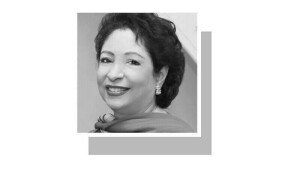
To those who know her well, the ambassador of Spain, Aurora Dicenta-Bernaldez, is an exceptionally nice person. She has achieved a level of popularity, both among the members of the diplomatic corps and local people in government and out, which is going to be hard to beat. All the more creditable because she is a senior diplomat and could have kept herself aloof or to put it bluntly, behaved formally. Some people were of the view that it could be argued whether a country like Spain can afford to appoint an ambassador that was not ‘diplomatic,’ but it’s not the influence of the country in a global context that counts. What matters is the relationship it has with other countries and how well these are maintained. Thanks to this charming ambassador, bilateral relations between our two countries are better today than ever before.
The sad part of this development is that the ambassador is leaving Pakistan after a four-year-tenure. She hosted a buffet/reception to mark the assumption of the presidency of the European Union by Spain and to bid farewell to friends and colleagues. The news that she was leaving came as a surprise to many of the guests who assumed that she would be staying on for at least another six months because of the presidency. It is usual for envoys that are familiar with the host countary to remain at their post during this period, but I guess there are exceptions to the rule. The ambassador is going home on a promotion in the Ministry of Foreign Affairs. While everyone expressed regret that she was leaving, they also congratulated her for going one step up the ladder of her career, and someone was heard wishing that she would soon be representing her country as it’s foreign minister!
The function was well attended, with some businessmen, as well as honorary consuls, flying in from Lahore and Karachi. The ambassador’s husband, Mariano Alonso-Buron Aberasturi, who is the Consul General of Spain in Washington DC, came specially to be by her side during at this special occasion. He has been coming to Pakistan off and on during the past four years and is well known to her circle of friends. According to Aurora, Mariano knows more than she does about Pakistan and the region, so who knows? Maybe he will be representing his country here one day!
While staying here the ambassador adopted the local dress and was often seen in the outfits she had made or purchased from the market. In fact she has been mistaken for a Pakistani many a time, much to her delight and sometimes, amusement. As she bid adieu to her guests, Aurora said she was sorry to be leaving a country she had come to love so well, but happy that she had achieved what she had set out to do and that was to make the ties between Pakistan and Spain stronger. —Diplomatic dispatcher
America’s chance to show sincerity
PRESIDENT Gen Pervez Musharraf’s speech marks the formal closure of one long and turbulent chapter in the nation’s history, a chapter which incidentally
was opened by another general, president Ziaul Haq. It is a chapter which should perhaps never have been opened in the first place. When it did, care should have been taken to ensure that things did not grow to the extent that they did, both at home and abroad. But we have the Americans plus incompetent leaderships in Islamabad to thank for all that.
Whether or not he had realized that sectarianism and violence at home and abroad would be spawned to the extent that it did, Gen Zia’s policy of promoting religious schools and groups was prompted by the American foreign policy of encouraging these to fuel the American-led anti-Soviet war in neighbouring Afghanistan in the 1980s. In a Muslim country like Pakistan, it was easy and politically expedient for a general, who came into power through a military coup, to promote religious schools and groups in the name of Islam, projecting himself as a pious leader in the process.
The products of some of these religious schools and the policies of some of these religious groups soon grew to become a nuisance for America, specially after the fall of Soviet communism. This suited America to some extent for it needed a new international threat perception to keep the wheels of its multi- billion dollar arms industry moving.
But this nuisance soon became intolerable for America. If Islamabad had the foresight to take action and keep these religious schools and groups under wraps when they first started to become a nuisance, the government would not have had to face the indignity of taking action against them now under foreign pressure and, worst still, under the threat of war from India, which is seen to be supported by America.
Yet, Islamabad denies that it is acting against religious extremists in the country at the behest of America. If this is so, then it has certainly chosen a very wrong time to crack down on them.
What is even more damaging for Islamabad’s prestige, as well as for American image in Pakistan, is the fact that despite Islamabad’s humiliating U-turn on its Taliban policy after Sept 11 and despite its support to America in the war in Afghanistan, specially in allowing the Americans to use Pakistani bases, the country is now being rewarded by this serious threat to its security on its eastern border, a pressure which America itself seems to be favouring to some extent as this suits its interests. How else can the people of Pakistan see Gen Musharraf’s speech clearly outlining Islamabad’s policy of crackdown on extremists at this particular time as anything but Islamabad acting under duress of American pressure?
Nevertheless, by pulling the plug on the extremists and their activities, both at home and abroad, President Musharraf is in effect removing the one excuse, viz. terrorism, which New Delhi has been projecting internationally as the cause of the problem in Kashmir, using it to justify Indian repressive policies there. Here precisely is the chance for America to show its sincerity to Pakistan and salvage some of its image lost because of persistent perceived treachery.
President Musharraf’s speech has served to place responsibility on America to play the effective role in resolving the Kashmir problem by putting pressure on New Delhi to consider the legitimate demands of the people of Kashmir and stop the Indian state terrorism and human rights violations there. American sincerity to Pakistan will be judged by its officials’ reaction to President Musharraf’s call for UN peace-keepers and other international organizations to be allowed into Kashmir to monitor the situation there. Particularly, American sincerity will be judged by how much pressure American officials are willing to exert on New Delhi to accept this point.
If the appropriate response expected from America vis-a-vis the Kashmir issue is not forthcoming and Pakistanis see American officials merely reiterating New Delhi’s stance, and the Kashmir issue continues to cause tension in the region, this could knock the final nail into the coffin of American sincerity to Pakistan.
The public has good reasons to be sceptical about any American-foisted policy even when it appears to be for the good of Pakistan. If President Zia was responsible for introducing the now dreaded Islamic extremism, President Musharraf ought to take care that in the process of cracking down on religious extremists, he does not fall into the opposite extreme of putting in place eventually the American version of Islam.
President Musharraf has defined in his speech what Islam in Pakistan should not be: it should not be extremist, intolerant, violent and hateful. But he did not quite define what Islam in Pakistan should be. He said it should be a tolerant welfare state but to what extent should this tolerance stretch? Certainly not to the opposite extreme of allowing things to happen in the country which would be perceived as running counter to basic, fundamental Islamic concepts like jihad. The people need to be reassured on this point and for once the country should have dynamic, independent policies formulated for its own good and interests, and not for the good and interests of America or anyone else.
It’s about air, water and some brooms
WE have had the elected city government around for quite some time. Indeed, well over the first hundred days. It is certainly time for the citizen to ask for a statement of accounts, so to say. Granted that this city has myriad problems, most of them mind-boggling. Granted also that none of them would yield to simple, easy or quick solutions.
No fair-minded person would deny that the people here are a model of patience. They do not even complain, let alone protest. This stoicism may be the other side of the ultimate in frustration and hopelessness. It is probably a case in which Mirza Ghalib would simply resign, saying Jab tawaqqu hi uthh gayee Ghalib Kiya kisi ka gila karay koyee.
This kind of giving in to dejection would have been understandable had we been roughing it out under a bone-stiff bureaucratic juggernaut. That is no longer the case. We have an elected government. Slowly but reasonably steadily the elected government has been gaining ground and control of its affairs. It is time there was some evidence of proper activity.
Is there any evidence of the positive performance by the elected City Government available anywhere? A correct answer has to be in the negative. What strikes at first and everywhere is that filth, garbage and muck. It is all over this virtually endless city. This is the most visible and disagreeable feature of life for all but a few of the 13 million people and more.
The elected government has not been able to reduce the piles of garbage from anywhere. Inevitably, if rubbish is not removed, it will be a foot higher every day because it is produced every day where people live a normal life. Some weeks ago there were some faint suggestions in the city press that action has been instituted to get the fleet of garbage collecting trucks in working condition. It appears that the expected has not happened.
Hardly less disagreeable is the situation resulting from the disarray in which the city’s sewerage and drainage network has been for so long. One should say for years. It is strongly suspected that at hundreds of places sewerage and water supply lines have crossed one another. It is supremely disquieting to contemplate that many of us, if not most, may be drinking lethally infected water, the fluid of life.
What about air in Karachi? As a matter of fact, air has to have the highest priority, well above garbage collection and drainage disorders. It will be no exaggeration to say that the air we breathe in Karachi has many parts more of petrol-diesel exhaust, dust and sand than oxygen, nitrogen and other elements in the normal atmosphere. Has anyone in the city administration cared to think of the epidemic of respiratory afflictions in this city? Rare is the household where cold, cough, asthma has no victims.
Together these three problems — solid-waste disposal and drainage disarray and air pollution — add up to a danger to life that is a little short of either homicide or suicide, perhaps both. Disposal of garbage and provision of clean water are two services without which only the people of Karachi can survive. It is a miracle that not as many people are sick as they might well have been.
However, let nobody in this city or elsewhere get away with the impression that the health of this city’s residents is out of the most serious peril. Karachi is perhaps the world’s least healthy city. And all this because our city fathers have been singularly unmindful of the elementary and very basic needs of life — air, water and sanitation.
These problems can be sorted out by the most elementary of devices. What is so awfully complicated or intractable about solid-waste disposal? You need transport and manpower with no sophisticated expertise. There was a time when Karachi’s roads would get shampoo every night without fail. Well, forget the shampoo. Give them at least the simple, indeed primitive, brooms.
According to one source, Karachi has some three thousand miles of underground and surface drains and sewers. Enough length for a journey to Islamabad and back. Repairing damage to this kind of network, mostly underground, is no doubt a mighty big job. Does it mean that because it is a big job, the only option is not to undertake it? One should have felt comfortable if the work had been taken in hand. Nobody is even talking about it, not to speak of doing it.
What is under focus here is a string of absolutely primary needs of a living being, that should include animals and beasts. What animal can live without clean air, clean water and clean surroundings? This city is wallowing in corruption in administration. Somehow, we manage to live on, corruption notwithstanding. But how long can we expect to live on if the air continues to be polluted more and more, if the water continues to be more and more contaminated and if the environment is allowed to decay endlessly?
Asking for clean air, potable water and undefiled surroundings is not asking for the moon. Nor is it being too fussy or demanding. If the city government, and an elected one at that, is unable to rise to these tasks, what on earth is it really good for? Not a million dollar question.
The citizens are waiting for an answer.