0
0

UNITED NATIONS: The United Nations has ruled out creating a traditional peacekeeping force in Afghanistan.
The international community is inclined toward a multinational force rather than a “classic” UN blue-helmet force, Francesc Vendrell, the world body’s deputy special representative to Afghanistan, told reporters on Thursday.
“We’ve got to have our terms very clear,” Vendrell said. “A multinational force is not necessarily a peacekeeping force.”
There are three options before the UN Security Council in its search for peace and stability in Afghanistan: an all-Afghan security force, a multinational force, and a UN peacekeeping force.
The preferred option is an all-Afghan force but this is not expected to materialize primarily because of the factionalism among the country’s main ethnic groups: Pashtuns, Tajiks, Uzbeks, and Hazaras.
Vendrell said that a UN peacekeeping force entails “blue helmets — a force to maintain peace, a force that does not act aggressively, and a force that does not have a robust mandate.”
However, he noted, “there is no agreement yet to verify, there is no peace agreement, and so the issue of a classic blue-helmet force does not arise for the moment.”
Vendrell said he envisages some form of “international security force that would be available to maintain order, help (a) new provisional or interim council work inside Kabul.”
UN Spokesman Fred Eckhard told reporters a multinational force is something “that the Security Council would ideally give its blessings to.”
However, some country with the necessary military capacity would have to take the lead to form it. “So, there you really have to look at the members of the Security Council and members of the United Nations more broadly to see whether a coalition force is in the making,” he added.
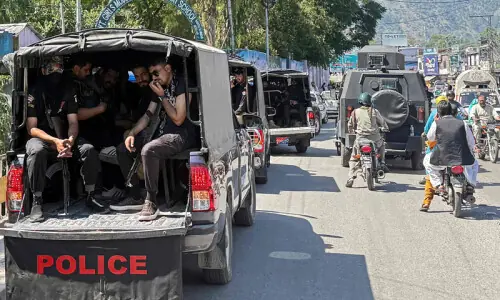
According to published reports, some 40 countries so far have volunteered troops for a proposed multinational force. Canada reportedly has earmarked some 3,000 troops for deployment in Afghanistan, and ordered one-third of them on 48-hour standby on Thursday.
According to British Secretary of State for Foreign and Commonwealth Affairs Jack Straw, discussions were under way among “a coalition of the willing”. The establishment of such a coalition, he said, would be much faster than a UN peacekeeping force.
Asked if Britain and the United States would provide security during the initial phase, he said that they would provide “some security in some areas, initially.” The arrangements were still being developed.
Straw also said it was obviously desirable that, in due course, the security of an independent Afghan nation be ensured by its own security forces, which would guard its borders, keep the peace internally and follow the requirements of international law.
“But it would take some time to create such a force,” he said, adding that there were some “international coalition forces” already providing assistance to Afghanistan.
“The very rapid military progress made by the Northern Alliance could not have been achieved without that assistance,” he said.
Asked to comment on the fact that the Northern Alliance had gone into Kabul in defiance of London and Washington, which had urged it to hold back from the Afghan capital, Straw said there had been concern about the possibility of “bloody fighting” for Kabul.
The United States also is believed to have ground troops — both regular and Special Forces — in Afghanistan. It so far has confirmed only that its ground forces have conducted raids on Afghan territory. —Dawn/The InterPress News Service.