



 0
0

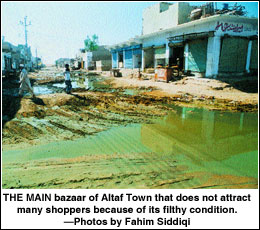 KARACHI, Nov 14: Unbearable stench from overflowing gutters, filling up the streets and open spaces, greets strangers when they get close to Altaf Town.
Its narrow streets are filled with haphazardly dumped rubble and earth. Weeds growing on the sewage has further blocked the passage and those wanting to reach their houses have to wind their way up to their doorsteps.
Not a single patch of a road is metalled or even paved. There are no street lights, no government school or dispensary.
This 10-year-old settlement, taking its name from the chief of the Muttahida Qaumi Movement and legal in every sense of the word, is an unwanted baby for the city fathers. When the last local bodies elections were being held, its would-be representatives were entangled in a legal battle. Although they won, it was too late for them to fight in the elections.
Now it has representation neither on the cantonment boards nor in the city government. Hence no voice to raise for its problems.
When ethnic riots erupted in the interior of Sindh in 1989, many people had to leave their homes and they came over to Karachi. Some of them were settled at a specially-developed land along the main Korangi road.
More than 800 plots of 80 square yards were created in 1991 on the KDA-owned land adjacent to Bhitai Colony, which is administered by the Korangi Creek Cantonment Board. Many more plots were added to the settlement later.
Makeshift arrangements were made to supply electricity to Altaf Town. Water supply was also arranged quickly and abundantly.
However, the sewerage system was long in coming. And when it was laid, it was connected to a faroff line of Allahwala Town for disposal. Naturally enough, the dirty water did not move on gravitation as was expected.
A couple of pumps have been installed on a large KDA plot in Allahwala Town to pump out sewage. The contractor is paid for the pumps and their day-night operation. The residents of Altaf Town, however, benefit little from this service. They allege the sewerage system of Bhitai Colony’s Sector A has been connected to Altaf Town’s, blocking the Town’s line. They formally reported the matter to police, who have not taken any step to discourage the misuse of their sewerage line.
The sewage-filled streets deter the KESC people from entering the locality. “This is the place where the KESC has agreed to install a PMT (pole-mounted transmitter),” says a social worker, adding: “But the KESC people refuse to do so before the place is cleared of sewage.”
The KESC, in a way, has forced the residents to use illegal connections to get power. So the so many kundas put to steal electricity surprise no one.
Water supply is sufficient. “Water is no problem. Rather, the problem is because of too much water,” says a resident.
It is so much that Bhitai Colony people pilfer the supply to Altaf Town, he alleges.
Amenity plots have been occupied by the socalled land mafia.
“There had been a plot each for a bank and a post office, which are no more,” said a resident. “A couple of plots were reserved for a playground and a park. Both have been usurped and disposed of by mafia elements.”
Another resident, however, says the amenity plots have not been usurped and are safe.
Despondency has gripped the residents so much that they think there is no solution at all to the Town’s problems.
“What would happen if you printed a report about these conditions?” cynically says a resident, who is a police department employee. “Nothing!”
He adds that many other newspapers had reported on the issue but the authorities did not move.
There are, however, people who still nurse the hope that the rot would be stemmed. “There is dawn after every night, however long the night may be,” says Ghufran Ahmed Khan, a low-paid government employee and apparently the lone crusader for the rights of the colony.
“I have shifted to Korangi-4 as my father is an asthma patient, and here his condition aggravates,” he says.
He has a long list to show of the authorities he has approached with applications and personal audience to help solve the problem — the Sindh governor, the base commander of the Korangi Creek PAF base, the corps commander of the 5th Corps, the secretary for housing and town planning, the city government Nazim, the KDA director-general, and so on.
Most people being daily-wage earners or lower-grade government employees cannot afford to supplement Ghufran’s efforts in a tangible way. He, however, occasionally manages to take along one or two construction workers.
“We pray that he succeeds in his endeavours,” says a mason.
Water-borne disease have afflicted many people as often water supply mixes with the dirty standing water. Mosquito population grows at a very high rate and causes various diseases related to this insect.
Desperate, many people have already left the locality for better places, renting out or selling off their houses.
Those who do not have such an option, stay on and continue to suffer the dirty conditions. Few of them are the original allottees.—Naseer Ahmad




























