



 0
0

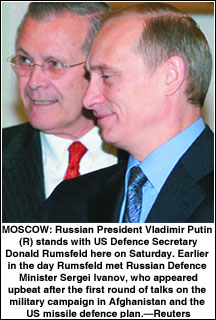 MOSCOW, Nov 3: Russia conceded Saturday that the 1972 ABM Treaty was “in part” a relic of the Cold War as Moscow and Washington bridged their differences over missile defense on the eve of a summit between the two nations’ presidents.
“We have been often told in the past that the ABM Treaty is a relic of the Cold War,” Russian Defense Minister Sergei Ivanov told reporters at the Kremlin following closed-door negotiations with his US counterpart Donald Rumsfeld.
“In part, and I repeat in part, I agree with this. But all Russian-US agreements, and those reached with the Soviet Union are — to a certain extent — relics of the Cold War,” Ivanov said after Rumsfeld held brief talks with President Vladimir Putin.
Rumsfeld made a brief stop-over in Moscow as part of a whirlwind five nation tour aimed at bolstering regional support for the US campaign in Afghanistan.
He arrived in Dushanbe, the capital of Tajikistan, late Saturday, expressing satisfaction but giving no details of his Moscow talks.
Ivanov stressed that Russia was unwilling to send its own soldiers into Afghanistan, where Soviet troops waged a brutal and eventually futile war between 1979 and 1989.
Russia is ready to share intelligence information, Ivanov said, but not risk getting involved in Afghanistan again.
Yet Rumsfeld’s agenda concerning Afghanistan was partially eclipsed by the ABM announcement from Ivanov, regarded as among the more conservative military advisors in the Putin entourage.
They marked the clearest admission to date that Moscow was prepared to give up its grip on the Anti-Ballistic Missile treaty just days before the November 13-15 summit in Washington and Crawford, Texas.
Bush has said he wanted to either scrap or drastically modify the pact in order to go ahead with development of a new anti-missile defense system for protection against “rogue states.”
Russia fears the shield could render its own nuclear missiles useless.
Yet adopting language of the US administration in mapping a new post-Cold War relationship, Ivanov said Russia and the United States, “as partners ... should look into the future together.
“But before dropping any one agreement, even though this is a sovereign right of the United States, we believe it is better to do so when something new is already in place,” said Ivanov.
Rumsfeld for his part said the United States was interested in formulating “a new framework for the 21st century,” adding that he and Ivanov “had good discussions as to how should go about this.”
Analysts meanwhile agreed that Ivanov’s ABM concession — while perhaps inevitable — meant that Moscow was looking for a long-term treaty that may take years to agree, but which should cement the feeling of goodwill that has recently warmed relations between the two rivals.
“This is a huge step,” said Andrei Piontkovsky of Moscow’s Center for Strategic Studies, while noting that the ABM decision may hurt Putin’s image at home in the short-term.
“But unfortunately for the Russian public, this will be a great humiliation, because the Russian government had been so insistent that the ABM was a cornerstone agreement that guaranteed security for all,” he said.
Analysts agreed that Moscow will now turn a blind eye to tests by the United States of its missile defense project, while Washington studies its options concerning a new strategic treaty with Russia.
“This may take three or four years,” Piontkovsky said.
“Russia is very concerned about collective security and Russia’s role in the new system,” added Sergei Markov, director of the Institute of Political Studies.
But he said that the Bush-Putin summit will be dominated by new agenda items — such as developing cooperation between two armies that for decades had been trained to eye other with distrust.
“You must remember that this is the first time the two sides’ intelligence services have to cooperate in 50 years,” said Markov.
“These are the real new issues for the Putin-Bush agenda. ABM is already on the periphery.”—AFP



























