0
0

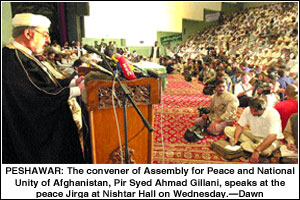 PESHAWAR, Oct 24: A two-day peace and national unity conference, organized by Pir Syed Ahmed Gilani of the National Islamic Front of Afghanistan (NIFA), began here on Wednesday and underlined the need for a political settlement of the Afghan crisis.
The NIFA, which had been a main component of the seven-party alliance during the prolonged resistance to the Russian forces in Afghanistan, invited tribal leaders of tribal agencies to attend the conference.
Some of the tribal leaders, who attended the conference, made fiery speeches, and claimed that they were part of Afghanistan and the Afghans considered them akin to themselves.
Darya Khan Zakakhel of the Khyber Agency said they would live and die with the Afghans.
No leader or representative of the Taliban government, the Northern Alliance, former Mujahideen and former Afghanistan king Zahir Shah attended the conference.
Some of the old commanders, who once belonged to Hikmatyar and Younus Khalis groups, attended the conference on their own. A group of ‘observers’, hailing from the United States, Britain, Germany, France and the Central Asian Republics, attended the conference.
A NIFA spokesman hoped that the meeting would pave the way for the Loya Jirga being proposed by the former king, Zahir Shah, Pashtun nationalist forces and the Pakistan government to chalk out a future plan for Afghanistan.
Talking to Dawn, S. Fida Yunus, former Pakistan diplomat to Afghanistan, said that there was no precedence of holding a Loya Jirga outside Afghanistan. “Then, it also counts that who is convening the Jirga”, he added.
He asked whether those Afghans, who were born in Pakistan and had witnessed a political process there, would be ready to accept the old tribal customs, which their ancestors had been forced to embrace.
He observed that if the Mujahideen had honoured the Peshawar jirga, the tribal structure would have crumbled down. “I think the old tribal structure is still intact”, he added.
Replying to a question, he said if the Afghans had been allowed to decide about their fate, they could have done so.
Some of the participants of the conference were of the view that Pir Gilani be picked to play a significant role in post-Taliban setup, as he had already met Zahir Shah in Rome.
They said Gilani was considered to be a moderate among his former (seven-party alliance) friends.
He had neither supported nor opposed the Taliban, and had kept a low profile during the entire conflict between the Northern Alliance and the Taliban, they added.