



 0
0

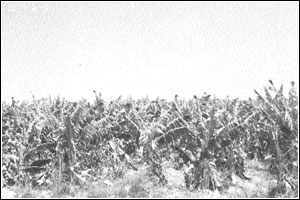 SINDH is known for its good quality tropical fruits, especially banana and mango. Unfortunately, for the last three years, Sindh’s banana has lost its flavour and sweetness after falling a victim to global warming.
Sindh has adopted so many crops and banana is most prominent among them.
In 1958 banana was planted in Sindh on experimental basis in the coastal belt in Thatta and Badin districts.
The fertile Indus basin nurtured the new fruit carefully and affectionately with concerted efforts and after a decade it became the second important tropical fruit of the area. The area and production grew to a record level of 20.500 hectares and 209.000 tons respectively in the year 1989-90. The area and production, both declined thereafter and banana plant is under threat for the last one decade. Initial threat was due to bunchy top diseases and now for the last three years extreme drought has intensified the extent of damage to the crop.
Botanically, banana is a giant herb with an underground rhizome which is surmounted by growing points. Lateral buds produce suckers which together with the parent corm make up the stool. Each growing point produces about forty leaves before it becomes productive. The onto genetic sequence of vegetative growth, flowering and reproductive growth continue around the year.
This onto genetic sequence is largely governed by temperature, adequate supply of balance nutrients and ample amount of moisture. The systematic analysis of current banana syndrome indicates that the crop is confronted with three core issues:
* drought
* malnutrition
* lack of research support.
Banana has an origin from humid tropics and it requires a consistent supply of moisture to maintain its vigour and turgidity. While Sindh has tropical arid climate, and traditionally farmers compensate the demand-supply difference through frequent irrigations. The current acute water shortage in the Indus River System has transformed banana fields from submerged and over-irrigation scenario to acute short supply leading to permanent wilting. Continuous prevalence of high temperature and strong wind has geared up the drought impact by splitting leaf sheaths just after emergence. The leaf life has reduced to 10-15 days from that of 25-30 days.
Banana is a luxurious consumer of plant food nutrients, especially potash and nitrogen. Continuous exotic cultivation and imbalanced supplement of plant food nutrients, especially potash have eroded the soils during the last four decades.
The current use of brackish ground water in orchards by growers to meet the canal water shortage has also impacted the free availability of nutrients. This malnutrition and the lack of canal water, a good source of potash, has drastically reduced per acre yield as well as the quality of fingers. Though Sindh has a 90 per cent area under banana crop, it is quite unfortunate that there is no research institute devoted to solve the problems faced by banana growers. Farmers have no access to any information about sound agronomic practices relating to local soil and environmental conditions. Moreover, for the last 20 years, farmers have no varietal choice except Basri due to lack of availability of other genetic material.
There is no provision for banana diseases free suckers and plant lets for the farmers to improve their plantation. This had led to the situation where farmers have no other choice of genetic material except Basri.
Though the situation is alarming, it is not as yet out of control and banana crop can be saved from complete fading through some multidimensional efforts.
Thatta and Badin be declared as the most favoured growing zone for banana cultivation and the following steps be taken to improve the situation:
* consistent canal water supply even at higher rates;
* an independent banana research station at Thatta for agronomic and breeding studies to ensure supply of bunchy top diseases free suckers/plant lets;
* growers’ training regarding crop management and pest control;
* Setting up a tissue analysis lab to provide charged facility to growers for micro and macro nutrients;
* improving banana marketing net-work;
* balanced use of NPK and zinc fertilizers based on soil and tissue analysis;
* light and frequent application of irrigation vs heavy irrigation. Planting disease free suckers/plant lets;
* maintenance of organic matter around one per cent to enhance water and nutrient efficacy.
These steps will ensure rehabilitation of banana plantation in Thatta, Badin and other areas and will increase banana production to meet local demand and create exportable surplus.




























