0
0

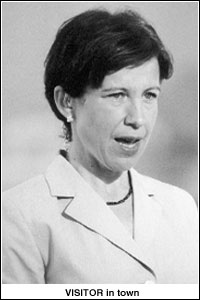 ISLAMABAD, Oct 17: Lyse Doucet is no stranger to Pakistanis. Television viewers were already familiar with the British Broadcasting Corporation’s anchorperson presenting the world news from London even before she arrived in Islamabad after September 11 to report from the capital of the frontline state on yet another American war in the region.
Since then, however, viewers have come to know Doucet as the “hard-talking” lady who gave President General Pervez Musharraf and, specially, Jama’at-i-Islami Amir Qazi Hussain Ahmad a tough time when she interviewed them over BBC’s “Hard Talk” programme.
As for many politicians, military leaders and journalists in Pakistan, they already know Doucet from the days when she was BBC’s Pakistan correspondent during 1990-1993.
Doucet feels that her valuable background on this country together with her year-long stint in reporting for the BBC from Kabul in 1989 during the Soviet troops’ withdrawal from Afghanistan stands her in good stead to cover the current events in a region that is reeled by the bitterness of having been let down by the Americans before.
Her experience in Kabul brought her fame as a frontline war correspondent. In a 1994 documentary film entitled No Man’s Land, Doucet was profiled together with an American correspondent, Janine di Giovanni, who reported from Sarajevo for London’s Sunday Times. The 50-minute film focused on the nature of these two women’s work, the dangers they face and the sacrifices they had to make.
But, said Doucet, “I don’t call myself a war correspondent. I just happen to go to places where sometimes there’s war and sometimes, peace.”
She was posted for four years as BBC’s correspondent in Jerusalem just after the Oslo peace accord on the Middle East, although that accord eventually broke down.
About women journalists being more “human” in their reports of war than men, Doucet’s reply was: “I have worked with women who are only interested in the bombs and bullets, and I have worked with men whose main concern is about the human costs.”
Brought up as a Catholic in a small village in Canada, Doucet first became familiar with Islam and Muslims when she went over to the Ivory Coast in West Africa after her graduation in 1982 to begin work in journalism.
She was in the right place at the right time as BBC was then setting up its first West Africa office. Doucet was its correspondent there from 1983-1988 covering Muslim countries like Senegal, Mali and Burkina Faso.
From Kabul, she also went over to Tehran to cover events in Iran following Ayatollah Khomeini’s death.
Of her experience as a woman working in mostly Muslim countries, she said: “There is great respect for and protection provided to women, contrary to what people in the West generally say about the difficulties of women working in Muslim countries.”
“When you’re a journalist, that translates into us women being allowed to take the front seat of the bus or the helicopter gunship, although that’s not the seat that you would want to be in,” added Doucet candidly.
“I was never prevented from performing any journalistic function simply because I was a woman. I was prevented sometimes though, because I worked for the BBC, but not because I was a woman,” explained Doucet.
Keeping the balance and telling both sides of the story is important in journalism, Doucet said. She believes journalists are on the scene not to take up any side’s cause or to make history but to report events and be the first ones out with the story.
But as with many other journalists, Doucet has been accused of taking sides in her coverage before. Together with BBC colleague Paul Adams, she was accused by the Jerusalem Post for discarding professional integrity and mounting a propaganda campaign against Israel, including what the paper said was “the depiction of Jews as child killers”.
Of the coverage on the current situation in Afghanistan, she said: “One shortcoming of the coverage of this war has been the lack of correspondents in the field to cover the events fully on the ground since they are not able to get visas for Afghanistan.”
Doucet, however, made no reference to the fact that journalists’ coverage in this war is also being limited by the American refusal to provide information which its says would have a negative impact on the campaign in Afghanistan and by the fact that it has disallowed the western media from reporting on information which it says would fan terrorism.